Question
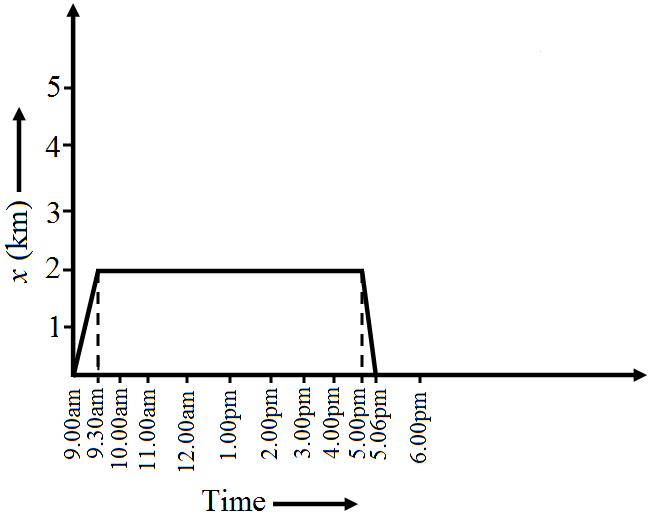
A woman starts from her home at $9.00$ am, walks with a speed of $5km h^{–1}$ on a straight road up to her office $2.5km$ away, stays at the office up to $5.00$ pm, and returns home by an auto with a speed of $25km h^{–1}$. Choose suitable scales and plot the x-t graph of her motion.
Answer

Speed of the woman = 5km/h Distance between her office and home = 2.5km Time Taken = Distance/Speed = 2.5/5 = 0.5h = 30 min It is given that she covers the same distance in the evening by an auto. Now, speed of the auto = 25km/h Time Taken = Distance/Speed = 2.5/25 = 1/10h = 0.1h = 6 min The suitable x-t graph of the motion of the woman is shown in the given figure.

Need a full question paper?

Generate a complete, print-ready paper with questions like this in minutes — across 16+ boards, with answer keys.

Start Generating Free

Similar questions

The escape speed of a projectile on the earth’s surface is $11.2km s^{-1}$. A body is projected out with thrice this speed. What is the speed of the body far away from the earth? Ignore the presence of the sun and other planets.
On an open ground, a motorist follows a track that turns to his left by an angle of $60^{\circ}$ after every 500 m . Starting from a given turn, specify the displacement of the motorist at the third, sixth and eighth turn. Compare the magnitude of the displacement with the total path length covered by the motorist in each case.
Differentiate the following:
  1. Wave velocity and particle velocity.
  2. Harmonics and overtones.
A chain of length l and mass m lies on the surface of a smooth sphere of radius R>1 with one end tied to the top of the sphere.
  1. Find the gravitational potential energy of the chain with reference level at the centre of the sphere.
  2. Suppose the chain is released and slides down the sphere. Find the kinetic energy of the chain, when it has slid through an angle $\theta.$
  3. Find the tangential acceleration $\frac{\text{dv}}{\text{dt}}$ of the chain when the chain starts sliding down.
A resistor of resistance $100\Omega$ is connected to an AC source $\in=(12\text{V})\sin(250\pi\text{s}^{-1})\text{t}.$ Find the energy dissipated as heat during $\text{t}=0$ to $\text{t}=1.0\text{ms}.$
You are riding in an automobile of mass $3000\  kg$. Assuming that you are examining the oscillation characteristics of its suspension system. The suspension sags $15\ cm$ when the entire automobile is placed on it. Also, the amplitude of oscillation decreases by $50\%$ during one complete oscillation. Estimate the values of $(a)$ the spring constant $k$ and $(b)$ the damping constant b for the spring and shock absorber system of one wheel, assuming that each wheel supports $750\ kg.$
A current of 1.0A is established in a tightly wound solenoid of radius 2cm having 1000 turns/ metre. Find the magnetic energy stored in each metre of the solenoid.
Mention the statements of the second law of thermodynamics given by Kelvin Planck and Clausius. How are the statements similar to each other?
The energy from the sun reaches just outside the earth's atmosphere at a rate of $1400W/m^2$. The distance between the sun and the earth is $1.5 \times 10^{11}m$.
  1. Calculate the rate at which the sun is losing its mass.
  2. How long will the sun last assuming a constant decay at this rate? The present mass of the sun is $2 \times 10^{80}kg$.
  1. Define friction.
  2. Show that kinetic friction is less than the static friction.
  3. Establish that static friction is a self-adjustable force.
  4. Write the basic laws of limiting friction.