Question
The angle of turn of a circular road of radius r is $\theta$. If the coefficient of friction between the tires of car and road is u then find the formula for (i) ideal speed of car (ii) maximum and minimum speed for the safe speed of the car.
Answer

self

Need a full question paper?

Generate a complete, print-ready paper with questions like this in minutes — across 16+ boards, with answer keys.

Start Generating Free

Similar questions

A three-wheeler starts from rest, accelerates uniformly with $1m s^{–2}$ on a straight road for $10s$, and then moves with uniform velocity. Plot the distance covered by the vehicle during the nth second $(n = 1, 2, 3….)$ versus n. What do you expect this plot to be during accelerated motion : a straight line or a parabola?
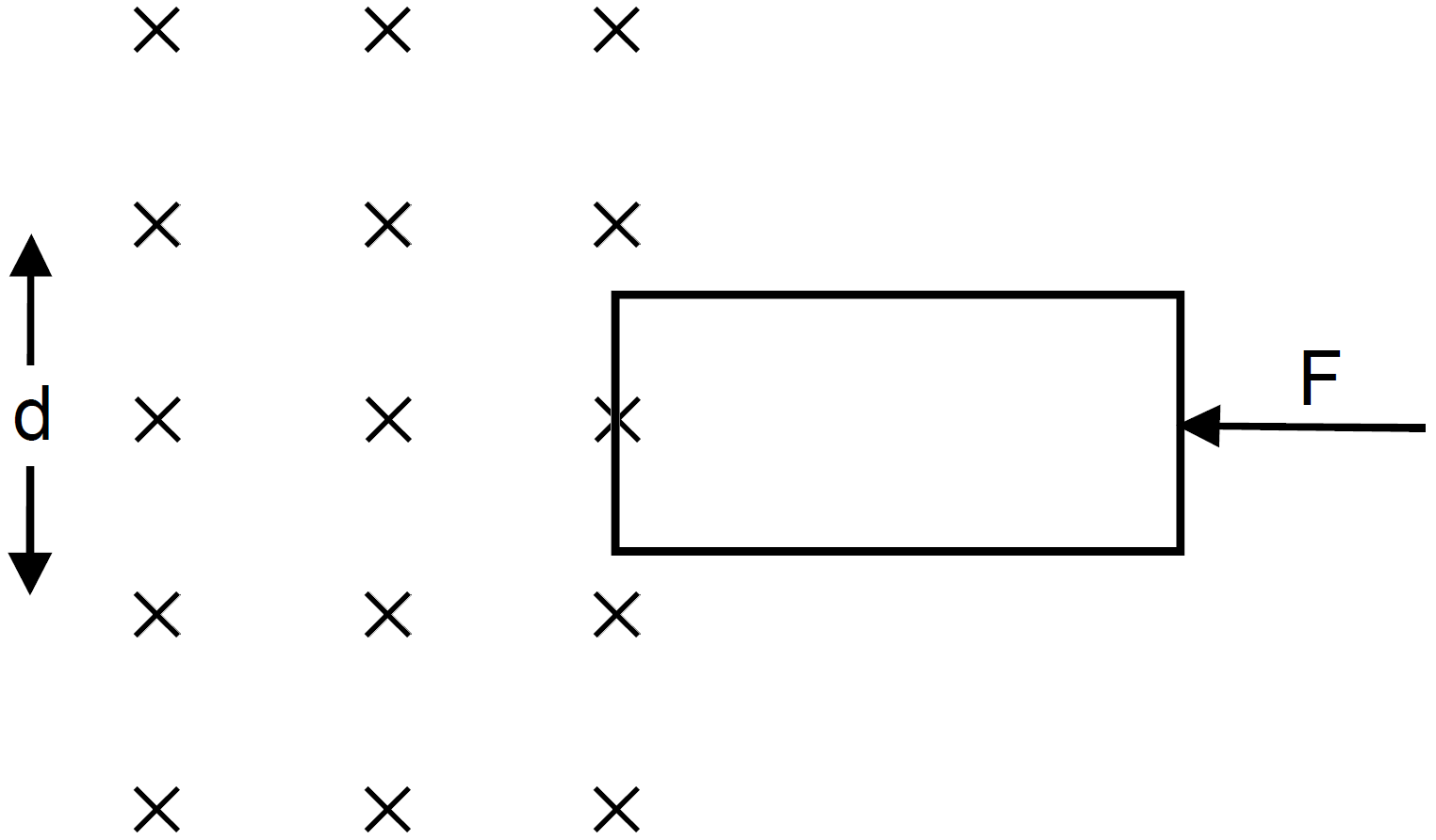
The rectangular wire-frame, shown in figure, has a width d, mass m, resistance R and a large length. A uniform magnetic field B exists to the left of the frame. A constant force F starts pushing the frame into the magnetic field at $t = 0$.
  1. Find the acceleration of the frame when its speed has increased to v.
  2. Show that after some time the frame will move with a constant velocity till the whole frame enters into the magnetic field. Find this velocity $v_0$.
  3. Show that the velocity at time t is given by $\text{v}=\text{v}_0\Big(1-\text{e}^{-\frac{\text{ft}}{\text{mv}_0}}\Big)$
According to Stefan’s law of radiation, a black body radiates energy $\sigma=\text{T}^4$ from its unit surface area every second where T is the surface temperature of the black body and $\sigma=5.67\times10^{-8}\text{w}/\text{m}^2\text{K}^4$ is known as Stefan’s constant. A nuclear weapon may be thought of as a ball of radius $0.5m$. When detonated, it reaches temperature of 106K and can be treated as a black body.
  1. Estimate the power it radiates.
  2. If surrounding has water at $30C°$, how much water can $10\%$ of the energy produced evaporate in $1s$?
$\big[\text{s}_w=4186.0\text{J/ kgK and L}_v=22.6\times10^5\text{J/ kg}\big]$
  1. If all this energy U is in the form of radiation, corresponding momentum is $\rho=\frac{\text{U}}{\text{c}}$ How much momentum per unit time does it impart on unit area at a distance of 1km?
A $5 ~ m$ long steel wire hanging from the ceiling of a room has a mass of 25 kg at a radius of 10 cm . The height of the ceiling is 5.21 m . When the body is made to oscillate, it passes through touching the floor. If $Y$ is $2 \times 10^{11} N / m ^2$ and the radius of the wire is 0.05 cm . If so, what will be the velocity of the body at its lowest point?
What is calorimetry? Explain its structure and working principle and find the temperature of the mixing.
A mass m moving with a speed u collides with a similar mass m at rest, elastically and obliquely. Prove that they will move in directions making an angle $\frac{\pi}{2}$ with each other.
An insulated container containing monoatomic gas of molar mass m is moving with a velocity $v_0$. If the container is suddenly stopped, find the change in temperature.
If the earth were a homogeneous sphere and a straight hole bored in it through its centre, show that if a body were dropped into the hole it would execute a simple harmonic motion. Also find its time period.
A particle executes a simple harmonic motion of amplitude $1.0cm$ along the principal axis of a convex lens of focal length $12cm$. The mean position of oscillation is at $20cm$ from the lens. Find the amplitude of oscillation of the image of the particle.
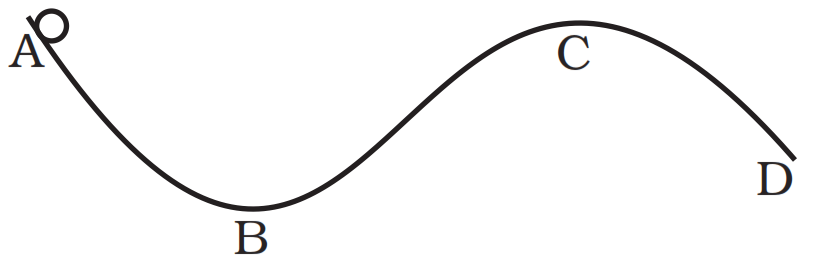
A curved surface is shown in. The portion BCD is free of friction. There are three spherical balls of identical radii and masses. Balls are released from rest one by one from A which is at a slightly greater height than C.
With the surface AB, ball 1 has large enough friction to cause rolling down without slipping, ball 2 has a small friction and ball 3 has a negligible friction.
  1. For which balls is total mechanical energy conserved?
  2. Which ball (s) can reach D?
  3. For balls which do not reach D, which of the balls can reach back A?