An electric charge ${10^{ - 3}}\,\mu \,C$ is placed at the origin $(0, 0)$ of $X -Y$ co-ordinate system. Two points $A$ and $B$ are situated at $\left( {\sqrt {2\,} \,,\,\,\sqrt 2 } \right)$ and $(2, 0)$ respectively. The potential difference between the points $A$ and $B$ will be......$volt$
Medium


Download our appand get started for free
Experience the future of education. Simply download our apps or reach out to us for more information. Let's shape the future of learning together!No signup needed.*
Similar Questions
- 1An electron enters between two horizontal plates separated by $2\,mm$ and having a potential difference of $1000\,V$. The force on electron isView Solution
- 2A point charge $2 \times 10^{-2}\,C$ is moved from $P$ to $S$ in a uniform electric field of $30\,NC ^{-1}$ directed along positive $x$-axis. If coordinates of $P$ and $S$ are $(1,2$, $0) m$ and $(0,0,0) m$ respectively, the work done by electric field will be $.........\,mJ$View Solution
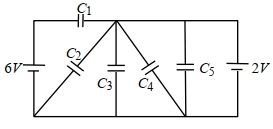
- 3In the following circuit $C_1=12 \mu F, C_2=C_3=4 \mu F$ and $C_4=C_5=2 \mu F$. The Charge stored in $C_3$ is. . . . . $\mu C$.View Solution
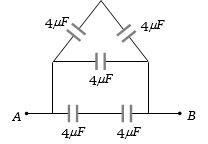
- 4Equivalent capacitance between $A$ and $B$ is......$\mu \,F$View Solution
- 5Two equal charges $q$ are placed at a distance of $2a$ and a third charge $ - 2q$ is placed at the midpoint. The potential energy of the system isView Solution
- 6View SolutionThe capacity of a parallel plate condenser depends on
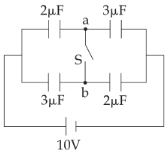
- 7In figure a system of four capacitors connected across a $10\, V$ battery is shown. Charge that will flow from switch $S$ when it is closed isView Solution
- 8Two plates are at potentials $-10\, V$ and $+30\, V$. If the separation between the plates be $2\, cm$. The electric field between them is.......$V/m$View Solution
- 9A $10\,\mu F$ capacitor is charged to a potential difference of $1000\, V$. The terminals of the charged capacitor are disconnected from the power supply and connected to the terminals of an uncharged $6\, \mu F$ capacitor. What is the final potential difference across each capacitor?......$V$View Solution
- 10The radius of a soap bubble whose potential is $16\,V$ is doubled. The new potential of the bubble will be.....$V$View Solution