Three particles, each having a charge of $10\,\mu C$ are placed at the corners of an equilateral triangle of side $10\,cm$. The electrostatic potential energy of the system is.....$J$ (Given $\frac{1}{{4\pi {\varepsilon _0}}} = 9 \times {10^9}\,N - {m^2}/{C^2}$)
Medium


Download our appand get started for free
Experience the future of education. Simply download our apps or reach out to us for more information. Let's shape the future of learning together!No signup needed.*
Similar Questions
- 1A parallel plate capacitor has plates with area $A$ and separation $d$ . A battery charges the plates to a potential difference $V_0$ . The battery is then disconnected and a dielectric slab of thickness $d$ is introduced. The ratio of energy stored in the capacitor before and after the slab is introduced, isView Solution
- 2Two metallic plates form a parallel plate capacitor. The distance between the plates is $'d'.$ A metal sheet of thickness $\frac{d}{2}$ and of area equal to area of each plate is introduced between the plates. What will be the ratio of the new capacitance to the original capacitance of the capacitor $?$View Solution
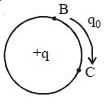
- 3A circle of radius $R$ is drawn with charge $+ q$ at the centre. A charge $q_0$ is brought from point $B$ to $C$, then work done isView Solution
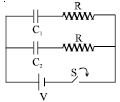
- 4In the circuit shown in figure $C_1=2C_2$. Switch $S$ is closed at time $t=0$. Let $i_1$ and $i_2$ be the currents flowing through $C_1$ and $C_2$ at any time $t$, then the ratio $i_1/ i_2$View Solution
- 5The electric potential in volts due to an electric dipole of dipole moment $2 \times 10^{-8}$ coulomb-metre at a distance of $3 \,m$ on a line making an angle of $60^{\circ}$ with the axis of the dipole is ..........View Solution
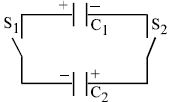
- 6Two capacitors $C_1 = 4\ \mu F$ and $C_2 = 2\ \mu F$ are charged to same potential $ V = 500\ Volt$, but with opposite polarity as shown in the figure. The switches $S_1$ and $S_2$ are closed.View Solution
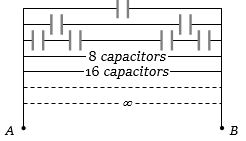
- 7An infinite number of identical capacitors each of capacitance $1\,\mu F$ are connected as in adjoining figure. Then the equivalent capacitance between $A$ and $B$ is......$\mu F$View Solution
- 8Three capacitors $1, 2$ and $4\,\mu F$ are connected in series to a $10\,volt$ source. The charge on the plates of middle capacitor isView Solution
- 9In the circuit shown in figure battery is $10 \ V$ and $C = 6\,\mu F$ . The charge stored in capacitor of capacity $C$ is......$\mu C$View Solution
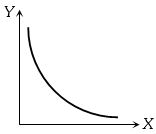
- 10What physical quantities may $X$ and $Y$ represent ? ($Y$ represents the first mentioned quantity)View Solution