Question
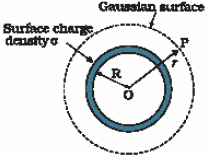
A thin conducting spherical shell of radius R has charge Q spread uniformly over its surface. Using Gauss’s law, derive an expression for an electric field at a point outside the shell.

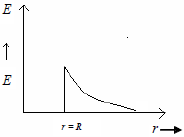
Draw a graph of electric field E(r) with distance r from the centre of the shell for $0\underline{<}\text{r}\underline{<}\infty.$
Answer

$\oint\overrightarrow{\text{E}}.\overrightarrow{\text{ds}} = \frac{\text{q}}{\varepsilon_\circ}$

$\text{E}\times4\pi\text{r}^{2} =\frac{\text{Q}}{\varepsilon_\circ}$

$\text{E} = \frac{1}{4\pi\varepsilon_\circ}\frac{\text{Q}}{\text{r}^{3}}$

Need a full question paper?

Generate a complete, print-ready paper with questions like this in minutes — across 16+ boards, with answer keys.

Start Generating Free

Similar questions

Find the electric field intensity due to a uniformly charged spherical shell at a point (i) outside the shell and (ii) inside the shell. Plot the graph of electric field with distance from the centre of the shell.
Describe the working principle of a moving coil galvanometer. Why is it necessary to use (i) a radial magnetic field and (ii) a cylindrical soft iron core in a galvanometer? Write the expression for current sensitivity of the galvanometer.
Can a galvanometer as such be used for measuring the current? Explain.
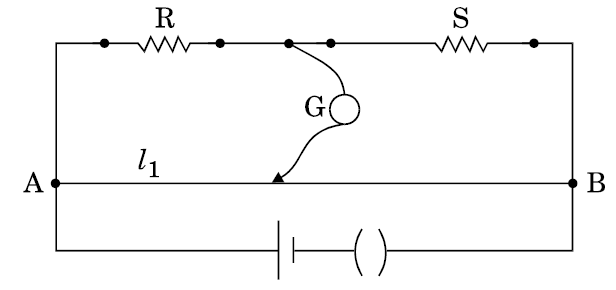
  1. Write the principle of working of a metre bridge.
  2. In a metre bridge, the balance point is found at a distance $l_1$ with resistances R and S as shown in the figure.

An unknown resistance X is now connected in parallel to the resistance S and the balance point is found at a distance $l_2$. Obtain a formula for X in terms of $l_1$, $l_2$ and S.

A sinusoidal voltage of peak value $283 V$ and frequency $50 Hz$ is applied to a series $L C R$ circuit in which $R =3 \Omega, L=25.48 mH$, and $C =796 \mu F$. Find (a) the impedance of the circuit; (b) the phase difference between the voltage across the source and the current; (c) the power dissipated in the circuit; and (d) the power factor.
State the underlying principle of working of a moving coil galvanometer. Write two reasons why a galvanometer can not be used as such to measure current in a given circuit. Name any two factors on which the current sensitivity of a galvanometer depends.
A particle having a charge of 2.0 × 10-4C is placed directly below and at a separation of 10cm from the bob of a simple pendulum at rest. The mass of the bob is 100g. What charge should the bob be given so that the string becomes loose?
Define coefficient of mutual induction i.e. mutual inductance.
When the current in a primary coil is changed from zero to 2.0 A within 300 ms, then an induced emf of a 0.80 volt is produced in secondary coil. Calculate coefficient of mutual inductance between the two coils.
In a plot of photoelectric current versus anode potential, how does?

  1. The saturation current vary with anode potential for incident radiations of different frequencies but same intensity?
  2. The stopping potential vary for incident radiations of different intensities but same frequency?
  3. Photoelectric current vary for different intensities but same frequency of incident radiations?

Justify your answer in each case.

Suppose the bob of the previous problem has a speed of 1.4m/ s when the string makes an angle of 0.20 radian with the vertical. Find the tension at this instant. You can use $\cos\theta\approx1-\frac{\theta^2}{2}$ and $\sin\theta\approx\theta$ for small $\theta.$
A dumb-bell consists of two identical small balls of mass $\frac{1}{2}\text{kg}$ each connected to the two ends of a 50cm long light rod. The dumb-bell is rotating about a fixed axis through the centre of the rod and perpendicular to it at an angular speed of 10rad/s. An impulsive force of average magnitude 5.0N acts on one of the masses in the direction of its velocity for 0.10s. Find the new angular velocity of the system.