MCQ
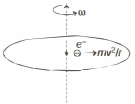
A thin metallic disc is rotating with constant angular velocity about a vertical axis that is perpendicular to its plane and passes through its centre. The rotation causes the free electrons in the disc to redistribute. Assume that, there is no external electric or magnetic field. Then,
  • A
    a point on the rim of the disc is at a higher potential than its centre
  • a point on the rim of the disc is at a lower potential than its centre
  • C
    a point on the rim of the disc is at the same potential as its centre
  • D
    the potential in the material has an extremum between centre and the rim
Answer

Correct option: B.
a point on the rim of the disc is at a lower potential than its centre
b
$(b)$ Centrifugal action causes electrons to accumulate around rim of disc.

So, rim of disc is at a negative potential with respect to centre of disc. So, points of rim are at lower potential than its centre.

Need a full question paper?

Generate a complete, print-ready paper with questions like this in minutes — across 16+ boards, with answer keys.

Start Generating Free

Similar questions

Momentum of a photon of wavelength $\lambda$ is
An accident in a nuclear laboratory resulted in deposition of a certain amount of radioactive material of half-life $18$ days inside the laboratory. Tests revealed that the radiation was $64$ times more than the permissible level required for safe operation of the laboratory. What is the minimum number of days after which the laboratory can be considered safe for use?
Finger prints are observed by the use of
Two bulbs each marked 100 W, 220 V are connected in series across 220 V supply. The power consumed by them, when lit, is
A 20cm long capillary tube is dipped in water. The water rises up to 8cm. If the entire arrangement is put in a freely falling elevator, the length of water column in the capillary tube will be:
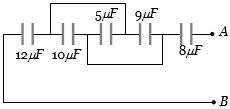
The capacities and connection of five capacitors are shown in the adjoining figure. The potential difference between the points $A$ and $B$ is $60\;volts$. Then the equivalent capacity between $A$ and $B$ and the charge on $5\,\mu F$ capacitance will be respectively
Every atom makes one free electron in copper. If $1.1$ $ampere$ current is flowing in the wire of copper having $1\, mm$ diameter, then the drift velocity (approx.) will be (Density of copper $ = 9 \times {10^3}\,kg\,{m^{ - 3}}$ and atomic weight = $63$)
In a hydrogen like atom electron make transition from an energy level with quantum number $n$ to another with quantum number $(n- 1)$. If $n > >  1$, the frequency ofradiation emitted is proportional to
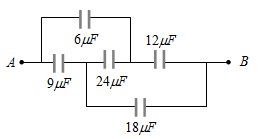
In the connections shown in the adjoining figure, the equivalent capacity between A and B will be
Ray optics is valid when characteristic dimensions are: