Question
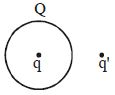
A thin metallic spherical shell contains a charge $Q$ on it. A point charge $+q$ is placed at the centre of the shell and another charge $q'$ is placed outside it as shown in fig. All  the three charges are positive. The force on the central charge due to the shell is :-
Answer

Note that there is no field inside the metallic shell.

Need a full question paper?

Generate a complete, print-ready paper with questions like this in minutes — across 16+ boards, with answer keys.

Start Generating Free

Similar questions

Light of frequency v is incident on a substance of threshold frequency $v_0$($v_0$ $< v)$. The energy of the emitted photo-electron will be
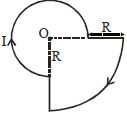
A current $I$ flowing through the loop as shown in the adjoining figure. The magnetic field at centre $O$ is
Semiconductor is damaged by the strong current due to
A fist looking from within water sees the outside world through a circular horizon. If the fish $\sqrt 7  cm$ below the surface of water, what will be the radius of the circular horizon.....$cm$
A string vibrates according to the equation $y = 5\sin \,\left( {\frac{{2\pi x}}{3}} \right)\,\,\cos \,20\,\pi t$, where $x$ and $y$ are in $cm$ and $t$ in sec. The distance between two adjacent nodes is .... $cm$
A particle of mass $\mathrm{m}$ is moving in the $x y$-plane such that its velocity at a point $(x, y)$ is given as $\vec{v}=\alpha(y \hat{x}+2 x \hat{y})$, where $\alpha$ is a non-zero constant. What is the force $\vec{F}$ acting on the particle?
The plate resistance of a triode is $2.5 ×10^{4}$ $\Omega$ and mutual conductance is $2 ×10^{-3}$ mho. What will be the value of amplification factor
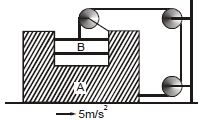
If block $A$ is moving with an acceleration of $5\,m/s^2$, the acceleration of $B$ w.r.t. ground is
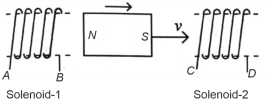
In the above diagram, a strong bar magnet is moving towards solenoid-$2$ from solenoid-$1$. The direction of induced current in solenoid-$1$ and that in solenoid-$2$, respectively, are through the directions:
Two resistances ${R_1}$ and ${R_2}$ are made of different materials. The temperature coefficient of the material of ${R_1}$ is $\alpha $ and of the material of ${R_2}$ is $ - \beta $. The resistance of the series combination of ${R_1}$ and ${R_2}$ will not change with temperature, if ${R_1}/{R_2}$ equals