Question
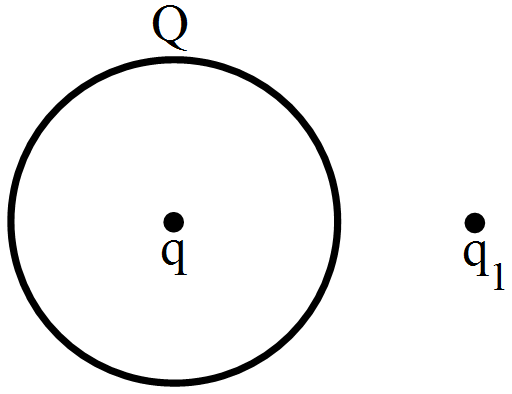
A thin, metallic spherical shell contains a charge $Q$ on it. A point charge q is placed at the centre of the shell and another charge $q_1$ is placed outside it as shown in figure. All the three charges are positive. The force on the charge at the centre is:
Answer


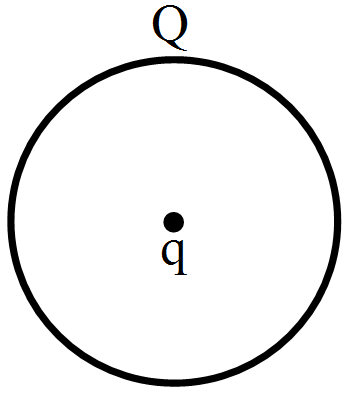
Electric field due to $Q\  q,$ inside the spherical shell is zero.

Need a full question paper?

Generate a complete, print-ready paper with questions like this in minutes — across 16+ boards, with answer keys.

Start Generating Free

Similar questions

A proton and an electron are placed in a uniform electric field.
When a thin transparent plate of thickness $t$ and refractive index $m$ is placed in the path of one of the two interfering waves of light, then the path difference changes by
Which one of the following is the weakest kind of bonding in solids(a) Ionic  (b) Metallic(c) Vander Waals(d) Covalent
       
Assertion  :  The earth’s magnetic field does not affect the working of a moving coil galvanometer.
Reason     : Earth’s magnetic field is very weak.(a) If both assertion and reason are true and the reason is the correct explanation of the assertion.(b) If both assertion and reason are true but reason is not the correct explanation of the assertion.(c) If assertion is true but reason is false.(d) If the assertion and reason both are false.


A susceptibility of a certain magnetic material is 400. What is the class of the magnetic material?
A p-type semiconductor is:
  1. Positively charged.
  2. Negatively charged.
  3. Uncharged.
  4. Uncharged at 0K but charged at higher ternperatures.
A force $F$ acts between sodium and chlorine ions of salt $($sodium chloride$)$ when put $1 \ cm$ apart in air. The permittivity of air and dielectric constant of water are $\varepsilon_0$ and $K$ respectively. When a piece of salt is put in water electrical force acting between sodium and chlorine ions $1 \ cm$ apart is
For the Bohr's first orbit of circumference $2 \pi r$, the de$-$Broglie wavelength of revolving electron will be
A battery of $\text{e.m.f.}\ E$ and internal resistance $r$ is connected to a variable resistor $R$ as shown here. Which one of the following is true
Liquids and gases never exhibit: