MCQ
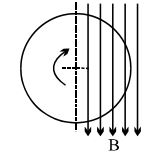
A thin non conducting disc of radius $R$ is rotating clockwise (see figure) with an angular velocity $w$ about its central axis, which is perpendicular to its plane. Both its surfaces carry $+ve$ charges of uniform surface density. Half the disc is in a region of a uniform, unidirectional magnetic field $B$ parallel to the plane of the disc, as shown. Then,
  • A
    The net torque on the disc is zero.
  • The net torque vector on the disc is directed leftwards.
  • C
    The net torque vector on the disc is directed rightwards.
  • D
    The net torque vector on the disc is parallel to $B.$

Answer

Correct option: B.
The net torque vector on the disc is directed leftwards.
b

Need a full question paper?

Generate a complete, print-ready paper with questions like this in minutes — across 16+ boards, with answer keys.

Start Generating Free

Similar questions

In an ideal parallel $LC$ circuit, the capacitor is charged by connecting it to a $D.C.$ source which is then disconnected. The current in the circuit.
The time period of a freely suspended magnet is 4 seconds. If it is broken in length into two equal parts and one part is suspended in the same way, then its time period will be
Two point charges $100\,\mu \,C$ and $5\,\mu \,C$ are placed at points $A$ and $B$ respectively with $AB = 40\,cm$. The work done by external force in displacing the charge $5\,\mu \,C$ from $B$ to $C$, where $BC = 30\,cm$, angle $ABC = \frac{\pi }{2}$ and $\frac{1}{{4\pi {\varepsilon _0}}} = 9 \times {10^9}\,N{m^2}/{C^2}$.........$J$
The electric potential at the surface of an atomic nucleus $(Z = 50)$ of radius $9.0×{10^{ - 13}}\, cm$ is
Three observers $A, B$ and $C$ measure the speed of light coming from a source to be $v_A, v_B$ and $v_C$. The observer $A$ moves towards the source, the observer C moves away from the source with the same speed. The observer B stays stationary. the surrounding space is vacuum every where. Then
Two protons move parallel to each other, keeping distance $r$ between them, both moving with same  velocity $\vec V\,$. Then the ratio of the electric and magnetic force of interaction between them is
For principal quantum number n = 3, the possible values of orbital quantum number ‘l’ are
Two short magnets placed along the same axis with their like poles facing each other repel each other with a force which varies inversely as
The electric field and the electric potential at a point are $E$ and $V$ respectively.
Energy of electron (in $eV$) in $2^{\text {nd }}$ orbit of $He ^{+}$ ion ? (in $eV$)