MCQ
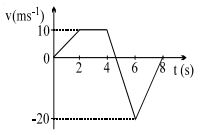
The figure shows a velocity-time graph of a particle moving along a straight line  The total distance travelled by the particle is  ........ $m$
  • $66.6$
  • B
    $51.6 $
  • C
    $0$
  • D
    $36.6$

Answer

Correct option: A.
$66.6$
a
Distance $=$ Area convered by $v-t$ graph on time axis $\Rightarrow \frac{1}{2}\left(+\frac{14}{3}\right) \times 10+\frac{1}{2} \times\left(8-\frac{14}{3}\right) \times 20$

$=\frac{100}{3}+\frac{100}{3}=\frac{200}{3} \Rightarrow 66.6 \mathrm{m}$

Need a full question paper?

Generate a complete, print-ready paper with questions like this in minutes — across 16+ boards, with answer keys.
Start Generating Free

Similar questions

The temperature of a gas is $ -68^\circ C$. At ...... $^oC$ temperature will the average kinetic energy of its molecules be twice that of at $ -68^\circ C$
A metal rod of $1\; m$ length, is dropped exact vertically on to a hard metal floor. With an oscilloscope, it is determined that the impact produces a longitudinal wave of $1.2 \;k Hz$ frequency. The speed of sound in the metal rod is
A sine wave of wavelength $\lambda $ is travelling in a medium. The minimum distance between the two particles, always having same speed, is
The mean radius of the earth's orbit round the sun is $1.5 \times {10^{11}}$. The mean radius of the orbit of mercury round the sun is $6 \times {10^{10}}\,m$. The mercury will rotate around the sun in
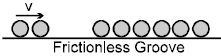
Six steel balls of identical size are lined up long a straight frictionless groove. Two similar balls moving with a speed $V$ along the groove collide with this row on the extreme left hand then
A ball moving with velocity $2 \,m/s$ collides head on with another stationary ball of double the mass. If the coefficient of restitution is $0.5,$ then their velocities after collision will be
This question contains Statement$-1$ and Statement$-2$. Of the four choices given after the statements, choose the one that best describes the two statements. 
Statement$-1$: For a mass $M$ kept at the centre ofa cube of side '$a$', the flux of gravitational field passing through its  sides $4\pi GM.$
Statement$-2$: If the direction of a field due to a point source is radial and its dependence on the distance '$r$' from the source is given as $\frac{1}{r^2}$ , its flux through a closed surface depends only on the strength of the source enclosed by the surface and not on the size or shape of the surface.
Five equal forces of $10N$ each are applied at one point and are all lying in one plane. If the angles between them are equal, the resultant of these forces will be:
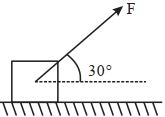
As shown in the figure a block of mass $10\,kg$ lying on a horizontal surface is pulled by a force $F$ acting at an angle $30^{\circ}$, with horizontal. For $\mu_{ s }=0.25$, the block will just start to move for the value of $F..........\,N$ : $\left[\right.$ Given $\left.g =10\,ms ^{-2}\right]$
A black metal foil is warmed by radiation from a small sphere at temperature $T$ and at a distance $d$. It is found that the power received by the foil is $`P$ '. If both the temperature and the distance are doubled, the power received by the foil will be