Question
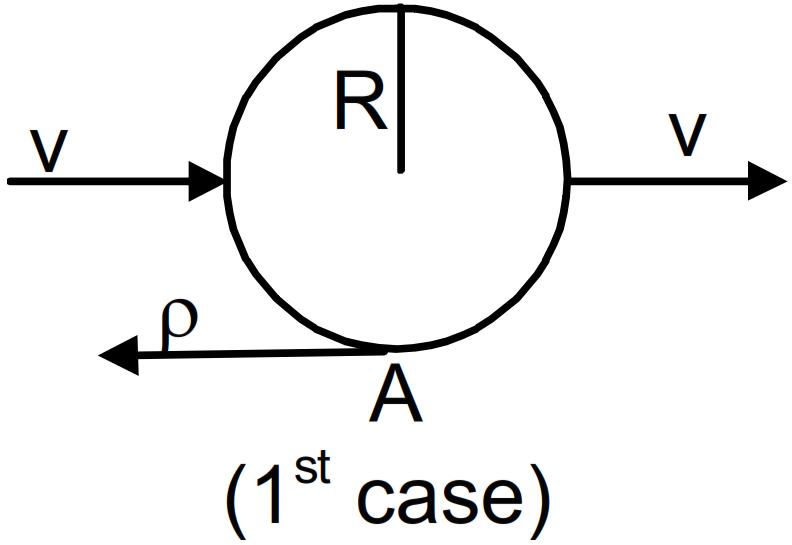
A thin spherical shell lying on a rough horizontal surface is hit by a cue in such a way that the line of action passes through the centre of the shell. As a result, the shell starts moving with a linear speed v without any initial angular velocity. Find the linear speed of the shell after it starts pure rolling on the surface.

Answer


The shell will move with a velocity nearly equal to v due to this motion a frictional force well act in the background direction, for which after some time the shell attains a pure rolling. If we consider moment about A, then it will be zero.
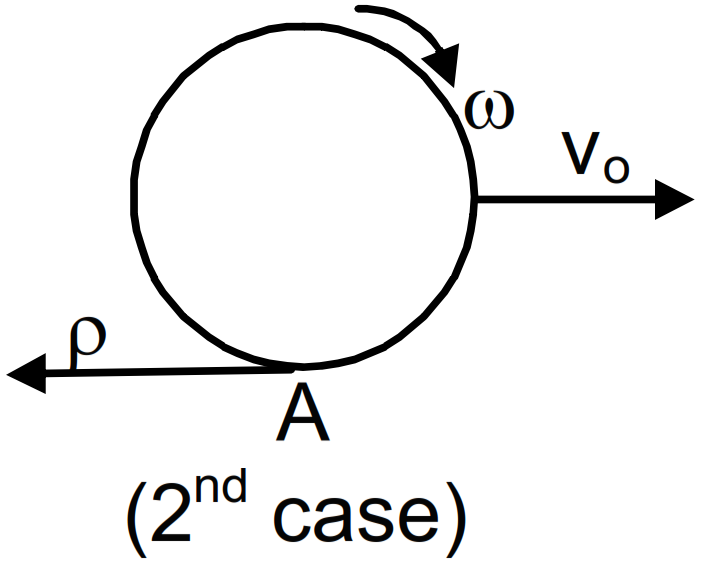
Therefore, Net angular momentum about A before pure rolling = net angular momentum after pure rolling.

Now, angular momentum before pure rolling about A = M(V × R) and angular momentum after pure rolling:

$\Big(\frac{2}{3}\Big)\text{MR}^2\times\Big(\frac{\text{V}_0}{\text{R}}\Big)+\text{MV}_0\text{R}$

(V0 = velocity after pure rolling)

$\Rightarrow\text{MVR}=\frac{2}3{}\text{MV}_0\text{R}+\text{MV}_0\text{R}$

$\Rightarrow\Big(\frac{5}{3}\Big)\text{V}_0=\text{V}$

$\Rightarrow\text{V}_0=\frac{3\text{V}}{5}$
Need a full question paper?

Generate a complete, print-ready paper with questions like this in minutes — across 16+ boards, with answer keys.

Start Generating Free

Similar questions

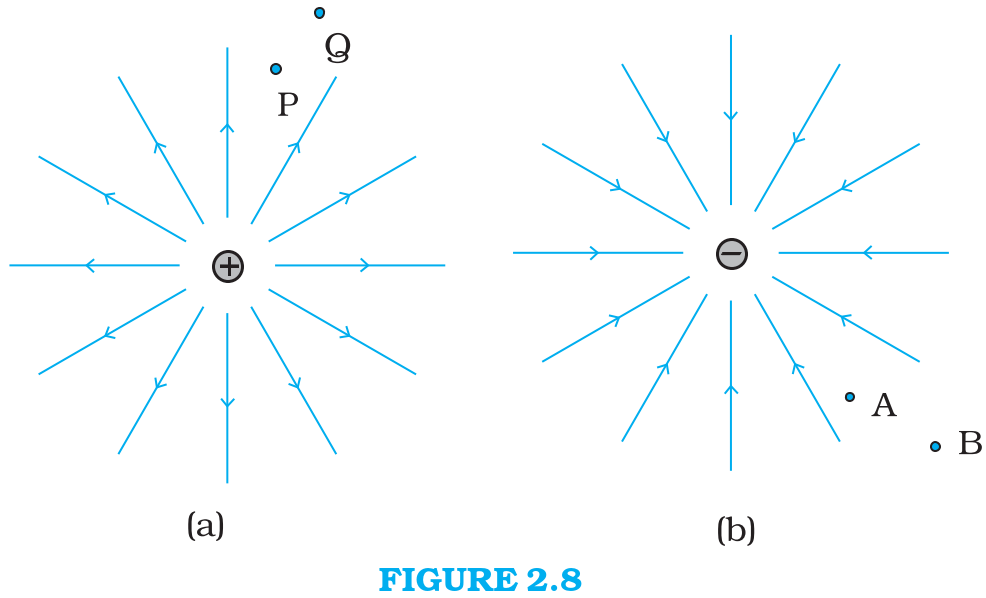
Figures 2.8 (a) and (b) show the field lines of a positive and negative point charge respectively.
Image
(a) Give the signs of the potential difference $V_{ P }-V_{ Q } ; V_{ B }-V_{ A }$.
(b) Give the sign of the potential energy difference of a small negative charge between the points $O$ and $P ; A$ and $B$.
(c) Give the sign of the work done by the field in moving a small positive charge from $Q$ to $P$.
(d) Give the sign of the work done by the external agency in moving a small negative charge from $B$ to $A$.
(e) Does the kinetic energy of a small negative charge increase or decrease in going from $B$ to $A$ ?
Which waves are electromagnetic waves?Which factors are responsible for their production?
Is inversion temperature always double of the neutral temperature? Does the unit of temperature have an effect in deciding this question?
A point charge is moving along a straight line with a constant velocity u. Consider a small area A perpendicular to the direction of motion of the charge (El). Calculate the displacement current through the area when its distance from the charge is x. The value of x is not large so that the electric field at any instant is essentially given by Coulomb's law.

(a) Calculate the potential at a point P due to a charge of $4 \times 10^{-7} C$ located 9 cm away.
(b) Hence obtain the work done in bringing a charge of $2 \times 10^{-9} C$ from infinity to the point $P$. Does the answer depend on the path along which the charges is brought?
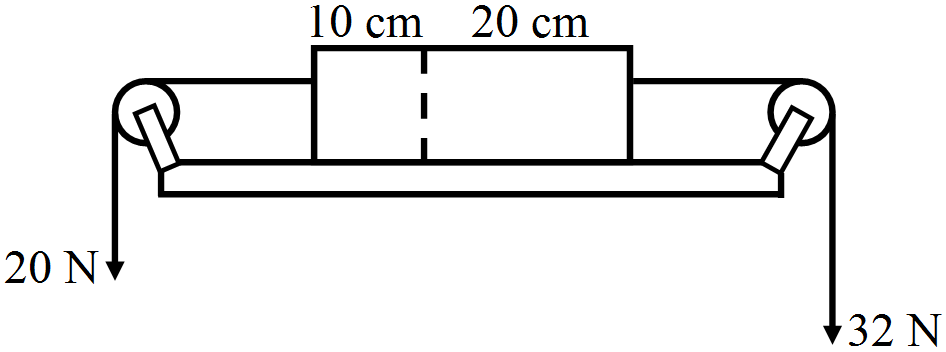
Figure shows a uniform rod of length 30cm having a mass of 3.0kg. The strings shown in the figure are pulled by constant forces of 20N and 32N. Find the force exerted by the 20cm part of the rod on the 10cm part. All the surfaces are smooth and the strings and the pulleys are light.

Two charged particles, having equal charges of 2.0 × 10-5C each, are brought from infinity to within a separation of 10cm. Find the increase in the electric potential energy during the process.
Whenever a photon is emitted by hydrogen in Balmer series, it is followed by another photon in Lyman series. What wavelength does this latter photon correspond to?
A free atom of iron emits $\text{K}_\alpha$ X-rays of energy 6.4keV. Calculate the recoil kinetic energy of the atom. Mass of an iron atom = 9.3 × 10⁻²⁶kg.
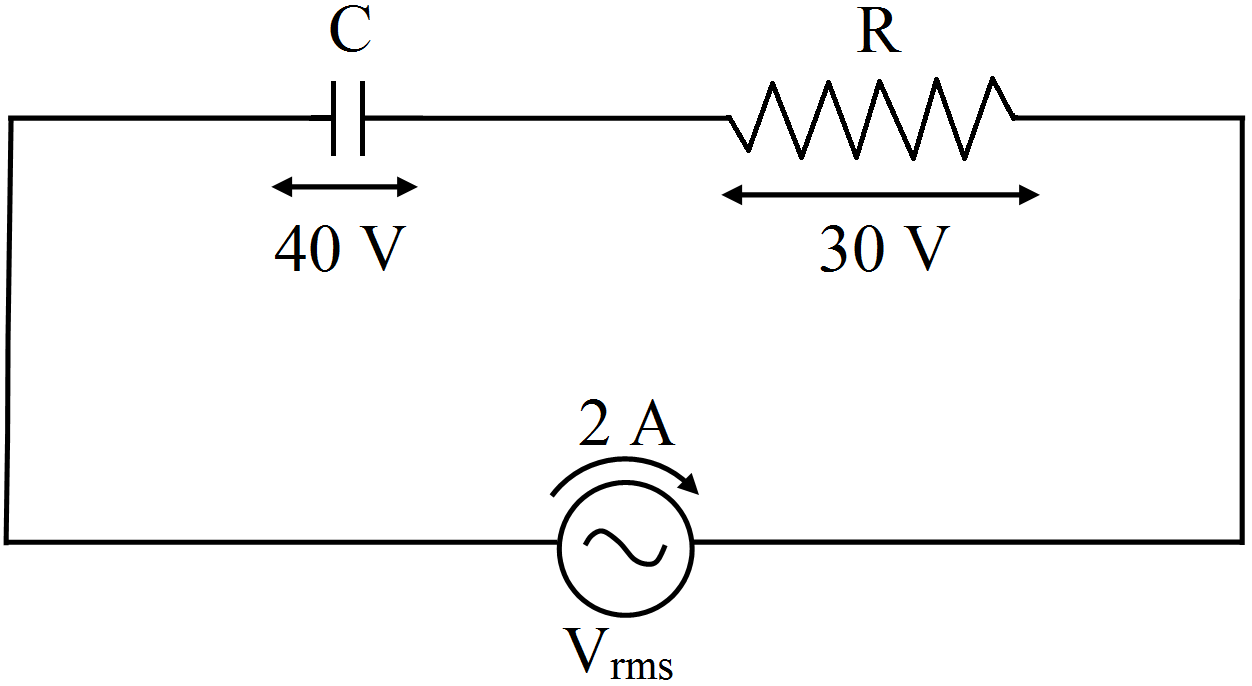
Calculate the following:

  1. Impedance of the given ac circuit.
  2. Wattless current of the given ac circuit.