Question
A toroid has a core $($non$-$ferromagnetic$)$ of inner radius $25 \ cm$ and outer radius $26 \ cm,$ around which $3500$ turns of a wire are wound. If the current in the wire is $11 A,$ what is the magnetic field,
  1. Outside the toroid,
  2. Inside the core of the toroid and,
  3. In the empty space surrounded by the toroid.

Answer

Inner radius of the toroid, $r_1 = 25 \ cm = 0.25 m$
Outer radius of the toroid, $r_2 = 26 \ cm = 0.26 m$
Number of turns on the coil, $N = 3500$
Current in the coil, $I = 11 A$
  1. Magnetic field outside a toroid is zero. It is non$-$zero only inside the core of a toroid.
  2. Magnetic field inside the core of a toroid is given by the relation.
$\text{B}=\frac{\mu_{0}\text{NI}}{l}$
Where,
$\mu_{0}=$ Permeability of free space $=4\pi\times10^{-7}\text{T mA}^{-1}$
$l =$ length of toroid
$2\pi\Big[\frac{\text{r}_{1}+\text{r}_{2}}{2}\Big]$
$\pi(0.25+0.26)$
$\therefore\text{B}=\frac{4\pi\times10^{-7}\times3500\times11}{0.51\pi}$
$≈ 3.0 \times 10^{-2} T$​​​​​​​
  1. Magnetic field in the empty space surrounded by the toroid is zero.

Need a full question paper?

Generate a complete, print-ready paper with questions like this in minutes — across 16+ boards, with answer keys.

Start Generating Free

Similar questions

The electric current in an $X-$ray tube $($from the target to the filament$)$ operating at $40\ kV$ is $10\ mA$. Assume that on an average$, 1\%$ of the total kinetic energy of the electron hitting hte target are converted into $X-$rays.
  1. What is the total power emitted as $X-$rays
  2. How much heat is produced in the target every second?
A converging lens and a diverging mirror are placed at a separation of 15cm. The focal length of the lens is 25cm and that of the mirror is 40cm. Where should a point source be placed between the lens and the mirror so that the light, after getting reflected by the mirror and then getting transmitted by the lens, comes out parallel to the principal axis?
Using Bohr's postulates, obtain the expression for the total energy of the electron in the stationary states of the hydrogen atom. Hence draw the energy level diagram showing how the line spectra corresponding to Balmer series occur due to transition between energy levels.
Three circuits, each consisting of a switch $'S\ ’$ and two capacitors, are initially charged, as shown in the figure. After the switch has been closed, in which circuit will the charge on the left$-$hand capacitor $(i)$ increase, $(ii)$ decrease and $(iii)$ remain same? Give reasons.
A solenoid has a core of a material with relative permeability 400 . The windings of the solenoid are insulated from the core and carry a current of 2A. If the number of turns is 1000 per metre, calculate (a) $H$, (b) $M$, (c) $B$ and (d) the magnetising current $I_m$.
Define the term wavefront. State Huygen's principle. Consider a plane wavefront incident on a thin convex lens. Draw a proper diagram to show how the incident wavefront traverses through the lens and after refraction focusses on the focal point of the lens, giving the shape of the emergent wavefront.
A simple pendulum of lerigth $1$ feet suspended from the ceiling of an elevator takes $\frac{\pi}{3}$ seconds to complete one oscillation. Find the acceleration of the elevator.
Calculate the energy released by $1g$ of natural uranium assuming $200\ MeV$ is released in each fission event and that the fissionable isotope $^{235}U$ has an abundance of $0.7\%$ by weight in natural uranium.
A block of mass $100g$ is moved with a speed of $5.0m/s$ at the highest point in a closed circular tube of radius $10\ cm$ kept in a vertical plane. The cross$-$section of the tube is such that the block just fits in it. The block makes several oscillations inside the tube and finally stops at the lowest point. Find the work done by the tube on the block during the process.
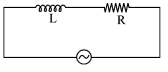
In the given figure, voltage across the ends of inductor ( L ) and resistor ( R ) is 120 V and 90 V respectively. The root mean square value of the current is 3 A. Calculate :
(i) impedance of the circuit and (ii) phase difference between voltage and current.
Image