Question
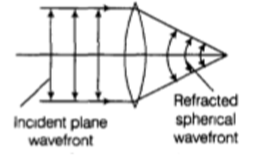
Define the term wavefront. State Huygen's principle. Consider a plane wavefront incident on a thin convex lens. Draw a proper diagram to show how the incident wavefront traverses through the lens and after refraction focusses on the focal point of the lens, giving the shape of the emergent wavefront.
Answer

When light is emitted from a source, then the particles present around it begins to vibrate. The locus of all such particles which are vibrating in the same phase is termed as wavefront. 
Huygens' principle: Every point on a wave-front may be considered a source of secondary spherical wavelets which spread out in the forward direction at the speed of light. The new wave-front is the tangential surface to all of these secondary wavelets. Now when a plane wavefront (parallel rays) is incident on a thin convex lens, the emergent rays are focused on the focal point of the lens. Thus the shape of emerging wavefront is spherical. 
Image

Need a full question paper?

Generate a complete, print-ready paper with questions like this in minutes — across 16+ boards, with answer keys.

Start Generating Free

Similar questions

Define coefficient of mutual induction i.e. mutual inductance.
When the current in a primary coil is changed from zero to 2.0 A within 300 ms, then an induced emf of a 0.80 volt is produced in secondary coil. Calculate coefficient of mutual inductance between the two coils.
A water particle of mass $10.0\ mg$ and having a charge of $1.50 \times 10^{-6}C$ stays suspended in a room. What is the magnitude of electric field in the room? What is its direction?
Consider the situation of the previous problem. A particle having charge q and mass m is projected from the point Q in a direction going into the plane of the diagram. It is found to describe a circle of radius r between the two plates. Find the speed of the charged particle.
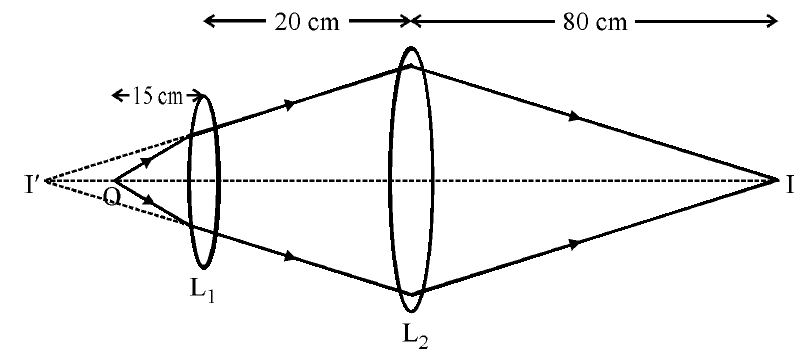
In the following diagram, an object $‘O\ ’$ is placed $15 \ cm$ in front of a convex lens $L_1$ of focal length $20 \ cm$ and the final image is formed at $‘I\ ’$ at a distance of $80 \ cm$ from the second lens $L_2$. Find the focal length of the lens $L_2$.
A train approaching a platform at a speed of 54km/h sounds a whistle. An observer on the platform finds its frequency to be 1620Hz. The train passes the platform keeping the whistle on and without slowing down. What frequency will the observer hear after the train has crossed the platfrom? The speed of sound in air = 332m/s.
A circular coil of radius $10 cm , 500$ turns and resistance $2 \Omega$ is placed with its plane perpendicular to the horizontal component of the earth's magnetic field. It is rotated about its vertical diameter through $180^{\circ}$ in $0.25 s$. Estimate the magnitudes of the emf and current induced in the coil. Horizontal component of the earth's magnetic field at the place is $3.0 \times 10^{-5} T$.
In Young’s double slit experiment, the two slits $0.15 \ mm$ apart are illuminated by monochromatic light of wavelength $450 \ nm$. The screen is $1.0 m$ away from the slits.
  1. Find the distance of the second $(i)$ bright fringe, $(ii)$ dark fringe from the central maximum.
  2. How will the fringe pattern change if the screen is moved away from the slits?
With the help of an example, explain how the neutron to proton ratio changes during $\alpha-$decay of a nucleus.
A convex lens of focal length 20 cm is placed coaxially with a convex mirror of radius of curvature 20 cm. The two are kept 15 cm apart. A point object is placed 40 cm in front of the convex lens. Find the position of the image formed by this combination. Draw the ray diagram showing the image formation.
A cylindrical metallic wire is stretched to increase its length by 10%. Calculate the percentage increase in its resistance.