Question
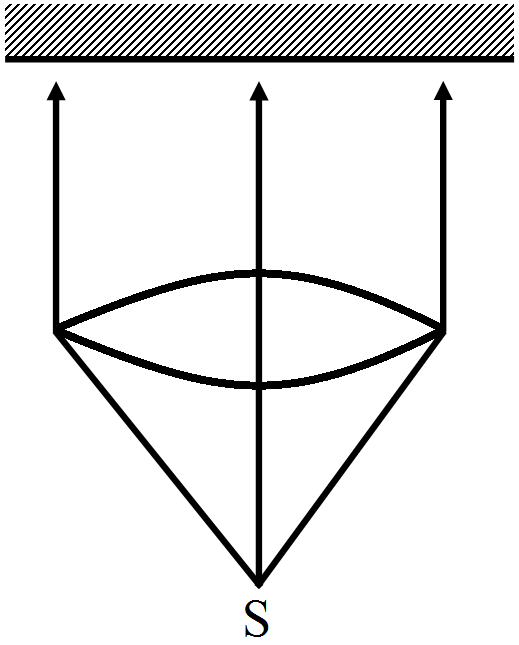
A totally reflecting, small plane mirror placed horizontally faces a parallel beam of light, as shown in the figure. The mass of the mirror is $20g.$ Assume that there is no absorption in the lens and that $30\%$ of the light emitted by the source goes through the lens. Find the power of the source needed to support the weight of the mirror. Take $g = 10\ m/s^2.$
Answer

$m = 20g$ The weight of the mirror is balanced.
Thus force exerted by the photons is equal to weight$\text{p}=\frac{\text{h}}{\lambda}$
$\text{E}=\frac{\text{hc}}{\lambda}=\text{pc}$
$\Rightarrow\frac{\text{E}}{\text{t}}=\frac{\text{p}}{\text{t}}\text{c}$
$\Rightarrow$ Rate of change of momentum $=\frac{\text{power}}{\text{C}}\ 30\%$ of light passes through the lens.
Thus it exerts force. $70\%$ is reflected.
$\therefore$ Force exerted $= 2($ rate of change of momentum$)$
$=2\times\frac{\text{power}}{\text{C}}$
$30\%\Big(\frac{2\times\text{power}}{\text{C}}\Big)=\text{mg}$
$\Rightarrow\text{power}=\frac{20\times10^{-3}\times10\times3\times10^{8}\times10}{2\times3}$
$=10\text{W}=100\text{MW.}$

Need a full question paper?

Generate a complete, print-ready paper with questions like this in minutes — across 16+ boards, with answer keys.

Start Generating Free

Similar questions

If one of the two electrons of a $H_2$ molecule is removed, we get a hydrogen molecular ion $\text{H}^+_2​.$ In the ground state of an $\text{H}^+_2​,$ the two protons are separated by roughly $1.5 \mathring A ,$ and the electron is roughly $1 \mathring A$ from each proton. Determine the potential energy of the system. Specify your choice of the zero of potential energy.
Three capacitors of capacitances $2 pF, 3 pF$ and $4 pF$ are connected in parallel.
  1. What is the total capacitance of the combination?
  2. Determine the charge on each capacitor if the combination is connected to a $100 V$ supply.
A string of length L fixed at both ends vibrates in its fundamental mode at a frequency v and a maximum amplitude A.
  1. Find the wavelength and the wave number k.
  2. Take the origin at one end of the string and the X-axis along the string. Take the Y-axis along the direction of the displacement. Take t = 0 at the instant when the middle point of the string passes through its mean position and is going towards the positive y-directian. Write the equation describing the standing wave:
The potential difference across a resistor $‘r\ ’$ carrying current $‘I\ ’$ is $Ir.$
  1. Now if the potential difference across $‘r\ ’$ is measured using a voltmeter of resistance $‘RV\ ’,$ show that the reading of voltmeter is less than the true value
  2. Find the percentage error in measuring the potential difference by a voltmeter.
  3. At what value of $RV,$ does the voltmeter measures the true potential difference?
What is Global Positioning System? Explain its working principle in brief.
A horizontal straight wire $10 m$ long extending from east to west is falling with a speed of $5.0 ms^{-1}$, at right angles to the horizontal component of the earth's magnetic field, $0.30 \times 10^{-4} Wb m ^{-2}$.
$a$. What is the instantaneous value of the emf induced in the wire?
$b$. What is the direction of the emf?
$c$. Which end of the wire is at the higher electrical potential?
Two particles, carrying charges -q and +q and having equal masses m each, are fixed at the ends of a light rod of length a to form a dipole. The rod is clamped at an end and is placed in a uniform electric field E with the axis of the dipole along the electric field. The rod is slightly tilted and then released. Neglecting gravity find the time period of small oscillations.
A person $(40\ kg)$ is managing to be at rest between two vertical walls by pressing one wall A by his hands and feet and the other wall B by his back. Assume that the friction coefficient between his body and the walls is $0.8$ and that limiting friction acts at all the contacts.
  1. Show that the person pushes the two walls with equal force.
  2. Find the normal force exerted by either wall on the person. Take $g = 10m/s^2.$
What is the de Broglie wavelength of:
  1. A bullet of mass $0.040 \ kg$ travelling at the speed of $1.0 \ km/s,$
  2. A ball of mass $0.060 \ kg$ moving at a speed of $1.0\ m/s,$ and
  3. A dust particle of mass $1.0 \times 10^{–9} \ kg$ drifting with a speed of $2.2\ m/s?$
A bar magnet M is dropped so that it falls vertically through the coil C. The graph obtained for voltage produced across the coil versus time is showing in figure (b).
  1. Explain the shape of the graph.
  2. Why is the negative peak longer than the positive peak?