Question
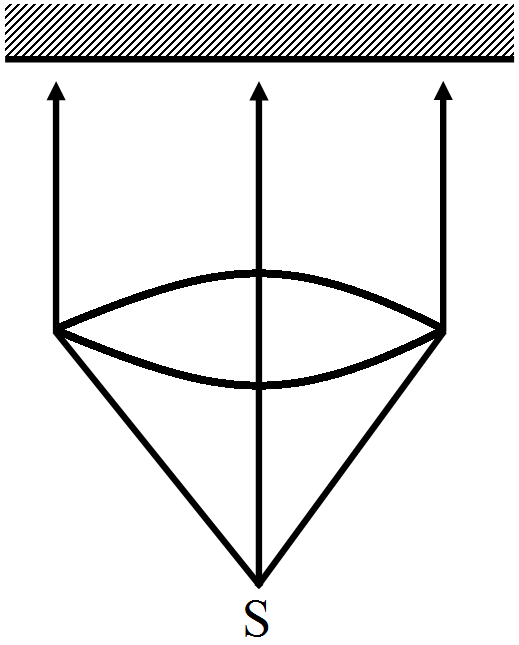
A totally reflecting, small plane mirror placed horizontally faces a parallel beam of light, as shown in the figure. The mass of the mirror is 20g. Assume that there is no absorption in the lens and that 30% of the light emitted by the source goes through the lens. Find the power of the source needed to support the weight of the mirror. Take g = 10m/s2.
Answer

m = 20g

The weight of the mirror is balanced. Thus force exerted by the photons is equal to weight

$\text{p}=\frac{\text{h}}{\lambda}$

$\text{E}=\frac{\text{hc}}{\lambda}=\text{pc}$

$\Rightarrow\frac{\text{E}}{\text{t}}=\frac{\text{p}}{\text{t}}\text{c}$

⇒ Rate of change of momentum $=\frac{\text{power}}{\text{C}}$

30% of light passes through the lens.

Thus it exerts force. 70% is reflected.

$\therefore$ Force exerted = 2(rate of change of momentum)

$=2\times\frac{\text{power}}{\text{C}}$

$30\%\Big(\frac{2\times\text{power}}{\text{C}}\Big)=\text{mg}$

$\Rightarrow\text{power}=\frac{20\times10^{-3}\times10\times3\times10^{8}\times10}{2\times3}$

$=10\text{W}=100\text{MW.}$

Need a full question paper?

Generate a complete, print-ready paper with questions like this in minutes — across 16+ boards, with answer keys.

Start Generating Free

Similar questions

The magnifying power of a converging lens used as a simple microscope is $\Big(1+\frac{\text{D}}{\text{f}}\Big).$ A compound microscope is a combination of two such converging lenses. Why don't we have magnifying power $\Big(1+\frac{\text{D}}{\text{f}_\text{o}}\Big) \Big(1+\frac{\text{D}}{\text{f}_\text{o}}\Big)?$ In other words, why can the objective not be treated as a simple microscope but the eyepiece can?
How many time constants will elapse before the current in a charging RC circuit drops to half of its initial value? Answer the same question for a discharging RC circuit.
A pole of length 1.00m stands half dipped in a swimming pool with water level 50.0 cm higher than the bed. The refractive index of water is 1.33 and sunlight is coming at an angle of 45° with the vertical. Find the length of the shadow of the pole on the bed.
A rod of mass m and length L, lying horizontally, is free to rotate about a vertical axis through its centre. A horizontal force of constant magnitude F acts on the rod at a distance of $\frac{\text{L}}{4}$ from the centre. The force is always perpendicular to the rod. Find the angle rotated by the rod during the time (t) after the motion starts.
How many time constants will elapse before the power delivered by a battery drops to half of its maximum value in an RC circuit?
A uniform wire of resistance $100\Omega$ is melted and recast as a wire of length is double that of the original. What would be the resistance of the wire?
The current through a wire depends on time as $\text{i}=\text{i}_0+\alpha\text{t},$
Where $\text{i}_0=10\text{A}$ and $\alpha=4\text{A/ s}.$ Find the charge that crosses through a section of the wire in 10 seconds.
The product of the hole concentration and the conduction electron concentration turns out to be independent of the amount of any impurity doped. The concentration of conduction electrons in germanium is 6 × 1019 per cubic metre. When some phosphorus impurity is doped into a germanium sample, the concentration of conduction electrons increases to 2 × 10²³ per cubic metre. Find the concentration of the holes in the doped germanium.
For a normal eye, the far point is at infinity and the near point of distinct vision is about 25 cm in front of the eye. The cornea of the eye provides a converging power of about 40 dioptres, and the least converging power of the eye-lens behind the cornea is about 20 dioptres. From this rough data estimate the range of accommodation (i.e., the range of converging power of the eye-lens) of a normal eye.
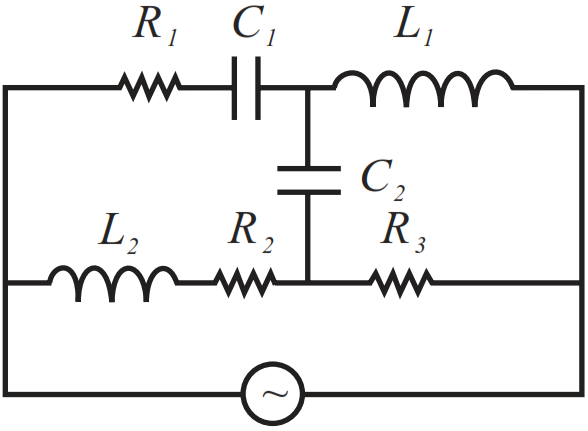
Draw the effective equivalent circuit of the circuit shown in Fig, at very high frequencies and find the effective impedance.