A train is moving with a constant speed along a large circular track. The engine of the train emits a sound of frequency $f$ . The frequency heard by the guard at rear end of the train
Medium
Download our app for free and get started
Veral along line goining
$ = {V_t}\cos \,\,\left( {90 - \theta } \right) - {v_t}\cos \,\,\left( {90 - \theta } \right)$
$=$ Zero $ \Rightarrow {f_{app}} = f$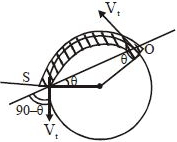

Download our appand get started for free
Experience the future of education. Simply download our apps or reach out to us for more information. Let's shape the future of learning together!No signup needed.*
Similar Questions
- 1A sounding body of negligible dimension emitting a frequency of $150\,\, Hz$ is dropped from a height. During its fall under gravity it passes near a balloon moving up with a constant velocity of $2m/s$ one second after it started to fall.The difference in the frequency observed by the man in balloon just before and just after crossing the body will be : (Given that -velocity of sound $= 300m/s; g = 10m/s^2$)View Solution
- 2Two sources of sound $A$ and $B$ produces the wave of $350 Hz$, they vibrate in the same phase. The particle $P$ is vibrating under the influence of these two waves, if the amplitudes at the point $P$ produced by the two waves is $0.3 mm$ and $0.4 mm,$ then the resultant amplitude of the point $P$ will be when $AP -BP = 25 cm$ and the velocity of sound is $350 m/sec$ .... $mm$View Solution
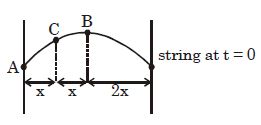
- 3A standing wave is established in single loop. At $t = 0$ , $K.E.$ of string is zero. Choose the correct optionView Solution
- 4View SolutionSound waves in air are
- 5The equation of displacement of two waves are given as ${y_1} = 10\sin \left( {3\pi t + \frac{\pi }{3}} \right)$; ${y_2} = 5(\sin 3\pi t + \sqrt 3 \cos 3\pi t)$. Then what is the ratio of their amplitudesView Solution
- 6Two vibrating strings of the same material but lengths $L$ and $2L$ have radii $2r$ and $r$ respectively. They are stretched under the same tension. Both the strings vibrate in their fundamental modes, the one of length $L$ with frequency $n_1$ and the other with frequency $n_2$. The ratio $n_1/n_2$ is given byView Solution
- 7A standing wave exists in a string of length $150\ cm$ , which is fixed at both ends with rigid supports . The displacement amplitude of a point at a distance of $10\ cm$ from one of the ends is $5\sqrt 3\ mm$ . The nearest distance between the two points, within the same loop and havin displacment amplitude equal to $5\sqrt 3\ mm$ is $10\ cm$ . Find the maximum displacement amplitude of the particles in the string .... $mm$View Solution
- 8$Assertion :$ The pitch of wind instruments rises and that of string instruments falls as an orchestra warms up.View Solution
$Reason :$ When temperature rises, speed of sound increases but speed of wave in a string fixed at both ends decreases. - 9View SolutionDecibel is unit of
- 10The ratio of intensities between two coherent soud sources is $4 : 1$. The differenmce of loudness in $dB$ between maximum and minimum intensities when they interfere in space is:View Solution