A sounding body of negligible dimension emitting a frequency of $150\,\, Hz$ is dropped from a height. During its fall under gravity it passes near a balloon moving up with a constant velocity of $2m/s$ one second after it started to fall.The difference in the frequency observed by the man in balloon just before and just after crossing the body will be : (Given that -velocity of sound $= 300m/s; g = 10m/s^2$)
Medium
Download our app for free and get started
after $1\, sec,$ falling point sound source (with freq $150$ $H z$ ) will attain velocity of $V_{s}=$ $10 m s^{-1},$ and observer sitting on the balloon is coming upward with velocity $V_{o}=$ $2 m s^{-1},$ say frequencies observed
by observer before and after crossing are $n_{1}$ and $n_{2}$ respectively, then
$n_{1}=\frac{300+2}{300-10} 150=156.20 \mathrm{Hz}$
$n_{2}=\frac{300-2}{300+10} 150=144.19 \mathrm{Hz}$
$n_{1}-n_{2}=12 H z(\text {approx})$

Download our appand get started for free
Experience the future of education. Simply download our apps or reach out to us for more information. Let's shape the future of learning together!No signup needed.*
Similar Questions
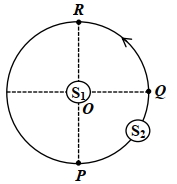
- 1$S_1$ and $S_2$ are two identical sound sources of frequency $656 Hz$. The source $S_1$ is located at $O$ and $S_2$ moves anti-clockwise with a uniform speed $4 \sqrt{2} ms ^{-1}$ on a circular path around $O$, as shown in the figure. There are three points $P, Q$ and $R$ on this path such that $P$ and $R$ are diametrically opposite while $Q$ is equidistant from them. A sound detector is placed at point $P$. The source $S_1$ can move along direction $O P$.View Solution
[Given: The speed of sound in air is $324 ms ^{-1}$ ]
($1$) When only $S_2$ is emitting sound and it is $Q$, the frequency of sound measured by the detector in $Hz$ is. . . . . .
($2$) Consider both sources emitting sound. When $S_2$ is at $R$ and $S_1$ approaches the detector with a speed $4 ms ^{-1}$, the beat frequency measured by the detector is $\qquad$ $Hz$.
- 2View SolutionThe tones that are separated by three octaves have a frequency ratio of
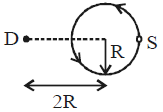
- 3A whistle $S$ of frequency $f$ revolves in a circle of radius $R$ at a constant speed $v$. What is the ratio of largest and smallest frequency detected by a detector $D$ at rest at a distance $2R$ from the centre of circle as shown in figure ? (take $c$ as speed of sound)View Solution
- 4The number of beats produced per second by two vibrations: $x_1 =x_0$ sin $646\pi t$ and $x_2 = x_0 sin 652 \pi t$ isView Solution
- 5If in a stationary wave the amplitude corresponding to antinode is $4 \,cm$, then the amplitude corresponding to a particle of medium located exactly midway between a node and an antinode is ........... $cm$View Solution
- 6What should be the velocity of a sound source moving towards a stationary observer so that apparent frequency is double the actual frequency (Velocity of sound is $v$)View Solution
- 7$Assertion :$ A transverse waves are produced in a very long string fixed at one end. Only progressive wave is observed near the free end.View Solution
$Reason :$ Energy of reflected wave does not reach the free end. - 8The equation of a wave travelling on a string is $y = 4\sin \frac{\pi }{2}\left( {8t - \frac{x}{8}} \right)$. If $x$ and $y$ are in $cm,$ then velocity of wave isView Solution
- 9A transverse harmonic wave on a string is given by $y(x, t)=5 \sin (6 t+0.003 x)$ where $x$ and $y$ are in $cm$ and $t$ in $sec$. The wave velocity is $...........\,ms ^{-1}$.View Solution
- 10The wave function of a pulse is given by $y=\frac{5}{(4 x+6 t)^2}$, where $x$ and $y$ are in metre and $t$ is in second. The velocity of pulse is ......... $m / s$View Solution