MCQ
A train moves from rest with a uniform acceleration $a$ . Attaining a maximum speed $v$ it  starts moving with uniform retardation $a$ . Assuming $s$ = total distance covered in the  unidirectional motion of the train, its total time of journey and maximum speed are  (respectively).
  • A
    $\sqrt {\frac{s}{a}},\sqrt {as}$
  • $2 \sqrt {\frac{s}{a}},\sqrt {as}$
  • C
    $\sqrt {\frac{2s}{a}},\sqrt {as}$
  • D
    $\frac{1}{2} \sqrt {\frac{s}{a}},\sqrt {\frac{as}{2}}$
Answer

Correct option: B.
$2 \sqrt {\frac{s}{a}},\sqrt {as}$
b

Need a full question paper?

Generate a complete, print-ready paper with questions like this in minutes — across 16+ boards, with answer keys.

Start Generating Free

Similar questions

Two constant forces ${F_1} = 2\hat i - 3\hat j + 3\hat k\,$($N$) and ${F_2} = \hat i + \hat j - 2\hat k\,$($N$) act on a body and displace it from the position ${r_1} = \hat i + 2\hat j - 2\hat k\,$($m$) to the position ${r_2} = 7\hat i + 10\hat j + 5\hat k\,$($m$). What is the work done......... $J$
A uniform rope of mass $M$ and length $L$ is fixed at its upper end vertically from a rigid support. Then the tension in the rope at the distance $l$ from the rigid support is $x$
A sphere is rolled on a rough horizontal surface. It gradually slows down and stops. The force of friction tries to:
A transverse wave of amplitude $0.5\, m$ and wavelength $1\, m$ and frequency $2\, Hz$ is propagating in a string in the negative $x-$direction. The expression for this wave is
In a projectile motion, velocity at maximum height is
A body of mass $\mathrm{m}$ is kept on a rough horizontal surface (coefficient of friction $=\mu$ ) A horizontal force is applied on the body, but it does not move. The resultant of normal reaction and the frictional force acting on the object is given by $\mathrm{F},$ where $\mathrm{F}$ is
Under elastic limit the stress is 
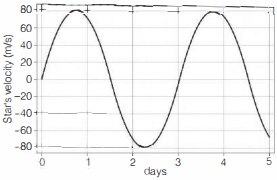
A star of mass $M$ (equal to the solar mass) with a planet (much smaller than the star) revolves around the star in a circular orbit. The velocity of the star with respect to the centre of mass of the star-planet system is shown below. The radius of the planet's orbit is closest to .......... $AU$ $(1 \,AU =$ Earth-Sun distance)
A composite rod made of three rods of equal length and cross-section as shown in the fig. The thermal conductivities of the materials of the rods are $K/2, 5K$ and $K$ respectively. The end $A$ and end $B$ are at constant temperatures. All heat entering the face Agoes out of the end $B$ there being no loss of heat from the sides of the bar. The effective thermal conductivity of the bar is
Of the following thermometers, the one which can be used for measuring a rapidly changing temperature is a
