Question
A transformer is an electrical device which is used for changing the a.c. voltages. It is based on the phenomenon of mutual induction i.e. whenever the amount of magnetic flux linked with a coil changes, an e.m.f. is induced in the neighbouring coil. For an ideal transformer, the resistances of the primary and secondary windings are negligible.
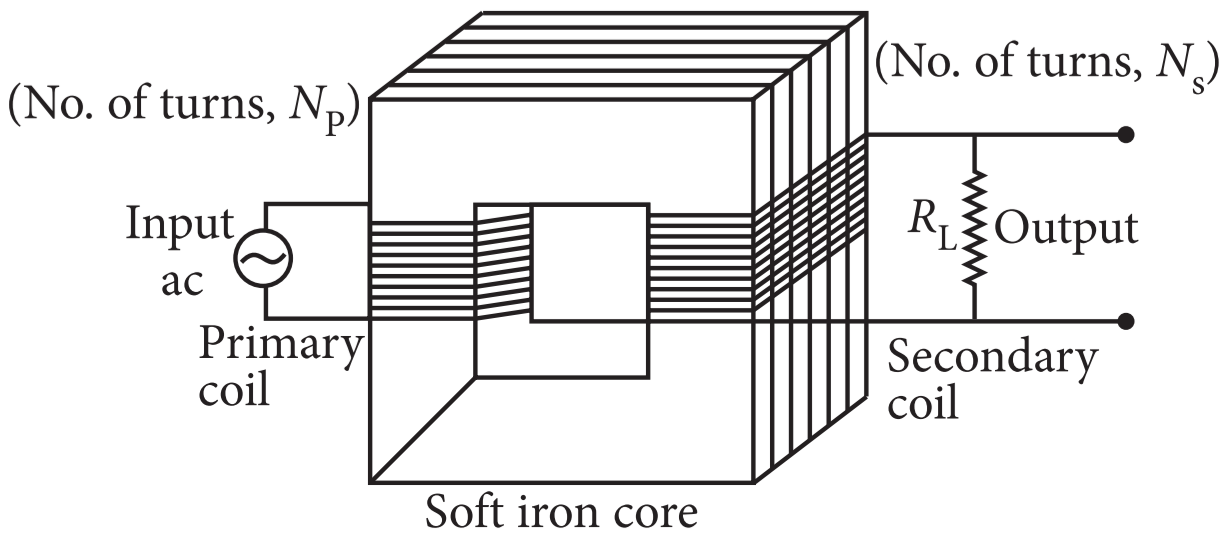
It can be shown that $\frac{\text{E}_\text{S}}{\text{E}_\text{P}}=\frac{\text{I}_\text{P}}{\text{I}_\text{S}}=\frac{\text{n}_\text{S}}{\text{n}_\text{P}}=\text{K}$
where the symbols have their standard meanings.
For a step up transformer, $\text{n}_\text{S} > \text{n}_\text{P}; \text{E}_\text{S} > \text{E}_\text{P}; \text{k} > \text{I}; \therefore \text{I}_\text{S} < \text{I}_\text{P}$
For a step down transformer, $\text{n}_\text{S} > \text{n}_\text{P}; \text{E}_\text{S} > \text{E}_\text{P}; \text{k} > \text{I};$
The above relations are on the assumptions that efficiency of transfonner is 100%.
lnfact, efficiency $\eta=\frac{\text{output power}}{\text{intput power }}=\frac{\text{E}_\text{S}\text{I}_\text{S}}{\text{E}_\text{P}\text{I}_\text{P}}$
  1. Which of the following quantity remains constant in an ideal transformer?
  1. Current.
  2. Voltage.
  3. Power.
  4. All of these.
  1. Transformer is used to.
  1. Convert ac to de voltage.
  2. Convert de to ac voltage.
  3. Obtain desired de power.
  4. Obtain desired ac voltage and current.
  1. The number of tums in primary coil of a transformer is 20 and the number of turns in a secondary is 10. If the voltage across the primary is ac 220V, what is the voltage across the secondary?
  1. ac 100V
  2. ac 120V
  3. ac 110V
  4. ac 220V
  1. In a transformer the number of primary turns is four times that of the secondary turns. Its primary is connected to an a.c. source of voltage V. Then,
  1. Current through its secondary is about four times that of the current through its primary.
  2. Voltage across its secondary is about four times that of the voltage across its primary.
  3. Voltage across its secondary is about two times that of the voltage across its primary.
  4. voltage across its secondary is about $\frac{1}{2\sqrt{2}}$ times that of the voltage across its primary.
  1. A transformer is used to light 100W-110V lamp from 220V mains. If the main current is 0.5A, the efficiency of the transformer is:
  1. 95%
  2. 99%
  3. 90%
  4. 96%

Answer

  1. (c) Power
Explanation:
In an ideal transformer, there is no power loss. The efficiency of an ideal transformer is $\eta=1$ (i.e 100%) i.e. input power = output power.
  1. (d) Obtain desired ac voltage and current.
Explanation:
Transformer is used to obtain desired ac voltage and current.
  1. (c) ac 110V
Explanation:
For a transformer, $\frac{\text{V}_\text{S}}{\text{V}_\text{p}}=\frac{\text{n}_\text{S}}{\text{n}_\text{p}}$
Where N denotes number of turns and V = voltage.
$\therefore{\text{V}_\text{S}}={\text{ac}\ 110}{\text{V}}$
  1. (a) Current through its secondary is about four times that of the current through its primary.
Explanation:
In a transformer the primary and secondary currents are related by,
$\text{I}_\text{S}=\Big(\frac{\text{N}_\text{S}}{\text{N}_\text{P}}\Big)\text{I}_\text{P}$
And the Voltage are related by,
$\text{V}_\text{S}=\Big(\frac{\text{N}_\text{P}}{\text{N}_\text{S}}\Big)\text{V}_\text{P}$
where subscripts p and s refer to the primary and secondary of the transformer.
Here, $\text{V}_\text{P}=\text{V},\frac{\text{N}_\text{P}}{\text{N}_\text{S}}=4\ \therefore\text{I}_\text{P}=4\text{I}_\text{P}$
and, $\text{V}_\text{S}=\Big(\frac{1}{4}\Big)\text{V}=\frac{\text{V}}{4}$
  1. (c) 90%
Explanation:
The efficiency of the transformer is:
$\eta=\frac{\text{output power}(\text{p}_\text{out})}{\text{intput power}(\text{p}_\text{in})}\times100$
Here, $\mathrm{P_{out}= 100W, P_{in}= (220V)(0.5A) = 110W}$
$\therefore\eta=\frac{100\text{W}}{110\text{W}}\times100=90\%$

Need a full question paper?

Generate a complete, print-ready paper with questions like this in minutes — across 16+ boards, with answer keys.

Start Generating Free

Similar questions


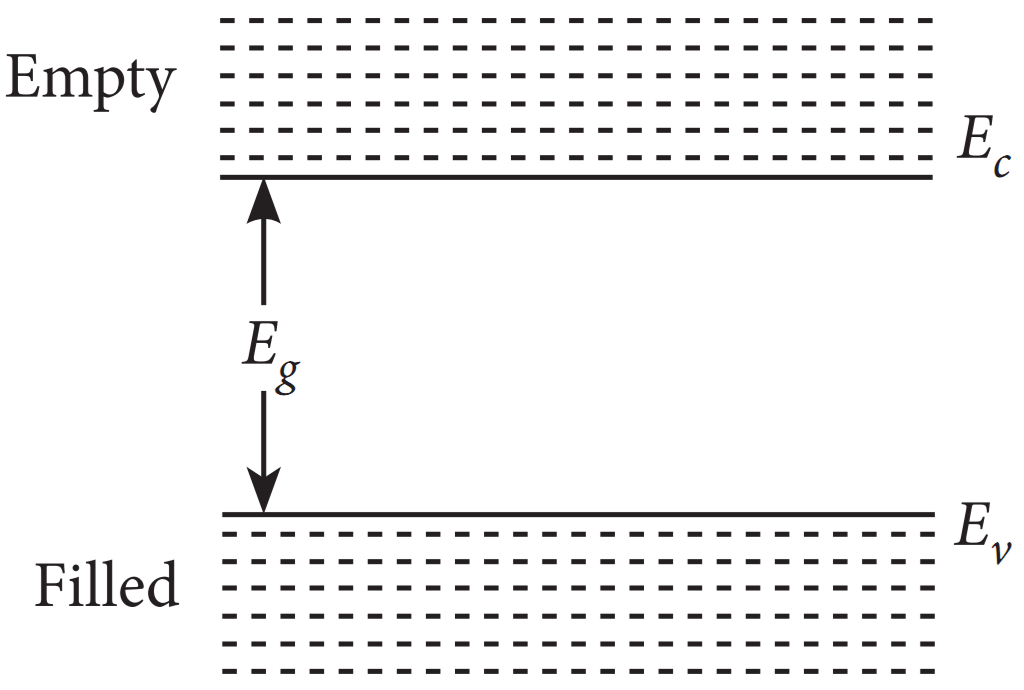
From Bohr's atomic model, we know that the electrons have well defined energy levels in an isolated atom. But due to interatomic interactions in a crystal, the electrons of the outer shells are forced to have energies different from those in isolated atoms. Each energy level splits into a number of energy levels forming a continuous band. The gap between top of valence band and bottom of the conduction band in which no allowed energy levels for electrons can exist is called energy gap.
  1. In an insulator energy band gap is:
  1. $E_g= 0$
  2. $E_g < 3eV$
  3. $E_g > 3eV$
  4. None of the above.
  1. In a semiconductor, separation between conduction and valence band is of the order of:
  1. 0eV
  2. 1eV
  3. 10eV
  4. 50eV
  1. Based on the band theory of conductors, insulators and semiconductors, the forbidden gap is smallest in:
  1. Conductors.
  2. Insulators.
  3. Semiconductors.
  4. All of these.
  1. Carbon, silicon and germanium have four valence electrons each. At room temperature which one of the following statements is most appropriate?
  1. The number of free electrons for conduction is significant only in Si and Ge but small in C.
  2. The number of free conduction electrons is significant in C but small in Si and Ge.
  3. The number of free conduction electrons is negligibly small in all the three.
  4. The number of free electrons for conduction is significant in all the three.
  1. Solids having highest energy level partially filled with electrons are:
  1. Semiconductor.
  2. Conductor.
  3. Insulator.
  4. None of these.
The electron beam in a colour TV is accelerated through 32kV and then strikes the screen. What is the wavelength of the most energetic X-ray photon?
The magnetic moment of the assumed dipole at the earth's centre is $8.0 \times 10^{22}A-m^2$. Calculate the magnetic field B at the geomagnetic poles of the earth. Radius of the earth is 6400km.
Maxwell showed that the speed of an electromagnetic wave depends on the penneability and pennittivity of the medium through which it travels. The speed of an electromagnetic wave in free space is given by $\text{c}=\frac{1}{\sqrt{\mu_0\in_0}}.$ The fact led Maxwell to predict that light is an electromagnetic wave. The emergence of the speed of light from purely electromagnetic considerations is the crowning achievement of Maxwell's electromagnetic theory. The speed of an electromagnetic wave in any medium of permeability $\mu$ and pennittivity $\in$ will be $\frac{\text{c}}{\sqrt{\text{K}\mu_\text{r}}}$ where K is the dielectric constant of the medium and $\mu,$ is the relative permeability.
  1. The dimensions of $\frac{1}{2}\in_0\text{E}^2$ ($\in:$ pennittivity of free space; E = electric field) is:
  1. $MLT^{-1}$
  2. $ML^2T^{-2}$
  3. $ML^{-1}T^{-2}$
  4. $ML^2T^{-1}$
  1. Let $[\in_0]$ denote the dimensional formula of the permittivity of the vacuum. UM = mass, L = length, T = time and A = electric current, then
  1. $[\in_0]=\text{M}^{-1}\text{L}^{-3}\text{T}^2\text{A}$
  2. $[\in_0]=\text{M}^{-1}\text{L}^{-3}\text{T}^4\text{A}^2$
  3. $[\in_0]=\text{MLT}^{-2}\text{A}^{-2}$
  4. $[\in_0]=\text{ML}^{2}\text{A}^{-1}$
  1. An electromagnetic wave offrequency 3MHz passes from vacuum into adielectricmedium with permittivity $\in=4.$ Then
  1. Wavelength and frequency both remain unchanged.
  2. Wavelength is doubled and the frequency remains unchanged.
  3. Wavelength is doubled and the frequency becomes half.
  4. Wavelength is halved and the frequency remains unchanged.
  1. Which of the following are not electromagnetic waves?
  1. Cosmic rays
  2. $\gamma-\text{rays}$
  3. $\beta-\text{rays}$
  4. X-rays
  1. The electromagnetic waves travel with,
  1. The same speed in all media.
  2. The speed oflight $c = 3 \times 10^8ms^{-1}$ in free space.
  3. The speed oflight $c = 3 \times 10^8ms^{-1}$ in solid medium
  4. The speed of light $c = 3 \times 10^8ms^{-1}$ in fluid medium.
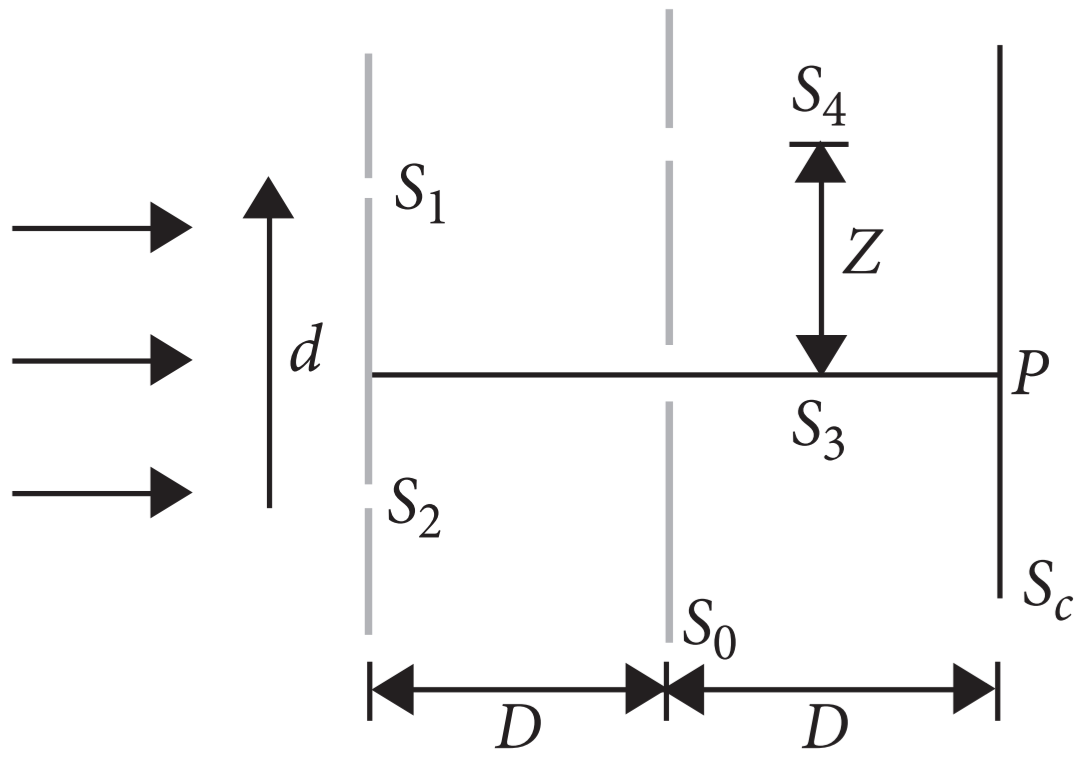
Consider the situation shown in figure. The two slits $S_1$ and $S_1$ placed symmetrically around the central line are illuminated by monochromatic light of wavelength $\lambda$. The separation between the slits is d. The light transmitted by the slits falls on a screen $S_0$ place at a distance D from the slits. The slits $S_3$ is at the central line and the slit $S_4$ is at a distance from $S_3.$ Another screen $S_c$ is placed a further distance D away from $S_c.$
  1. Find the path difference if $\text{z}=\frac{\lambda\text{D}}{2\text{d}}$.
  1. $\lambda$
  2. $\frac{\lambda}{2}$
  3. $\frac{3}{2\lambda}$
  4. $2\lambda$
  1. Find the ratio of the maximum to minimum intensity observed on $S_c$ if $\text{z}=\frac{\lambda\text{D}}{\text{d}}$
  1. 4
  2. 2
  3. $\infty$
  4. 1
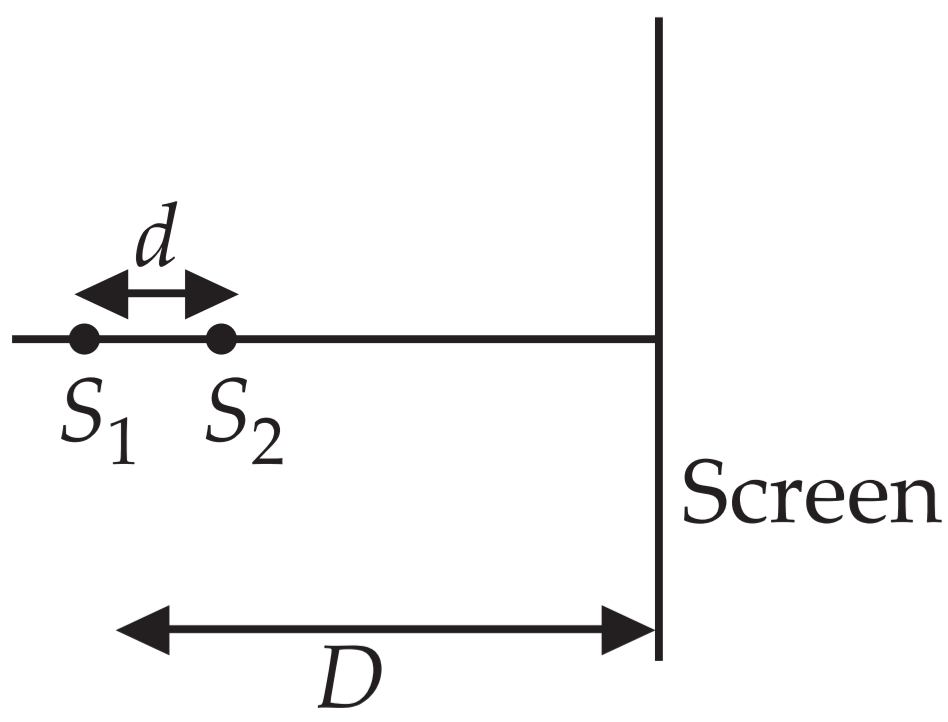
  1. Two coherent point sources $S_1$ and $S_2$ are separated by a small distanced as shown in figure. The fringes obtained on the screen will be:
  1. Concentric circles.
  2. Points.
  3. Straight lines.
  4. Semi-circles.
  1. ln the case of light waves from two coherent sources $S_1$ and $S_2$, there will be constructive interference at an arbitrary point P, if the path difference $S_1P - S_2P$ is:
  1. $\Big(\text{n}+\frac{1}{2}\Big)\lambda$
  2. $\text{n}\lambda$
  3. $\Big(\text{n}-\frac{1}{2}\Big)\lambda$
  4. $\frac{\lambda}{2}$
  1. Two monochromatic light waves of amplitudes $3_A$ and $2_A$ interfering at a point have a phase difference of 60º. The intensity at that point will be proportional to:
  1. $5A^2$
  2. $13A^2$
  3. $7A^2$
  4. $19A^2$
The half-life of ${ }^{226} \mathrm{Ra}$ is 1602 y . Calculate the activity of 0.1 g of $\mathrm{RaCl}_2$ in which all the radium is in the form of ${ }^{226} \mathrm{Ra}$. Taken atomic weight of Ra to be $226 \mathrm{~g} / \mathrm{mol}^{-1}$ and that of Cl to be $35.5 \mathrm{~g} / \mathrm{mol}^{-1}$.
Out of the two magnetic materials, 'A' has relative permeability slightly greater than unity while 'B' has less than unity. Identify the nature of the materials 'A' and 'B'. Will their susceptibilities be positive or negative?
The entering flux from a closed surface is $2 \times 10^3$ Newton-metre ${ }^2 /$ Coulomb and the emerging flux is $8 \times 10^3$ Newton-metre ${ }^2 /$ Coulomb. Find the value of charge enclosed in the surface.
Cloudy nights are warmer than the nights with clean sky. Explain.
In the year 1939, German scientist Otto Hahn and Strassmann discovered that when an uranium isotope was bombarded with a neutron, it breaks into two intermediate mass fragments. It was observed that, the sum of the masses of new fragments formed were less than the mass of the original nuclei. This difference in the mass appeared as the energy released in the process. Thus, the phenomenon of splitting of a heavy nucleus (usually A > 230) into two or more lighter nuclei by the bombardment of proton, neutron $\alpha$-particle, etc. with liberation of energy is called nuclear fission.
$\ _{92}\text{U}^{235}+\ _0\text{n}^{1}\rightarrow_{92}\text{U}^{236} \rightarrow\ _{56}\text{B}^{114}+\ _{36}\text{Kr}^{89}\ +3\ _{0}\text{n}^{1} + \text{Q}$
$\big[\because \ _{92}\text{U}^{236}= \text{Unstable nucleus}\big]$
  1. Nuclear fission can be explained on the basis of.
  1. Millikan's oil drop method
  2. Liquid drop model
  3. Shell model
  4. Bohr's model.
  1. For sustaining the nuclear fission chain reaction in a sample (of small size) of $_{92}^{235}\text{U}$ it is desirable to slow down fast neutrons by.
  1. Friction
  2. Elastic damping/ scattering
  3. Absorption
  4. None of these.
  1. Which of the following is/ are fission reaction(s)?
  1. $_0^1\text{n}\ +\ _{92}^{235}\text{U}\rightarrow\ _{92}^{235}\text{U}\rightarrow\ _{51}^{133}\text{Sb}+\ _{41}^{99}\text{nb}+\ 4_1^0\text{n}$
  2. $_0^1\text{n}\ +\ _{92}^{235}\text{U}\rightarrow\ _{54}^{1.40}\text{Xe}+\ _{38}^{94}\text{Sr}\ +2_0^1\text{n}$
  3. $_1^2\text{H}\ +\ _1^2\text{H}\rightarrow\ _2^3\text{He}+\ _0^1\text{n}$
  1. Both II and III
  2. Both I and III
  3. Only II
  4. Both I and II
  1. On an average, the number of neutrons and the energy of a neutron released per fission of a uranium atom are respectively.
  1. 2.5 and 2 keV
  2. 3 and 1 keV
  3. 2.5 and 2 MeV
  4. 2 and 2 keV
  1. In any fission process, ratio of mass of daughter nucleus to mass of parent nucleus is.
  1. Less than I
  2. Greater than I
  3. Equal to I
  4. Depends o the mass of parent nucleus.