MCQ
A transistor is a/an
  • A
    chip
  • B
    insulator
  • semiconductor
  • D
    metal

Answer

Correct option: C.
semiconductor
c
As transistor is made of two $p-$ types with $n-$ type semiconductor in between or two $n-$ types with $p-$ type in between

Need a full question paper?

Generate a complete, print-ready paper with questions like this in minutes — across 16+ boards, with answer keys.

Start Generating Free

Similar questions

A photon in motion has a mass
Column$-II$ is related to Column$-I$. Join them appropriately :
Column $-I$  Column $-II$ 
$(a)$ When temperature raised Young’s modulus of body $(i)$ Zero
$(b)$ Young’s modulus for air $(ii)$ Infinite
  $(iii)$ Decreases
  $(iv)$Increases
The coefficient of apparent expansion of mercury in a glass vessel is $153 \times 10^{-6} /{ }^{\circ} C$ and in steel vessel is $144 \times 10^{-6} /{ }^{\circ} C$. If $\alpha$ for steel is $12 \times 10^{-6} /{ }^{\circ} C ,$ then that of glass is
A particle is executing simple harmonic motion with a time period $T.$ At time $t = 0$, it is at its position of equilibrium. The kinetic energy-time graph of the particle will look like
A $500 \,\mu F$ capacitor is charged at a steady rate of $100\, \mu C/sec$. The potential difference across the capacitor will be $10\, V$ after an interval of.....$sec$
The total work done on a particle is equal to the change in its kinetic energy. This is applicable
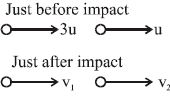
Two smooth objects with a coefficient of restitution $e,$ collide directly and bounce as shown. Newton's law of restitution gives
Half life of radioactive element depends upon
An electron falls through a small distance in a uniform electric field of magnitude $2 \times {10^4}N{C^{ - 1}}$. The direction of the field is reversed keeping the magnitude unchanged and a proton falls through the same distance. The time of fall will be
If an electron in a hydrogen atom jumps from the $3^{rd}$ orbit to the $2^{nd}$ orbit, it emits a photon of wavelength $\lambda$. when it jumps from the $4^{th}$ orbit to the $3^{rd}$ orbit, the corresponding wavelength of the photon will be