Question
A transverse harmonic wave on a string is described by $\text{y}(\text{x},\text{t})=3.0\sin(36\ \text{t}+0.018\text{x}+\pi/ 4)$ where x and y are in cm and t is in s. The positive direction of x is from left to right.
  1. The wave is travelling from right to left.
  2. The speed of the wave is 20m/ s.
  3. Frequency of the wave is 5.7Hz.
  4. The least distance between two successive crests in the wave is 2.5cm.
Answer

  1. The wave is travelling from right to left.
  2. The speed of the wave is 20m/ s.
  3. Frequency of the wave is 5.7Hz.

Explanation:

The standard from of a wave propagated from left to right i. e., in+ ve direction

$\text{y}=\text{a}\sin(\omega\text{t}-\text{k}\text{x}+\phi)$ and

$\text{y}=3.0\sin\Big(36\text{t}+0.018\text{x}+\frac{\pi}{4}\Big)$ (given)

  1. As in given equation x is in positive sigh so given wave travalling from right to left verifies option (a)
  2. $\text{k}=0.018=\frac{2\pi}{\lambda}=0.018\Rightarrow\lambda=\frac{2\pi}{0.018}$

$\therefore\text{v}=\text{v}\lambda=\frac{18}{\pi}\times\frac{2\pi}{0.018}=2000\text{cm}/ \ \text{s}=20\text{m/ s}$

Verifies the option (b)

  1. $\omega=36$ or $2\pi\text{n}=36$ or $\text{v}=\frac{36}{2\pi}=\frac{18}{3.14}=5.7\text{Hz}$

Verifies option (c) n = 5.7Hz

Need a full question paper?

Generate a complete, print-ready paper with questions like this in minutes — across 16+ boards, with answer keys.

Start Generating Free

Similar questions

The height $y$ and the distance $x$ along the horizontal plane of a projectile on a certain planet (with no surrounding atmosphere) are given by $y = (8t - 5{t^2})$ meter and $x = 6t\, meter$, where $t$ is in second., the acceleration due to gravity is given by ......... $m/{\sec ^2}$
The upper end of a wire $1\,m$ long and $4\,mm$ radius is clamped. The lower end is twisted by an angle of $30^o$. The angle of shear is ...... $^o$
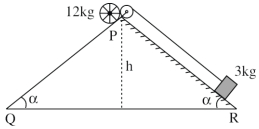
A rolling wheel of $12 \,kg$ is on an inclined plane at position $P$ and connected to a mass of $3 \,kg$ through a string of fixed length and pulley as shown in figure. Consider $PR$ as friction free surface. The velocity of centre of mass of the wheel when it reaches at the bottom $Q$ of the inclined plane $P Q$ will be $\frac{1}{2} \sqrt{ xgh } \,m / s$. The value of $x$ is.............
Velocity $(v)$ and acceleration $(a)$ in two systems of units $1$ and $2$ are related as $V _{2}=\frac{ n }{ m ^{2}} v _{1}$ and $a_{2}=\frac{a_{1}}{m n}$ respectively. Here $m$ and $n$ are constants. The relations for distance and time in two systems respectively are
Neglecting the air resistance, the time of flight of a projectile is determined by
Two waves having equations

${x_1} = a\sin (\omega \,t + {\phi _1})$, ${x_2} = a\sin \,(\omega \,t + {\phi _2})$

If in the resultant wave the frequency and amplitude remain equal to those of superimposing waves. Then phase difference between them is

A large horizontal surface moves up and down in $S.H.M.$ with an amplitude of $1\, cm$. If a mass of $10\, kg$ (which is placed on the surface is to remain continuously in contact with it, the maximum frequency of $S.H.M.$ will be .... $Hz$
A man standing on a road has to hold his umbrella at 30° with the vertical to keep the rain away. He throws the umbrella and starts running at 10kmh-1.
He finds that raindrops are hitting his head vertically. The actual speed of raindrops is:
In an inelastic collision:
  1. The initial kinetic energy is equal to the final kinetic energy.
  2. The final kinetic energy is less than the initial kinetic energy.
  3. The kinetic energy remains constant.
  4. The kinetic energy first increases then decreases.
Two pendulums differ in lengths by $22\,cm$ . They oscillate at the same place such that one of them makes $15\,oscillations$ and the other makes $18\,oscillations$ during the same time. The lengths (in $cm$ ) of the pendulums are