Questions

M.C.Q (1 Marks)

Take a timed test

17 questions · self-marked practice — reveal the answer and mark yourself.

Question 11 Mark
A string of mass 2.5kg is under a tension of 200N. The length of the stretched string is 20.0m. If the transverse jerk is struck at one end of the string, the disturbance will reach the other end in:
  1. One second
  2. 0.5 second
  3. 2 seconds
  4. Data given is insufficient.
Answer
  1. 0.5 second

Explanation:

M = mass string 2.5kg, l = 20m 

M = mas per unit length $=\frac{\text{M}}{\text{l}}=\frac{2.5}{20}=0.125\text{kg/ m}$

$\text{v}=\sqrt{\frac{\text{T}}{\mu}}=\sqrt{\frac{200}{0.125}}=\sqrt{1600}=40\text{m/ s}$

time $= \frac{\text{distance}}{\text{speed}}=\frac{20\text{m}}{40\text{m/ s}}=\frac{1}{2}\sec=0.5\sec.$
View full question & answer
Question 21 Mark
Water waves produced by a motor boat sailing in water are:
  1. Neither longitudinal nor transverse.
  2. Both longitudinal and transverse.
  3. Only longitudinal.
  4. Only transverse.
Answer
  1. Both longitudinal and transverse.

Explanation:

As the waves are produced by motor boat on surface as well as inside water, the waves are both, transverse as well as longitudinal.

View full question & answer
Question 31 Mark
Which of the following statements are true for wave motion:
  1. Mechanical transverse waves can propagate through all mediums.
  2. Longitudinal waves can propagate through solids only.
  3. Mechanical transverse waves can propagate through solids only.
  4. Longitudinal waves can propagate through vacuum.
Answer
  1. Mechanical transverse waves can propagate through solids only.

Exlanation:

In case of mechanical transverse wave propagates through a medium, the medium particles oscillate right angles to the direction of wave motion or energy propagation. It travels in the form of crests and troughs.

When mechanical transverse wave propagates through a medium element of the medium is subjected to shearing stress. Solids and strings have shear modulus, that is why, sustain shearing stress. Fluids have no shape of their own, they yield to shearing stress. Transverse waves can be transmitted through solids, they can be setup on the surface of liquids. But they cannot be transmitted into liquids and gases.

View full question & answer
Question 41 Mark
Speed of sound waves in a fluid depends upon:
  1. Directty on density of the medium.
  2. Square of Bulk modulus of the medium.
  3. Inversly on the square root of density.
  4. Directly on the square root of bulk modulus of the medium.
Answer
  1. Inversly on the square root of density.
  2. Directly on the square root of bulk modulus of the medium.

Explanation:

Speed od sound wave in fluid of bulk modules k and density $\rho$ is given by $\text{v}=\sqrt{\frac{\text{k}}{\rho}}$

so $\text{v}=\sqrt{\text{k}}$ (if $\rho$ is constant)

And $\text{v}=\sqrt{\frac{1}{\rho}}$ (if k is constann)

so verifies the option (c) and (d).

View full question & answer
Question 51 Mark
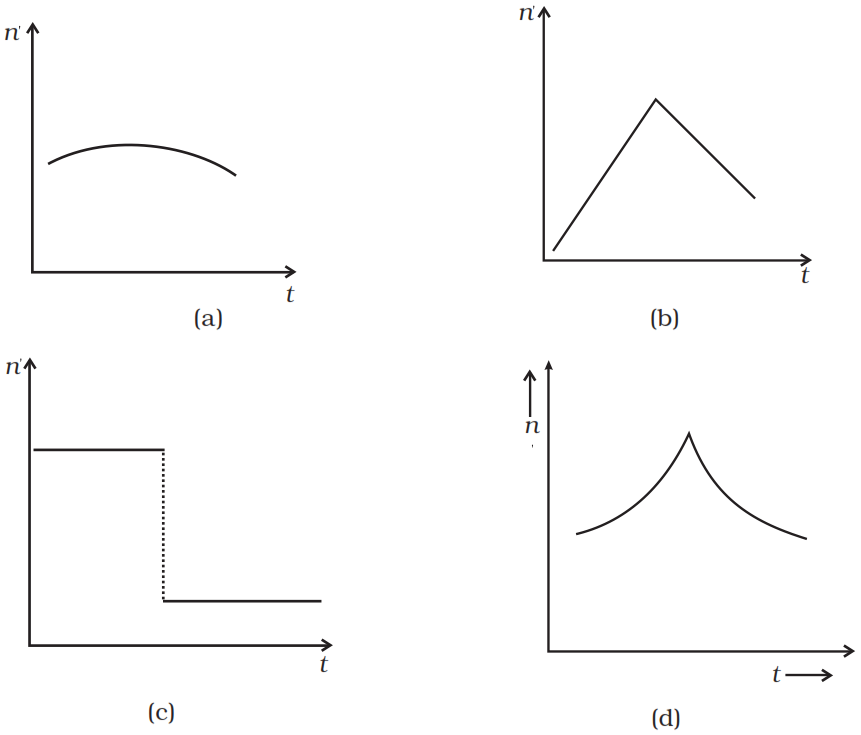
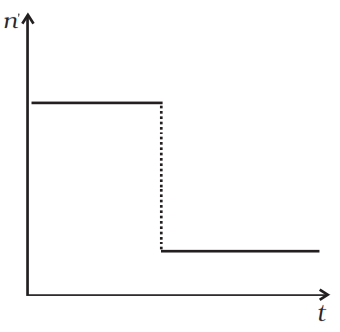
A train whistling at constant frequency is moving towards a station at a constant speed V. The train goes past a stationary observer on the station. The frequency n′ of the sound as heard by the observer is plotted as a function of time t Identify the expected curve:

Answer
  1.  

Explanation:

When qbserver is at rest and source of sound id moving towards observer then observed frequency n'.

$\text{n}'=\Big(\frac{\text{v}}{\text{V}-\text{v}_\text{s}}\Big)\text{n}_0$

Where n0 original frequency of source of sound

v = speed of sound in medium

$\therefore​​​​​​\text{n}'>\text{n}_0\ \ \text{v}_\text{s}=$ speed of source

When source is moving away from observer

$\text{n}'=\frac{\text{v}}{(\text{v}+\text{v}_\text{s})}\text{n}_0\ \text{n}''<\text{n}_0$

Hence, the frequencies in both cases are same and $\text{n}'>\text{n}''.$ so graph (c) verifies the answer.

View full question & answer
Question 61 Mark
During propagation of a plane progressive mechanical wave:
  1. All the particles are vibrating in the same phase.
  2. Amplitude of all the particles is equal.
  3. Particles of the medium executes S.H.M.
  4. Wave velocity depends upon the nature of the medium.
Answer
  1. Amplitude of all the particles is equal.
  2. Particles of the medium executes S.H.M.
  3. Wave velocity depends upon the nature of the medium.

Explanation:

During propagation of mechanical wave each particles displaces from zero to maximum i.e., upto amplitude So amplitude of each particle is equal. Verifies the option (b).

For progressive wave medium particles oscillates about their mean position in which restoring force $\text{F}\propto(-\text{y}).$ So motion of medium particles is simple harmonic motion. So verifies the option(c).For progressive wave propagating in a medium of density $(\rho)$ and Bulk modulus k the velocity $(\nu)$

As the depends on k and $(\rho)$ and k, $(\rho)$ are different for different medium so of wave depends on nature of medium, hence, verifies the option (d).

View full question & answer
Question 71 Mark
Which of the following statements are true for a stationary wave?
  1. Every particle has a fixed amplitude which is different from the amplitude of its nearest particle.
  2. All the particles cross their mean position at the same time.
  3. All the particles are oscillating with same amplitude.
  4. There is no net transfer of energy across any plane.
  5. There are some particles which are always at rest.
Answer
  1. Every particle has a fixed amplitude which is different from the amplitude of its nearest particle
  1. All the particles cross their mean position at the same time.  
  1.  There is no net transfer of energy across any plane.
  1.  There are some particles which are always at rest.

Explanation:

In stationary waves $[\text{y}(\text{x, t})=\text{a}\sin\text{kx}\cos\omega\text{t}]$ the particles between two nodes vibrates with different amplitude which increases fron nodes.

The amplitude of a particle will remain constant a cos kx, but varies with $\lambda$

$\because\text{k}=\frac{2\pi}{\lambda}.$ Hence verifies the option (a)

particles between two nodes are in same phase i.e., motion of particles between two nodes will be either upward or downward and crosses the mean position at same time. Hence the verifies option (b)

Hence the reject option (c)

As the particles at nodes are rest so energy does not transfer verifies option (d)

The amplitude of particles at nodes has amplitude zero verifies option (e)

View full question & answer
Question 81 Mark
Change in temperature of the medium changes:
  1. Frequency of sound waves.
  2. Amplitude of sound waves.
  3. Wavelength of sound waves.
  4. Loudness of sound waves.
Answer
  1. Wavelength of sound waves.

Explanation:

Speed of sound wave in amedium $\text{v}=\sqrt{\frac{\gamma\ \text{RT}}{\text{M}}}.$ here $\gamma,\text{R}$ and M are constent.

Hence, $\text{v}\propto\sqrt{\text{T}}$ (where T is tempreature of the medium)

It mence when temprature changes, speed also changes.

As, $\text{v}=\text{f}\lambda,$ where f is frequency and $\lambda$ is wavelength.

As frequency (f) remains fixed, $\text{v}\propto\lambda$ or $\lambda$ hence wavelength $(\lambda)$changes.

Hence verifies the option (c).

View full question & answer
Question 91 Mark
The displacement of a string is given by $\text{y}(\text{x, t})=0.06\sin(2\pi\text{x}/ 3)\cos(120\pi\text{t})$ where x and y are in m and t in s. The length of the string is 1.5m and its mass is $3.0\times10^{-2}\text{kg}$
  1. It represents a progressive wave of frequency 60Hz.
  2. It represents a stationary wave of frequency 60Hz.
  3. It is the result of superposition of two waves of wavelength 3m, frequency 60Hz each travelling with a speed of 180m/ s in opposite direction.
  4. Amplitude of this wave is constant.
Answer
  1. It represents a stationary wave of frequency 60Hz.
  2. It is the result of superposition of two waves of wavelength 3m, frequency 60Hz each travelling with a speed of 180m/ s in opposite direction.

Explanation:

We know thet standard equation of stationary wave is $\text{y}(\text{x, t})=\text{a}\sin(\text{kx})\cos(\omega\text{t})$ and given equation is $\text{y}(\text{x, t})=0.06\sin\Big(\frac{2\pi}{3}\Big)\cos[9120\pi)\text{t})$

  1. Comparring both equation $\omega=120\pi$

$2\pi\text{v}=120\pi$ or $\text{v}=\frac{120}{2}=60\text{Hz}$

Verifies the option (b).

  1. $\frac{2\pi}{\lambda}=\text{k}$ from $\text{k}=\frac{2\pi}{3}$

$\therefore\frac{2\pi}{\lambda}=\frac{2\pi}{3}$

$\Rightarrow\lambda=3\text{m},\ \text{v}=60\text{Hz}$

speed $\text{v}=\text{v}\lambda=60\times3=180\text{m/ s}.$ Hence, verifies the option (c).

View full question & answer
Question 101 Mark
With propagation of longitudinal waves through a medium, the quantity transmitted is:
  1. Matter.
  2. Energy.
  3. Energy and matter.
  4. Energy, matter and momentum.
Answer
  1. Energy.

Explanation:

During propagation of any wave in a medium only energy is transmitted from one point to another. Matter does not change its own position it, vibrates about its mean position only.

View full question & answer
Question 111 Mark
A sound wave is passing through air column in the form of compression and rarefaction. In consecutive compressions and rarefactions:
  1. Density remains constant.
  2. Boyle’s law is obeyed.
  3. Bulk modulus of air oscillates.
  4. There is no transfer of heat.
Answer
  1. There is no transfer of heat.

Explanation:

  1. The density of medium particles are maximum and minimum at compression and rarefaction point, so rejects option (a).
  2. Also density changes very rapidly, so temperature of medium increases. So, rejects option (b).
  3. Bulk modules of air remains constant, rejects option (c).
  4. The time of compressions and rarefaction is very small so heat does not transfer.
View full question & answer
Question 121 Mark
Sound waves of wavelength $\pi$ travelling in a medium with a speed of v m/ s enter into another medium where its speed is 2v m/ s. Wavelength of sound waves in the second medium is:

  1. $\pi$

  2. $\frac{\pi}{2}$

  3. $2\pi$

  4. $4\pi$

Answer
  1. $2\pi$

Explanation:

When wave passes from one medium to another its frequency (v) does not chang but its velocity and wavelength changs.

$\text{v}=\text{v}\lambda$ or $\text{v}=\frac{\text{v}}{\lambda}$

$\frac{\text{v}}{\lambda}=\frac{2\text{v}}{\lambda_2}\Rightarrow\lambda_2=2\lambda.$

Hence verifies the correct option (c)

View full question & answer
Question 131 Mark
A transverse harmonic wave on a string is described by $\text{y}(\text{x},\text{t})=3.0\sin(36\ \text{t}+0.018\text{x}+\pi/ 4)$ where x and y are in cm and t is in s. The positive direction of x is from left to right.
  1. The wave is travelling from right to left.
  2. The speed of the wave is 20m/ s.
  3. Frequency of the wave is 5.7Hz.
  4. The least distance between two successive crests in the wave is 2.5cm.
Answer
  1. The wave is travelling from right to left.
  2. The speed of the wave is 20m/ s.
  3. Frequency of the wave is 5.7Hz.

Explanation:

The standard from of a wave propagated from left to right i. e., in+ ve direction

$\text{y}=\text{a}\sin(\omega\text{t}-\text{k}\text{x}+\phi)$ and

$\text{y}=3.0\sin\Big(36\text{t}+0.018\text{x}+\frac{\pi}{4}\Big)$ (given)

  1. As in given equation x is in positive sigh so given wave travalling from right to left verifies option (a)
  2. $\text{k}=0.018=\frac{2\pi}{\lambda}=0.018\Rightarrow\lambda=\frac{2\pi}{0.018}$

$\therefore\text{v}=\text{v}\lambda=\frac{18}{\pi}\times\frac{2\pi}{0.018}=2000\text{cm}/ \ \text{s}=20\text{m/ s}$

Verifies the option (b)

  1. $\omega=36$ or $2\pi\text{n}=36$ or $\text{v}=\frac{36}{2\pi}=\frac{18}{3.14}=5.7\text{Hz}$

Verifies option (c) n = 5.7Hz

View full question & answer
Question 141 Mark
The transverse displacement of a string (clamped at its both ends) is given by $\text{y}(\text{x, t})=0.06\sin(1\pi\text{x/ 3})\cos(120\pi\text{t}).$
All the points on the string between two consecutive nodes vibrate with
  1. Same frequency.
  2. Same phase.
  3. Same energy.
  4. Different amplitude.
Answer
  1. Same frequency.
  1. Same phase. 
  1. Different amplitude.

Explanation:

The frequencies of all particles are same, verifies the option (a).  

particles between any two consecutive nodes vibrates either upside or downside having sameb phase $120\pi\text{t}$ ay atime, verifies the option (b)

particles have ditternt energies. so rejects the option (c)

As the amplitude of different particles are diffrent between two nodes energy (E)  $\propto\text{A}^2.$ verifies the option (d)

View full question & answer
Question 151 Mark
Equation of a plane progressive wave is given by $\text{y}=0.6\sin2\pi\Big(\text{t}-\frac{\text{x}}{2}\Big).$ On reflection from a denser medium its amplitude becomes 2/3 of the amplitude of the incident wave. The equation of the reflected wave is:

  1. $\text{y}=0.6\sin2\pi\Big(\text{t}+\frac{\text{x}}{2}\Big)$

  2. $\text{y}=-0.4\sin2\pi\Big(\text{t}+\frac{\text{x}}{2}\Big)$

  3. $\text{y}=0.4\sin2\pi\Big(\text{t}+\frac{\text{x}}{2}\Big)$

  4. $\text{y}=-0.4\sin2\pi\Big(\text{t}-\frac{\text{x}}{2}\Big)$

Answer
  1. $\text{y}=-0.4\sin2\pi\Big(\text{t}+\frac{\text{x}}{2}\Big)$

Explanation:

After reflection of wave changes by phase 180°

$\text{y}_\text{i}=0.6\sin2\pi\Big[\text{t}+\frac{\text{x}}{2}\Big]$

$\text{y}_\text{r}\Big(\frac{2}{3}\times0.6\Big)\sin2\pi\Big[\pi+\text{t}+\frac{\text{x}}{2}\Big]$

$\text{y}_\text{r}=-0.4\sin2\pi\Big(\text{t}+\frac{\text{x}}{2}\Big).$ Hence verifies the option (b).

View full question & answer
Question 161 Mark
A train, standing in a station yard, blows a whistle of frequency 400Hz in still air. The wind starts blowing in the direction from the yard to the station with a speed of 10m/ s. Given that the speed of sound in still air is 340m/ s,
  1. The frequency of sound as heard by an observer standing on the platform is 400Hz.
  2. The speed of sound for the observer standing on the platform is 350m/ s.
  3. The frequency of sound as heard by the observer standing on the platform will increase.
  4. The frequency of sound as heard by the observer standing on the platform will decrease.
Answer
  1. The frequency of sound as heard by an observer standing on the platform is 400Hz.
  2. The speed of sound for the observer standing on the platform is 350m/ s.

Explanation:

As the disatance between listener and source does not change so frequency of sound does not change the as heard listener. i.e.,he heard $\text{v}_0=400\text{Hz}.$ verifies option(a)

$\text{v}_0=400\text{Hz}$ frequency of source of sound.

Velocity of wind $\text{v}_\text{w}=10\text{m/ s}$ from source of listenr.

Speed of sound in still air $= \text{v}_\text{s}=340\text{m/ s}$

As the listenner is standing on platfrom.

Speed od sound with respect to listener $\text{v}_\text{s}+\text{v}_\text{w}=340+10=350\text{m/ s}$

Verifies the option (b)

Reject the option (c)and (d) as it constant $\text{v}_0=400\text{Hz}$

View full question & answer
Question 171 Mark
Speed of sound wave in air:
  1. Is independent of temperature.
  2. Increases with pressure.
  3. Increases with increase in humidity.
  4. Decreases with increase in humidity.
Answer
  1. Increases with increase in humidity.

Explanation:

Speed of sound (longitudinal) wave in air is $\text{v}=\sqrt{\frac{\lambda\text{p}}{\text{p}}}.$ the density of water vapours is less (rises up) than the air so on increasing humidity, the density of medium decrease in turn increases the speed of sound in air by $\text{v}=\propto\frac{1}{\sqrt{\text{p}}}$ (relation).

Hence verifies the option (c).

View full question & answer
M.C.Q (1 Marks) - Physics STD 11 Science Questions - Vidyadip