Question
Explain internal reflection and total internal reflection and also derive the necessary formula for it.

Answer

→When a ray of light travels from an optically denser medium to a rarer medium at the interface, it is partly reflected back into the same medium and partly refracted to the second medium. This reflection is called the internal reflection.
→When a ray of light enters from a denser medium to a rarer medium it bends away from the normal.
Image
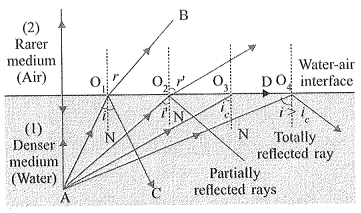
→$AO _1$ is the incident ray to ray $AO _1 B . O _1 C$ is partially reflected and $O _1 B$ is the partially refracted ray. Here, the ray passes from denser medium to the rarer medium, so incidence angle $(i) <$ refraction angle $(r)$.
→As we move from $O _1$ to $O _2, O _3 \ldots$. the value of incidence angle increases, As a result the value of refraction angle also increases.
→The angle of refraction is $90^{\circ}$ for the ray $AO _3$.
→Here the refracted ray becomes parallel to the surface separating the two media. This is shown in figure by the ray $AO _3 D$.
→The angle of incidence for which the refraction angle becomes $\frac{\pi}{2}$, that incidence angle is called critical angle.
→If the angle of incidence is increased still further (ray $AO _4$ ) refraction is not possible and the incident ray is totally reflected. This is called total internal reflection.
→According to Snell's law at point $O _3$,
$\begin{aligned}& n_1 \sin i_{ C }=n_2 \sin 90^{\circ} \\\therefore & \sin i_{ C }=\frac{n_2(1)}{n_1} \\\therefore & \sin i_{ C }=\frac{n_2}{n_1}=n_{21}\end{aligned}$
(where, $n_{21}$ is refractive index of medium 2 with respect to medium 1)
→If $n_2=1$ (air) and $n_1=n$, then
$\therefore \sin i_{ C }=\frac{1}{n}$

Need a full question paper?

Generate a complete, print-ready paper with questions like this in minutes — across 16+ boards, with answer keys.
Start Generating Free

Similar questions

Find the binding energy per nucleon of $\text{ }^{197}_{79}\text{Au}$ if its atomic mass is 196.96u.
A string of length 40cm and weighing 10g is attached to a spring at one end and to a fixed wall at the other end. The spring has a spring constant of 160N/m and is stretched by 1.0cm. If a wave pulse is produced on the string near the wall, how much time will it take to reach the spring?
Why is it not possible to make permanent magnets from paramagnetic materials?
A myopic person has been using spectacles of power –1.0 dioptre for distant vision. During old age he also needs to use separate reading glass of power + 2.0 dioptres. Explain what may have happened.
Consider a radioactive nucleus A which decays to a stable nucleus C through the following sequence:
A → B → C
Here B is an intermediate nuclei which is also radioactive. Considering that there are $N_0$ atoms of A initially, plot the graph showing the variation of number of atoms of A and B versus time.
  1. In Young's double slit experiment, two slits are 1 mm apart, and the screen is placed 1 m away from the slits. Calculate the fringe width when light of wavelength 500 nm is used.
  2. What should be the width of each slit in order to obtain 10 maxima of the double slits pattern within the central maximum of the single slit pattern?
Define an equipotential surface. Draw equipotential surface:
  1. In the case of a single point charge and,
  2. In a constant electric field in Z-direction.
Why the equipotential surfaces about a single charge are not equidistant?
  1. Can electric field exist tangential to an equipotential surface? Give reason.
Consider a sample of oxygen at 300K. Find the average time taken by a molecule to travel a distance equal to the diameter of the earth.
A hollow charged conductor has a tiny hole cut into its surface. Show that the electric field in the hole is $(\sigma /2ε_0)$ $\hat{\text{n}}$ , where $\hat{\text{n}}$ is the unit vector in the outward normal direction, and σ is the surface charge density near the hole.
Estimate the proportion of boron impurity whieh will increase the conductivity of a pure silicon sample by a factor of 100. Assume that each boron atom creates a hole and the concentration of holes in pure silicon at the same temperature is $7 \times 10^{15}$ holes per cubic metre. Density of silicon is $5 \times 10^{21}$ atoms per cubic metre.