A triangular lamina of area $A$ and height h is immersed in a liquid of density $\rho $ in a vertical plane with its base on the surface of the liquid. The thrust on the lamina is
Medium


Download our appand get started for free
Experience the future of education. Simply download our apps or reach out to us for more information. Let's shape the future of learning together!No signup needed.*
Similar Questions
- 1An open $U$-tube contains mercury. When $13.6 \,cm$ of water is poured into one of the arms of the tube, then the mercury rise in the other arm from its initial level is ....... $cm$View Solution
- 2A $U-$ tube containing a liquid moves with a horizontal acceleration a along a direction joining the two vertical limbs. The separation between these limbs is $d$ . The difference in their liquid levels isView Solution
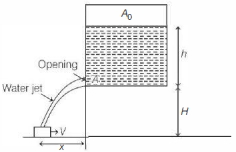
- 3Consider the configuration of a stationary water tank of cross-section area $A_{0}$ and a small bucket as shown in figure below; the speed $v$ is .......... $m/s$ of the bucket, so that the water leaking out of a hole of cross-section area $A$ (as shown) from the water tank does not fall outside the bucket? (Take, $h=5 \,m , H=5 \,m , g=10 \,m / s ^{2}, A=5 \,cm ^{2}$ and $\left.A_{0}=500 \,cm ^{2}\right)$.View Solution
- 4Water is filled in a container upto height of $3\,m$. A small hole of area $‘A_0’$ is punched in the wall of the container at a height $52.5\, cm$ from the bottom. The cross sectional area of the container is $A$. If $A_0/A = 0.1$ then $v^2$ is......... $m^2/s^2$ (where $v$ is the velocity of water coming out of the hole)View Solution
- 5The reading of a spring balance when a block is suspended from it in air is $60 \,N$. This reading is changed to $40 \,N$ when the block is submerged in water. The specific gravity of the block must be therefore ............View Solution
- 6$Assertion :$ The buoyant force on a submerged rigid object can be considered to be acting at the centre of mass of the object.View Solution
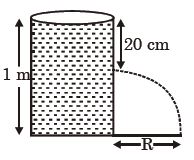
$Reason :$ For a rigid body a force field distributed uniformly through its volume can be considered to be acting at the centre of mass of the body. - 7A tank is filled with water upto a height $1\,m$. A hole is made at a distance $20\, cm$ from top. Find, the horizontal distance from the base of the tank, where the water strikes the ground. ......... $cm$View Solution
- 8Alarge tank is filled with water to a height $H$.A small hole is made at the base of the tank. It takes $T_1$ time to decrease the height of water to $H/ \eta , (\eta > 1)$ and it takes $T_2$ time to take out the rest of water. If $T_1 = T_2$ , then the value of $\eta$ is :View Solution
- 9A block of wood floats in water with $\frac{4}{5}^{th}$ of its volume submerged, but it just floats in another liquid. The density of liquid is $($in $kg / m ^3 )$View Solution
- 10View SolutionA cork is submerged in water by a spring attached to the bottom of a bowl. When the bowl is kept in an elevator moving with acceleration downwards, the length of spring