An open $U$-tube contains mercury. When $13.6 \,cm$ of water is poured into one of the arms of the tube, then the mercury rise in the other arm from its initial level is ....... $cm$
Medium
Download our app for free and get started
(b)
$P_A+(\rho g h)_{\text {water }}-(\rho g h)_{\text {Mercury }}=P_B$
$(\rho g h)_{\text {water }}=(\rho g h)_{\text {Mercury }}$
$10,00 \times g \times 13.6=13660 \times g \times 2 y$
$y=\frac{1}{2} \Rightarrow y=0.5\,cm$

Download our appand get started for free
Experience the future of education. Simply download our apps or reach out to us for more information. Let's shape the future of learning together!No signup needed.*
Similar Questions
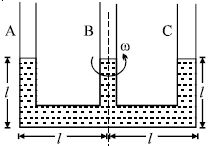
- 1Figure shows a three arm tube in which a liquid is filled upto levels of height $l$. It is now rotated at an angular frequency $\omega$ about an axis passing through arm $B$. The angular frequency $\omega$ at which level of liquid in arm $B$ becomes zero.View Solution
- 2If velocity of flow is $4 \,m / s$, then velocity head is .........$m$View Solution
- 3Water falls down a $500.0 \,m$ shaft to reach a turbine which generates electricity. ................ $m^3$ water must fall per second in order to generate $1.00 \times 10^9 \,W$ of power ? (Assume $50 \%$ efficiency of conversion and $\left.g=10 \,ms ^{-2}\right)$View Solution
- 4A block of ice floats on a liquid of density $1.2$ in a beaker then level of liquid when ice completely meltView Solution
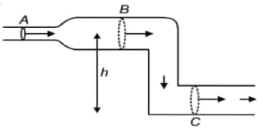
- 5Water is flowing through a channel (lying in a vertical plane) as shown in the figure. Three sections $A, B$ and $C$ are shown. Sections $B$ and $C$ have equal area of cross section. If $P_A, P_B$ and $P_C$ are the pressures at $A, B$ and $C$ respectively thenView Solution
- 6A cyclindrical vessel of cross-sectional area $1000$ $cm^2$, is fitted with a frictionless piston of mass $10$ $kg$, and filled with water completely.A small hole of cross-sectional area $10$ $mm^2$ is opened at a point $50$ $cm$ deep from the lower surface of the piston. The velocity of efflux from the hole will be ........... $m/s$View Solution
- 7A cubical block of wood of edge $10$ $cm$ and mass $0.92$ $kg$ floats on a tank of water with oil of rel. density $0.6$ to a depth of $4$ $cm$ above water. When the block attains equilibrium with four of its sides edges verticalView Solution
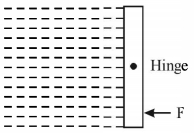
- 8A square gate of size $1\,m \times 1\,m$ is hinged at its mid-point. A fluid of density $\rho$ fills the space to the left of the gate. The force F required to hold the gate stationary isView Solution
- 9A tank is filled with water of density $1\,g$ per $cm^3$ and oil of density $0.9\,g$ per $cm^3$ . The height of water layer is $100\,cm$ and of the oil layer is $400\,cm.$ If $g = 980\,cm/sec^2,$ then the velocity of efflux from an opening in the bottom of the tank isView Solution
- 10There is a $1$ $mm $ thick layer of glycerine between a flat plate of area $100$ $cm^2$ $\&$ a big fixed plate. If the coefficient of viscosity of glycerine is $1.0$ $kg/m^{-s}$ then ....... $N$ force is required to move the plate with a velocity of $7$ $cm/s$ ?View Solution