A triode has a mutual conductance of $2 \times 10^{-3} mho$ and an amplification factor of $50.$ The anode is connected through a resistance of $25 \times 10^3$ ohms to a $250$ volts supply. The voltage gain of this amplifier is
[MP PMT 1989]


Download our appand get started for free
Experience the future of education. Simply download our apps or reach out to us for more information. Let's shape the future of learning together!No signup needed.*
Similar Questions
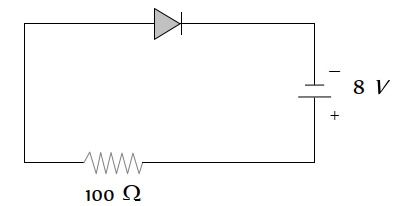
- 1A source voltage of $8 V$ drives the diode in fig. through a currentlimiting resistor of $100 ohm$. Then the magnitude of the slope load line on the $V-I$ characteristics of the diode isView Solution
- 2In $N$-type semiconductors, majority charge carriers areView Solution
- 3View SolutionThe unit of mutual conductance of a triode valve is
- 4The electron mobility in $N$-type germanium is $3900 cm / v - s$ and its conductivity is $6.24 mho / cm$, then impurity concentration will be if the effect of cotters is negligibleView Solution
- 5View SolutionLeast doped region in a transistor
- 6With a change of load resistance of a triode, used as an amplifier, from $50$ kilo ohms to $100$ kilo ohms, its voltage amplification changes from $25$ to $30.$ Plate resistance of the triode isView Solution
- 7View SolutionChoose the correct statement
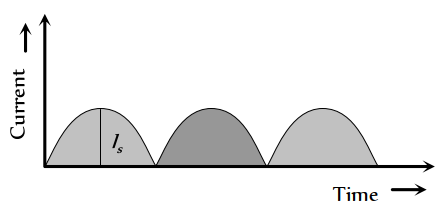
- 8View SolutionThe output current versus time curve of a rectifier is shown in the figure. The average value of the output current in this case is
- 9The amplification factor of a triode is $50.$ If the grid potential is decreased by $0.20\ V$, what increase in plate potential will keep the plate current unchangedView Solution
- 10In a $P$-type semi-conductor, germanium is dopped withView Solution