With a change of load resistance of a triode, used as an amplifier, from $50$ kilo ohms to $100$ kilo ohms, its voltage amplification changes from $25$ to $30.$ Plate resistance of the triode is
[MP PET 1986]


Download our appand get started for free
Experience the future of education. Simply download our apps or reach out to us for more information. Let's shape the future of learning together!No signup needed.*
Similar Questions
- 1View SolutionWhich of the following has negative temperature coefficient of resistance
- 2If $l_1, l_2, l_3$ are the lengths of the emitter, base and collector of a transistor thenView Solution
- 3A semiconductor $X$ is made by doping a germanium crystal with arsenic $(Z=33)$. A second semiconductor $Y$ is made by doping germanium with indium $(Z=49)$. The two are joined end to end and connected to a battery as shown. Which of the following statements is correctView Solution
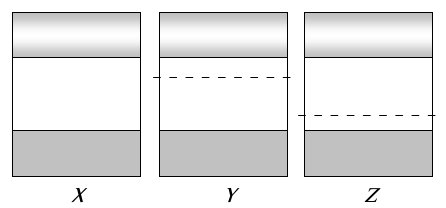
- 4View SolutionThe energy band diagrams for three semiconductor samples of silicon are as shown. We can then assert that
- 5In a full wave rectifiers, input $a c$ current has a frequency ' $v$. The output frequency of current isView Solution
- 6Consider the following statements $A$ and $B$ and identify the correct choice of the given answers(A) A zener diode is always connected in reverse bias(B) The potential barrier of a $P N$ junction lies between $0.1$ to $0.3\ V$ approximatelyView Solution
- 7In order to forward bias a $P N$ junction, the negative terminal of battery is connected toView Solution
- 8If the thermionic current density is $J$ and emitter temperature is $T$ then the curve between $\frac{J}{T^2}$ and $\frac{1}{T}$ will beView Solution
- 9View SolutionWhich is reverse biased diode
- 10View SolutionThe cut-in voltage for silicon diode is approximately