Question
A trolley of mass $200kg$ moves with a uniform speed of $36km/h$ on a frictionless track. A child of mass $20kg$ runs on the trolley from one end to the other ($10m$ away) with a speed of $4ms^{-1}$ relative to the trolley in a direction opposite to the its motion, and jumps out of the trolley. What is the final speed of the trolley? How much has the trolley moved from the time the child begins to run?
Answer

Mass of the trolley, $M=200 \mathrm{~kg}$ Speed of the trolley, $v=36 \mathrm{~km} / \mathrm{h}=10 \mathrm{~m} / \mathrm{s}$ Mass of the boy, $\mathrm{m}=20 \mathrm{~kg}$ Initial momentum of the system of the boy and the trolley $=(M+m) v=(200+20) \times 10=2200 \mathrm{kgm} / \mathrm{s}$ Let $\mathrm{v}^{\prime}$ be the final velocity of the trolley with respect to the ground. Final velocity of the boy with respect to the ground $=\mathrm{v}^{\prime}-4$ Final momentum $=M v^{\prime}+m\left(v^{\prime}-4\right)=200 v^{\prime}+20 v^{\prime}-80=220 v^{\prime}-80$ As per the law of conservation of momentum, Initial momentum = Final momentum $2200=220 \mathrm{v}^{\prime}-80 \therefore \mathrm{v}^{\prime}=\frac{2280}{220}=10.36 \mathrm{~m} / \mathrm{s}$ Length of the trolley, $\mathrm{I}=10 \mathrm{~m}$ Speed of the boy, $\mathrm{v}^{\prime \prime}=4 \mathrm{~m} / \mathrm{s}$ Time taken by the boy to run, $\mathrm{t}=\frac{10}{4}=2.5 \mathrm{~s}$ Distance moved by the trolley $=\mathrm{v}^{\prime \prime} \times \mathrm{t}=10.36 \times$ $2.5=25.9 \mathrm{~m}$

Need a full question paper?

Generate a complete, print-ready paper with questions like this in minutes — across 16+ boards, with answer keys.

Start Generating Free

Similar questions

When a body slides down from rest along a smooth inclined plane making an angle of 45° with the horizontal, it takes time T. When the same body slides down from rest along a rough inclined plane making the same angle and through the same distance, it is seen to take time pT, where p is some number greater than 1. Calculate the co-efficient of friction between the body and the rough plane.
Refer to the graphs in Fig. Match the following.
Graph
 
Characteristic
a.
i.
has v > 0 and a < 0 throughout.
b.
ii.
has x > 0 throughout and has a point with v = 0 and a point with a = 0.
c.
iii.
has a point with zero displacement for t > 0.
d.
iv.
has v < 0 and a > 0.
If a body moving with uniform acceleration in straight line describes successive equal distance in time interval $t_1, t_2$ and $t_3$, then show that $\frac{1}{\text{t}_1}-\frac{1}{\text{t}_2}+\frac{1}{\text{t}_3}=\frac{3}{\text{t}_1+\text{t}_2+\text{t}_3}$
In a gamma decay process, the internal energy of a nucleus of mass M decreases, a gamma photon of energy E and linear momentum $\frac{\text{E}}{\text{c}}$ is emitted and the nucleus recoils. Find the decrease in internal energy.
A chain of length l and mass m lies on the surface of a smooth sphere of radius R>1 with one end tied to the top of the sphere.
  1. Find the gravitational potential energy of the chain with reference level at the centre of the sphere.
  2. Suppose the chain is released and slides down the sphere. Find the kinetic energy of the chain, when it has slid through an angle $\theta.$
  3. Find the tangential acceleration $\frac{\text{dv}}{\text{dt}}$ of the chain when the chain starts sliding down.
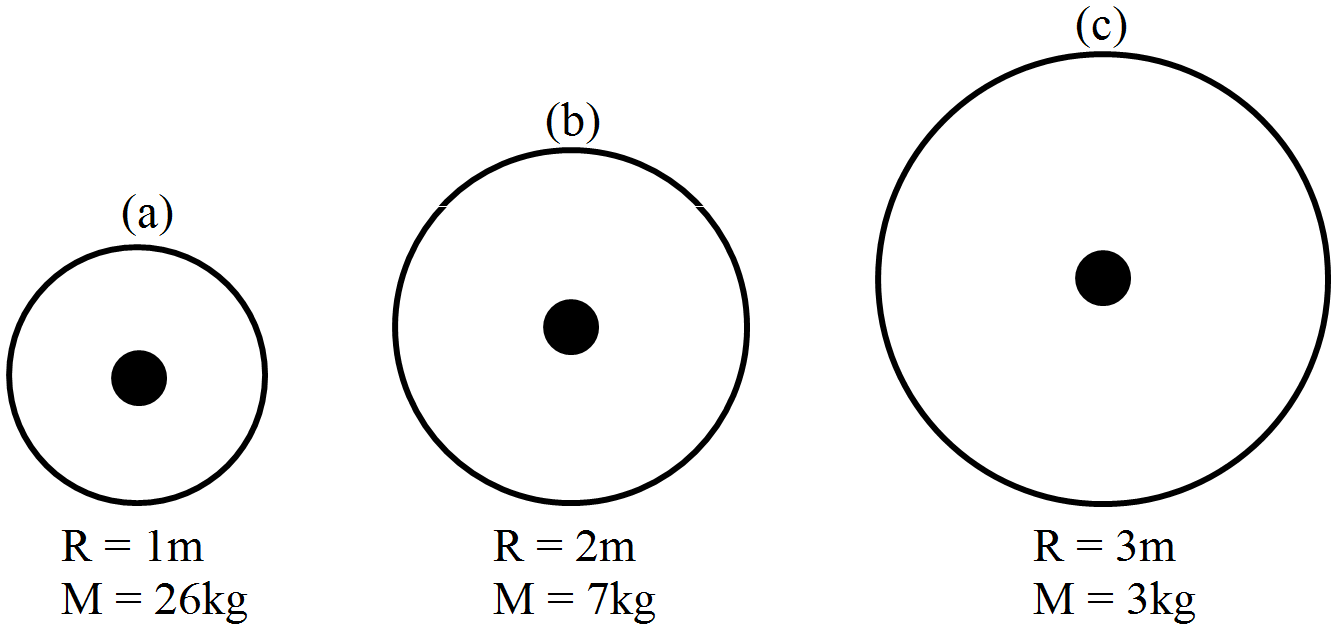
Figure shows three uniform discs, along with their radii R and masses M. Rank the discs according to their rotational inertia about their central axes, greatest first.
A $50kg$ girl wearing high heel shoes balances on a single heel. The heel is circular with a diameter $1.0cm$. What is the pressure exerted by the heel on the horizontal floor?
Io, one of the satellites of Jupiter, has an orbital period of $1.769$ days and the radius of the orbit is $4.22 \times 10^8m$. Show that the mass of Jupiter is about one-thousandth that of the sun.
Considering the pressure p to be proportional to the density, find the pressure p at a height h if the pressure on the surface of the earth is $p_0$.
Define linear momentum. Prove that for fixed mass, $P \propto v$ and for constant momentum $v \propto \frac{1}{m}$.