Figure shows three uniform discs, along with their radii R and masses M. Rank the discs according to their rotational inertia about their central axes, greatest first.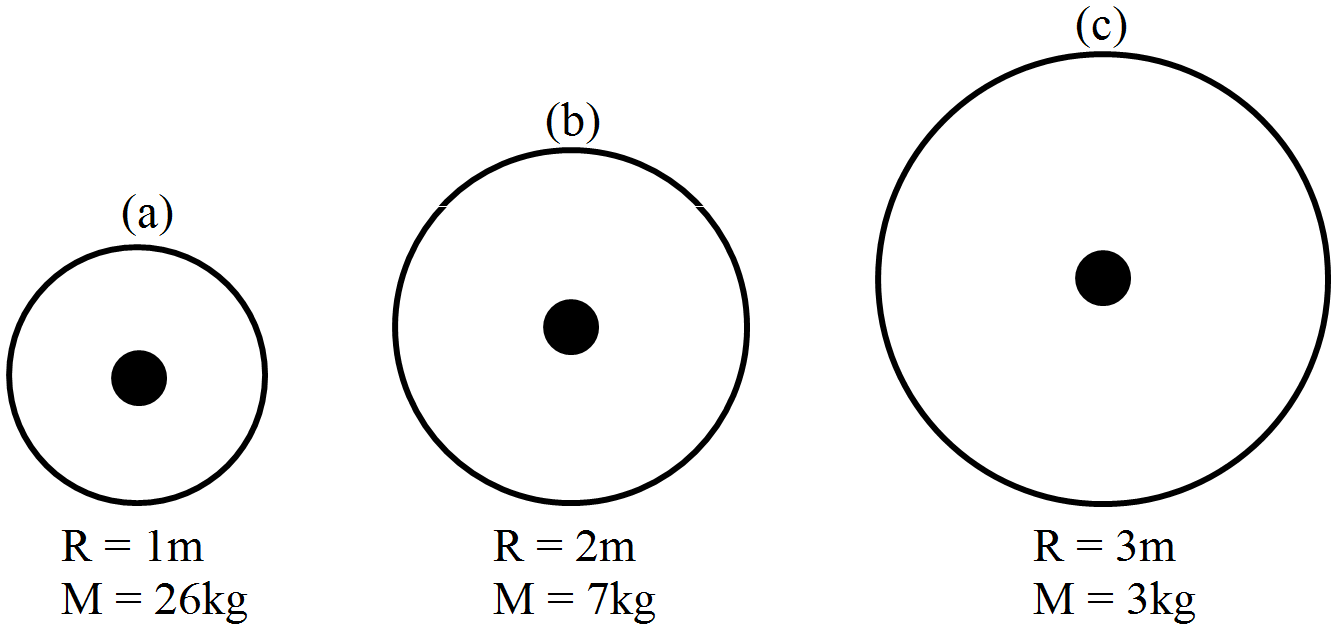
Download our app for free and get started
$\text{I}=\frac{1}{2}\text{MR}^2$
- $\Big(\frac{1}{2}\times26\times2\times1\Big)\text{kgm}^2=13\text{kgm}^2$
- $\Big(\frac{1}{2}\times7\times2\times2\Big)\text{kgm}^2=14\text{kgm}^2$
- $\Big(\frac{1}{2}\times3\times3\times3\Big)\text{kgm}^2=13.5\text{kgm}^2$

Download our appand get started for free
Experience the future of education. Simply download our apps or reach out to us for more information. Let's shape the future of learning together!No signup needed.*
Similar Questions
- 13 A man stands on a rotating platform, with his arms stretched horizontally holding a 5kg weight in each hand. The angular speed of the platform is 30 revolutions per minute. The man then brings his arms close to his body with the distance of each weight from the axis changing from 90cm to 20cm. The moment of inertia of the man together with the platform may be taken to be constant and equal to $7.6kgm^2$.View Solution
- What is his new angular speed? (Neglect friction).
- Is kinetic energy conserved in the process? If not, from where does the change come about?
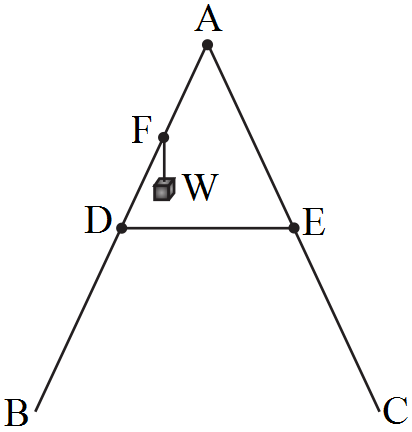
- 2As shown in the two sides of a step ladder BA and CA are 1.6m long and hinged at A. A rope DE, 0.5m is tied half way up. A weight 40kg is suspended from a point F, 1.2m from B along the ladder BA. Assuming the floor to be frictionless and neglecting the weight of the ladder, find the tension in the rope and forces exerted by the floor on the ladder. (Take $g = 9.8m/s^2$) (Hint: Consider the equilibrium of each side of the ladder separately).View Solution
- 3Two discs of moments of inertia $I_1$ and $I_2$ about their respective axes (normal to the disc and passing through the centre), and rotating with angular speeds $\omega_1$ and $\omega_2$ are brought into contact face to face with their axes of rotation coincident.View Solution
- What is the angular speed of the two-disc system?
- Show that the kinetic energy of the combined system is less than the sum of the initial kinetic energies of the two discs. How do you account for this loss in energy? Take $\omega_1\neq\omega_2$
- 4View SolutionA wheel in uniform motion about an axis passing through its centre and perpendicular to its plane is considered to be in mechanical (translational plus rotational) equilibrium because no net external force or torque is required to sustain its motion. However, the particles that constitute the wheel do experience a centripetal acceleration directed towards the centre.How do you reconcile this fact with the wheel being in equilibrium? How would you set a half-wheel into uniform motion about an axis passing through the centre of mass of the wheel and perpendicular to its plane? Will you require external forces to sustain the motion?
- 5View SolutionThree particles of masses 1.0kg, 2.0kg and 3.0kg are placed at the corners A, B and C respectively of an equilateral triangle ABC of edge 1m. Locate the centre of mass of the system.
- 6Two cylindrical hollow drums of radii R and 2R, and of a common height h, are rotating with angular velocities $\omega$ (anti-clockwise) and $\omega$ (clockwise), respectively. Their axes, fixed are parallel and in a horizontal plane separated by $(3\text{R}+\delta).$ They are now brought in contact $(\delta\rightarrow0){:}$View Solution
- Show the frictional forces just after contact.
- Identify forces and torques external to the system just after contact.
- What would be the ratio of final angular velocities when friction ceases?
- 7A circular hole of radius $1m$ is cut off from a disc of radius $6m$. The centre of the hole is $3m$ from the centre of the disc. Find the centre of mass of the remaining disc.View Solution
- 8View SolutionHow much fraction of the kinetic energy of rolling is purely:
- Translational.
- Rotational.
- 9View SolutionA uniform disc of radius R and mass M is mounted on an axis supported in fixed frictionless bearing. A light chord is wrapped around the rim of the wheel and suppose that we hang a body of mass m from the chord. Find the angular acceleration of the disc and tangential acceleration of point on the rim.
- 10View SolutionDefine radius of gyration and give the physical significance of moment of inertia.