Question
A tungsten cathode and a thoriated-tungsten cathode have the same geometric dimensions and are operated at the same temperature. The thoriated-tungsten cathode gives 5000 times more current than the other cathode. Find the operating temperature. Take relevant data from the previous problem.
Answer

Pure tungsten:
$\phi=4.5\text{eV}$
$\text{A}=60\times10^{4}\text{A/m}^2-\text{k}^2$
$\text{i}=\text{AST}^2\text{e}^{\frac{\phi}{\text{KT}}}$
Thoriated tungsten:
$\phi=2.6\text{eV}$
$\text{A}=3\times10^{4}\text{A/m}^2-\text{k}^2$
$\text{i}_{\text{Thoriated Tungsten}}=5000\text{i}_{\text{Tungsten}}$
So, $5000\times\text{S}\times60\times10^{4}\times\text{T}_2\times\text{e}^{\frac{-4.5\times1.6\times10^{-19}}{1.38\times\text{t}\times10^{-23}}}$
$\Rightarrow\text{S}\times3\times10^{4}\times\text{T}^2\times\text{e}^{\frac{-2.56\times1.6\times10^{-19}}{1.38\times\text{T}\times10^{-23}}}$
$\Rightarrow3\times10^{8}\times\text{e}^{\frac{-4.5\times1.6\times10^{-19}}{1.38\times\text{t}\times10^{-23}}}=\text{e}^{\frac{-2.56\times1.6\times10^{-19}}{1.38\times\text{T}\times10^{-23}}}\times3\times10^4$
Taking 'in'
$\Rightarrow9.21\text{T}=220.29$
$\Rightarrow\text{T}=\frac{22029}{9.21}=2391.856\text{K}$

Need a full question paper?

Generate a complete, print-ready paper with questions like this in minutes — across 16+ boards, with answer keys.

Start Generating Free

Similar questions

A heavy nucleus breaks into comparatively lighter nuclei, which are more stable compared to the original heavy nucleus. When a heavy nucleus like uranium is bombarded by slow moving neutrons, it splits into two parts, releasing large amount of energy. The typical fission reaction of $_{92}\text{U}^{235}$.
$_{92}\text{U}^{235}+\ _0\text{n}^1\rightarrow\ _{56}\text{Ba}^{141}+\ _{36}\text{kr}^{92}+\ 3_0\text{n}^1+\ 200\text{ MeV}$
The fission of $_{92}\text{U}^{235}$ approximately released 200 MeV of energy.
  1. If 200 MeV energy is released in the fission of a single nucleus of $_{92}^{235}\text{U}$, the fissions which are required to produce a power of 1kW is.
  1. 3.125 × 10¹³
  2. 1.52 × 106
  3. 3.125 × 1012
  4. 3.125 × 10¹⁴
  1. The release in energy in nuclear fission is consistent with the fact that uranium has
  1. More mass per nucleon than either of the two fragments.
  2. More mass per nucleon as the two fragment.
  3. Exactly the same mass per nucleon as the two fragments.
  4. Less mass per nucleon than either of two fragments.
  1. When $_{92}\text{U}^{235}$ undergoes fission, about 0.1% of the original mass is converted into energy. The energy released when 1kg of $_{92}\text{U}^{235}$ undergoes fission is.
  1. 9 × 1011J
  2. 9 × 1013J
  3. 9 × 1015J
  4. 9 × 1018J
  1. A nuclear fission is said to be critical when multiplication factor or K.
  1. K = 1
  2. K > 1
  3. K < 1
  4. K = 0
  1. Einstein's mass-energy conversion relation E = mc2 is illustrated by.
  1. Nuclear fission
  2. $\beta-\text{decay}$
  3. Rocket propulsion
  4. Steam engine
A prism is a portion of a transparent medium bounded by two plane faces inclined to each other at a suitable angle. A ray of light suffers two refractions on passing through a prism and hence deviates through a certain angle from its original path. The angle of deviation of a prism is, $\delta=(\mu-1)\text{A},$ through which a ray deviates on passing through a thin prism of small refracting angle A.
If $\mu$ is refractive index of the material of the prism, then prism formula is, $\mu=\frac{\frac{\sin(\text{A}\delta_\text{m})}{2}}{\frac{\sin\text{A}}{2}}$
  1. For which colour, angle of deviation is minimum?
  1. Red
  2. Yellow
  3. Violet
  4. Blue
  1. When white light moves th rough vacuum:
  1. All colours have same speed.
  2. Different colours have different speeds.
  3. Violet has more speed than red.
  4. Red has more speed than violet.
  1. The deviation through a prism is maximum when angle of incidence is:
  1. 45º
  2. 70º
  3. 90º
  4. 60c
  1. What is the deviation produced by a prism of angle 6º? (Refractive index of the material of the prism is 1.644).
  1. 3.864º
  2. 4.595º
  3. 7.259º
  4. 1.252º
  1. A ray of light falling at an angle of 50º is refracted through a prism and suffers minimum deviation. If the angle of prism is 60º, then the angle of minimum deviation is:
  1. 45º
  2. 75º
  3. 50º
  4. 40º
An ideal gas is pumped into a rigid container having diathermic walls so that the temperature remains constant. In a certain time interval, the pressure in the container is doubled. Is the internal energy of the contents of the container also doubled in the interval?
A bar magnet takes $\frac{\pi}{10}$ second to complete one oscillation in an oscillation magnetometer. The moment of inertia of the magnet about the axis of rotation is 1.2 × 10⁻⁴ kg-m2 and the earth's horizontal magnetic field is $30\mu \text{T}.$ Find the magnetic moment of the magnet.
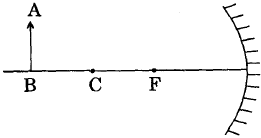
An object AB is kept in front of a concave mirror as shown in the figure.

  1. Complete the ray diagram showing the image formation of the object.
  2. How will the position and intensity of the image be affected if the lower half of the mirror's reflecting surface is painted black?
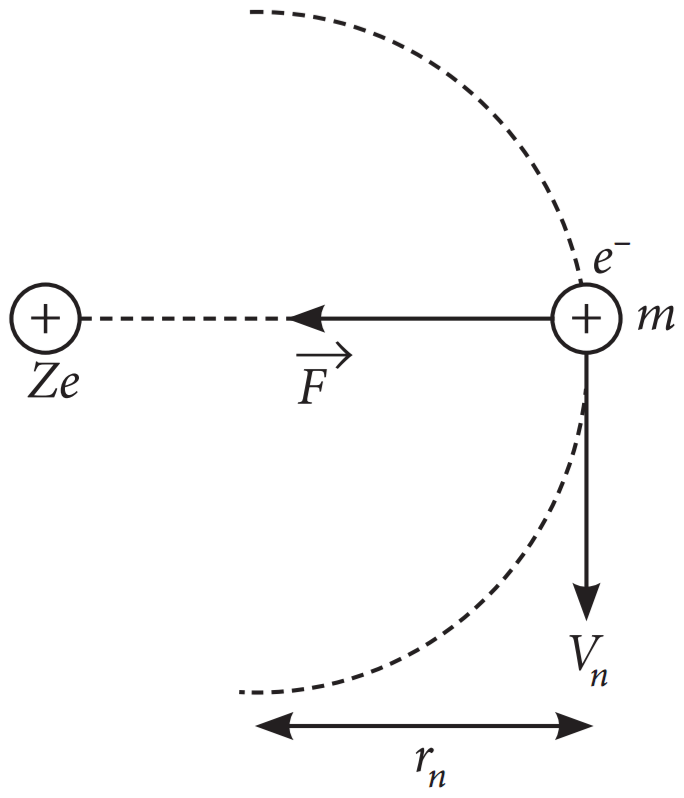
Explain Bohr's atomic model.
###
State three postulates of Bohr's atomic model.
By mistake, an eye surgeon puts a concave lens in place of the lens in the eye after a cataract operation. Will the patient be able to see clearly any object placed at any distance?
Hydrogen is the simplest atom of nature. There is one proton in its nucleus and an electron moves around the nucleus in a circular orbit. According to Niels Bohr, this electron moves in a stationary orbit. When this electron is in the stationary orbit, it emits no electromagnetic radiation.The angular momentum of the electron is quantized, i.e., ⁣$\text{mvr}=\big(\frac{\text{nh}}{2\pi}\big)$ where m = mass of the electron, v = velocity of the electron in the orbit, r = radius of the orbit and n = 1, 2, 3, .... When transition takes place from Kth orbit to Jth orbit, energy photon is emitted. If the wavelength of the emitted photon is $\lambda$ we find that $\frac{1}{\lambda}=\text{R}\bigg[\frac{1}{\text{J}^2}-\frac{1}{\text{K}^2}\bigg]$where find that On a different planet, the hydrogen atom's structure was somewhat different from ours. The angular momentum of electron was $\text{P}=2\text{n}\Big(\frac{\text{h}}{2\pi}\Big)$ i.e., an even multiple of $\Big(\frac{\text{h}}{2\pi}\Big)$.

  1. The minimum permissible radius of the orbit will be.
  1. $\frac{2\in_0\text{h}^2}{\text{m}\pi\text{e}^2}$
  2. $\frac{4\in_0\text{h}^2}{\text{m}\pi\text{e}^2}$
  3. $\frac{\in_0\text{h}^2}{\text{m}\pi\text{e}^2}$
  4. $\frac{\in_0\text{h}^2}{\text{2m}\pi\text{e}^2}$
  1. In our world, the velocity of electron is v0 when the hydrogen atom is in the ground state. The velocity of electron in this state on the other planet should be.
  1. $\text{v}_0$
  2. $\frac{\text{v}_0}{2}$
  3. $\frac{\text{v}_0}{4}$
  4. $\frac{\text{v}_0}{8}$
  1. In our world, the ionization potential energy of a hydrogen atom is 13.6eV. On the other planet, this ionization potential energy will be.
  1. 13.6eV
  2. 3.4eV
  3. 1.5eV
  4. 0.85eV
  1. Check the correctness of the following statements about the Bohr model of hydrogen atom.
  1. The acceleration of the electron in n = 2 orbit is more than that in n = 1 orbit.
  2. The angular momentum of the electron in n = 2 orbit is more than that in n = 1 orbit.
  3. The kinetic energy of the electron in n = 2 orbit is less than that in n = 1 orbit.
  1. Only (III) and (I) are correct
  2. Only (III) and (I) are correct
  3. Only (II) and (III) are correct.
  4. All the statements are correct.
  1. In Bohr's model of hydrogen atom, let PE represent potential energy and TE the total energy. In going to a higher orbit.
  1. PE increases, TE decreases
  2. PE decreases, TE increases
  3. PE increases, TE increases
  4. PE decreases, TE decreases
When the electron orbiting in hydrogen atom in its ground state moves to the third excited state, show how the de Broglie wavelength associated with it would be affected.
A police jeep is chasing a culprit going on a motorbike. The motorbike crosses a turning at a speed of 72km/h. The jeep follows it at a speed of 90km/h, crossing the turning ten seconds later than the bike. Assuming that they travel at constant speeds, how far from the turning will the jeep catch up with the bike?