$\text{L}\propto\frac{1}{\text{p}}$ for L = half of the tube length, P = 0.02mm of Hg

As ‘P’ becomes half, ‘L’ doubles, that is the whole tube is filled with Crook’s dark space.
Hence the required pressure $=\frac{0.02}{2}=0.01\text{m of Hg}$
15 questions · timed · auto-graded


$\frac{\text{n(T)}}{\text{n(1000K)}}=\frac{\text{AS}\times(300)^2\times\text{e}^{-4.52\times1.6\times10^{-19}/1.38\times10^{-23}\times300}}{\text{AS}\times1.7396\times10^{-17}}=7.05\times10^{-55}$
$$$\frac{\text{n(T)}}{\text{n(1000K)}}=\frac{\text{AS}(2000)^2\times\text{e}^{-4.52\times1.6\times10^{-19}/1.38\times10^{-23\times2000}}}{\text{AS}\times1.7396\times10^{-17}}=9.59\times10^{11}$
$\frac{\text{n(T)}}{\text{n(1000K)}}=\frac{\text{AS}\times(3000)^2\times\text{e}^{-4.52\times1.6\times10^{-19}/1.38\times10^{-23}\times3000}}{\text{AS}\times1.7396\times10^{-17}}=1.340\times10^{16}$

Explanation:
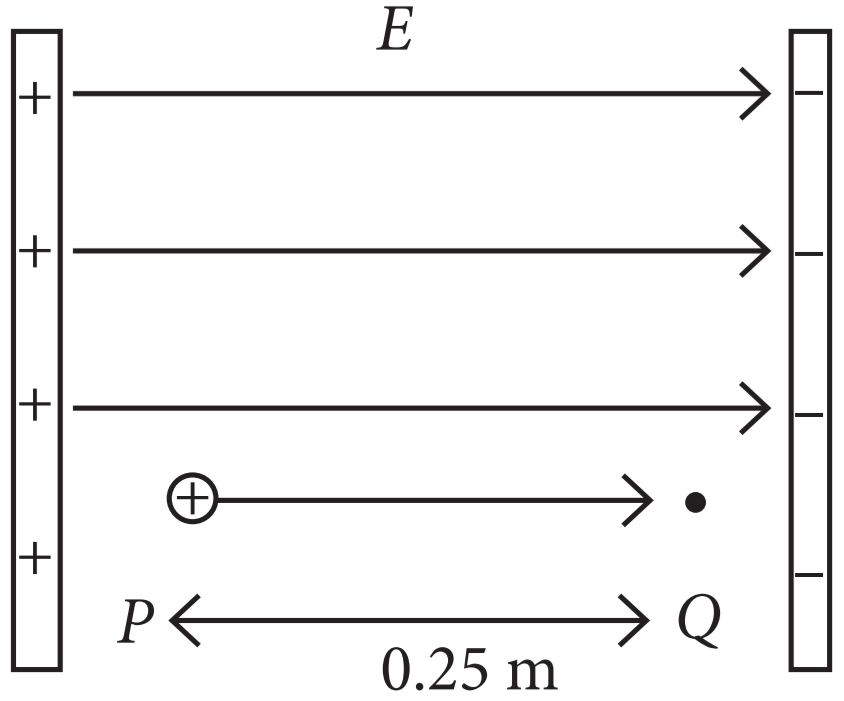
As $\triangle\text{V}=-\text{E}\triangle\text{x}=-(4.0\times10^8\frac{\text{V}}{\text{m}})(0.25\text{m})$
$=-10^8\text{V}.$
Explanation:
As $\triangle\text{U}=\text{q}_0\triangle\text{V}$
$=-(1.6\times10^{-19})\times(-1.0\times10^8\text{V})$
$=-1.6\times10^{-11}\text{V}.$
Explanation:
Here, q1 = q2 = 1.6 × 10⁻¹⁹C, r = 9 × 10-15m
$\text{U}=\frac{9\times10^9\times1.6\times10^{-19}\times1.6\times10^{-19}}{9\times10^{-15}}$
$=2.56\times10^{-14}\text{J}.$
Explanation:
Here, $\text{q}_1=4\mu\text{C},\text{ q}_2=3\mu\text{C}$
r = 10cm = 0.1m
Electrostatic potential energy,
$\text{U}=\frac{1}{4\pi\in_0}\frac{\text{q}_1\text{q}_2}{\text{r}}$
$=9\times10^9\times\frac{4\times10^{-6}\times(-3)\times10^{-6}}{0.1}$
= -1.1J
Explanation:
As proton moves in the direction of the electric field, then its potential energy decreases.

Explanation:
$\text{k}=\frac{\text{Capacitance with dielectric }}{\text{Capacitance without dielectric }}$
$=\frac{80\mu\text{F}}{4\mu\text{F}}=20$
Explanation:
Capacitance of the capacitor with air between plates
$\text{C'}=\frac{\in_0\text{A}}{\text{d}}=8\text{pF}$
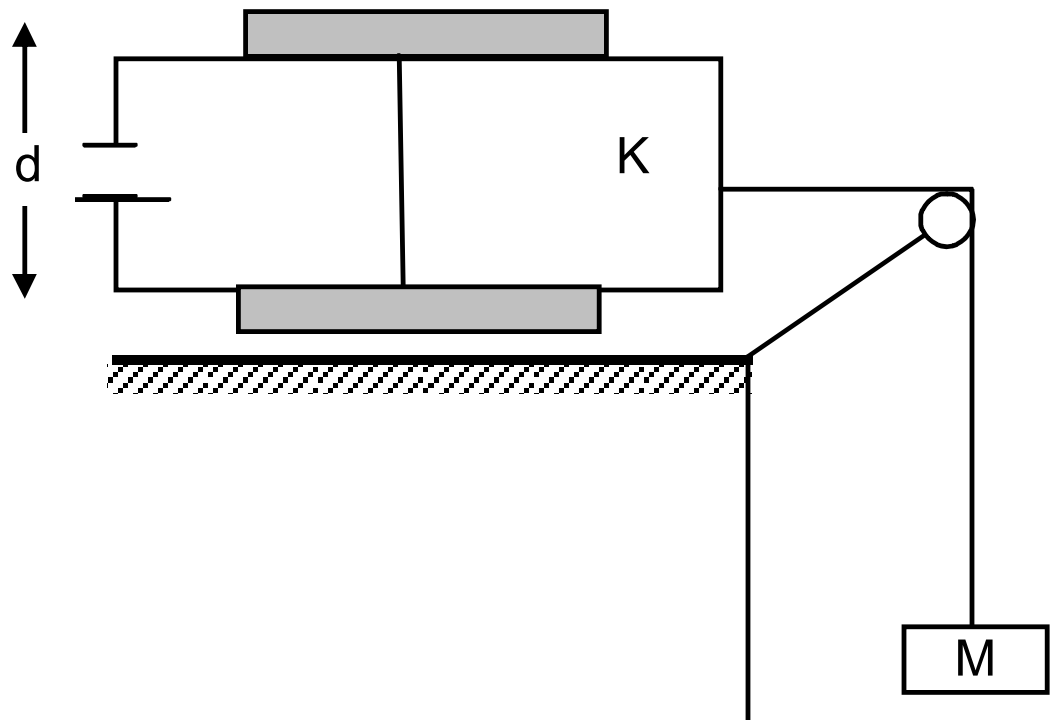
With the capacitor is filled with dielectric (k = 5) between its plates and the distance between the plates is reduced by half, capacitance become,
$\text{C'}=\frac{\in_0\text{A}}{\frac{\text{d}}{2}}=\frac{\in_0\times5\times\text{A}}{\frac{\text{d}}{2}}$
$=\text{10C'}=10\times8=80\text{pF}.$
Explanation:
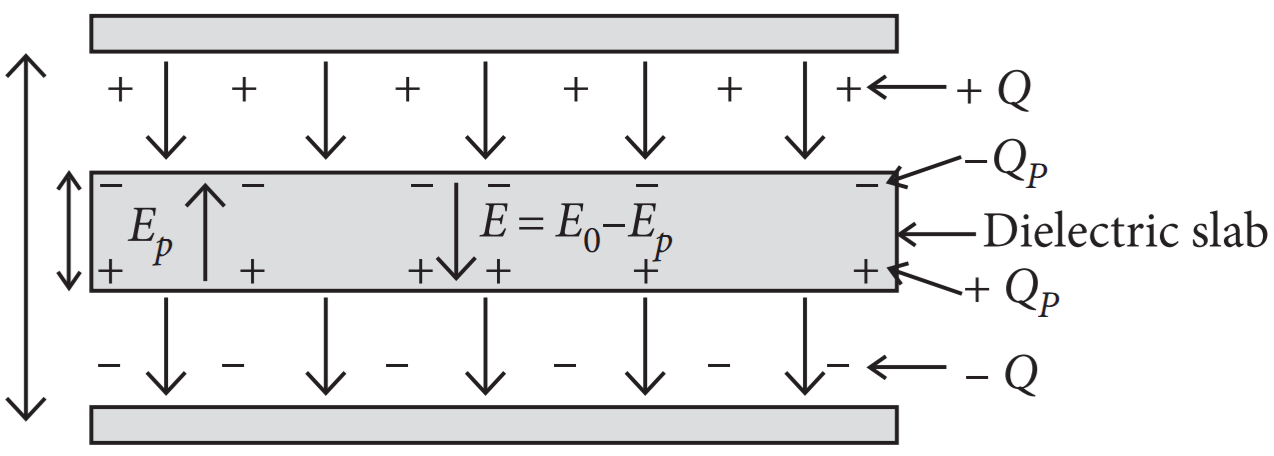
If a dielectric medium of dielectric constant K is filled completely between the plates then capacitance increases by K times.
Explanation:
$\text{C'}=\frac{\in_0\text{A}}{\text{d}}=1\text{pF}$ (i)
$\text{C'}=\frac{\text{x}\in_0\text{A}}{\text{(2d})}=2\text{pF}$ (ii)
Divide (ii) by (i), $\frac{\text{x}}{2}=\frac{2}{1}$
⇒ x = 4
Explanation:
As capacitance, $\text{C}_0=\frac{\in_0\text{A}}{\text{d}}$
$\therefore$ After inserting copper plate, $\text{C}=\frac{\in_0\text{A}}{\text{d-b}}$

Explanation:
As, $\text{C}_1=2\mu\text{F},\text{C}_2=4\mu\text{F}$
ln series combination, the equivalent capacitance will be,
$\text{C}=\frac{\text{C}_1\text{C}_2}{\text{C}_1+\text{C}_2}=\Big(\frac{2\times4}{2+4}\Big)\mu\text{F}$
$=\frac{4}{3}\mu\text{F}$
Potential difference applied, V = 6V
Energy stored in the system, $\text{U}=\frac{1}{2}\text{CV}^2$
$=\frac{1}{2}\times\frac{4}{3}\times10^{-6}\times(6)^2$
$\text{J}=24\mu\text{J}.$
Explanation:
The energy stored in a capacitor is
$\text{U}=\frac{1}{2}\text{CV}^2$
$=\frac{1}{2}\times(10\times10^{-6})(10)^2=500\mu\text{J}.$
Explanation:
When the gap between the plates is completely filled with dielectric of dielectric constant K, then potential is:
$\text{V}=\frac{\text{Qd}}{\text{A}\in_0\text{K}}$ (i)
and electric field is
$\text{E}=\frac{\text{Q}}{\text{A}\in_0\text{K}}$ (ii)
From equations (i) and (ii), both electric field and potential decrease.
Explanation:
Work done $=\text{U}_\text{f}-\text{U}_\text{i}=\frac{1}{2}\frac{\text{q}^2}{\text{C}_\text{f}}-\frac{1}{2}\frac{\text{q}^2}{\text{C}_\text{i}}$
$=\frac{\text{q}^2}{2}\Big[\frac{1}{\text{C}_\text{f}}-\frac{1}{\text{C}_\text{i}}\Big]$
$=\frac{(5\times10^{-6})^2}{2}\Big[\frac{1}{2\times10^{-6}}-\frac{1}{5\times10^{-6}}\Big]$
= 3.75 × 10⁻⁶J
Explanation:
Here r = 18cm = 18 × 10-2m, q = 5 × 10⁻⁶C
As, $\text{C}=4\pi\in_0\text{r}=\frac{18\times10^{-2}}{9\times10^9}=2\times10^{-11}\text{F}$
Energy of charged conductor is
$\text{U}=\frac{\text{q}^2}{\text{2C}}=\frac{(5\times10^{-6})^2\text{C}}{2\times2\times10^{-11}\text{F}}=0.625\text{J}.$
Explanation:
W = (P.E.)final - (P.E.)initial
$=\frac{\text{ke}^2}{2}-\frac{\text{ke}^2}{1}=\frac{\text{-ke}^2}{2}$
Explanation:
Potential at the centre of the square due to four equal charges q at four corners,
$\text{V}=\frac{\text{4q}}{\frac{4\pi\in_0\text{(a}\sqrt{2})}{2}}=\frac{\sqrt{2}\text{q}}{\pi\in_0\text{a}}$
$\text{W}_{0\rightarrow\infty}=-\text{W}_{0\rightarrow\infty}=-(\text{-q})\text{V}$
$=\frac{\sqrt{2}\text{q}^2}{\pi\in_0\text{a}}$
Explanation:
Here, $\text{q}=2\mu\text{C}=2\times10^{-6}\text{C},\text{r}_{\text{A}}=2\text{m},\text{r}_{\text{B}}=1\text{m}.$
$\therefore\text{V}_\text{A}-\text{V}_\text{B}=\frac{\text{q}}{4\pi\in_0}\Big[\frac{1}{\text{r}_\text{A}}-\frac{1}{\text{r}_\text{B}}\Big]$
$=2\times10^{-6}\times9\times10^9\Big[\frac{1}{2}-\frac{1}{1}\Big]$
$\text{V}=-9\times10^3\text{V}.$
Explanation:
Required work done = Change in potential energy of the system,
$\text{W}=\text{U}_\text{f}-\text{U}_\text{i}=\text{k}\frac{\text{q}_1\text{q}_2}{\text{r}_\text{f}}-\text{k}\frac{\text{q}_1\text{q}_2}{\text{r}_\text{i}}$
$=\text{k }\text{q}_1\text{q}_2\Big[\frac{1}{\text{r}_\text{f}}-\frac{1}{\text{r}_\text{i}}\Big]$
$\therefore\text{W}=(9\times10^9)(3\times10^{-9}\times1\times10^{-9})$
$\times\Big[\frac{1}{4\times10^{-2}}-\frac{1}{5\times10^{-2}}\Big]$
= 27 × 10-7 × (0.05) = 1.35 × 10⁻⁷J.

Explanation:
The electrical potential at any point on circle of radius a due to charge Q at its centre is $\text{V}=\frac{1}{4\pi\in_0}\frac{\text{Q}}{\text{a}}$
It is an equipotential surface.
Hence, work done in carrying a charge q round the circle is zero.
Explanation:
Work done to move a unit charge along an equipotential surface from P to Q,
$\text{W}=-\int\limits_{\text{P}}^{\text{Q}}\vec{\text{E}}\cdot\text{d}\vec{\text{l}}$
On equipotential surface $\vec{\text{E}}\perp\text{d}\vec{\text{l}}$
$\text{W}=-\int\limits_{\text{P}}^{\text{Q}}\text{E}(\text{dl})\cos90^\circ=0$

Explanation:
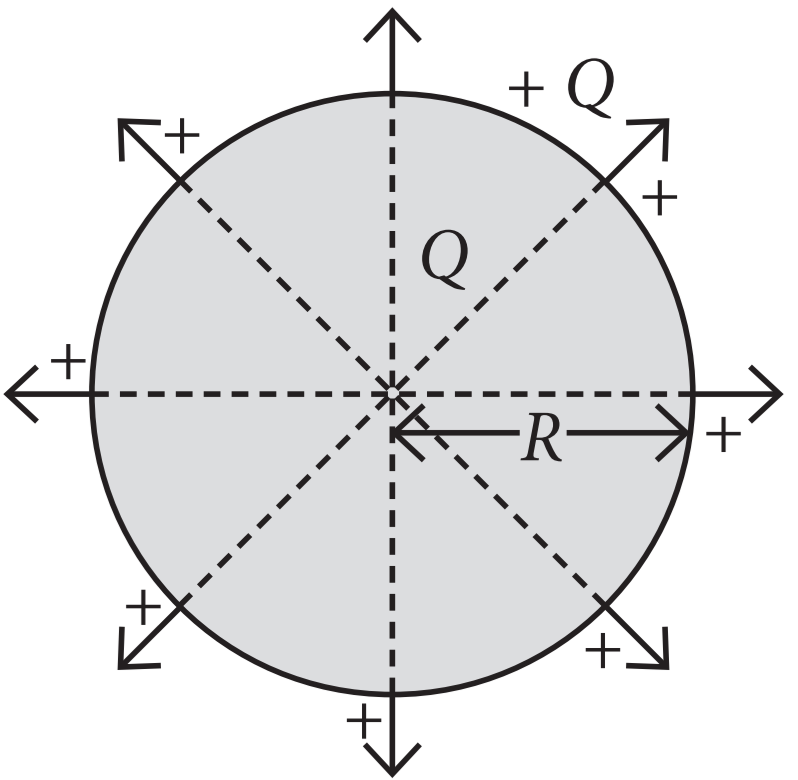
Since, E = 0 inside the conductor and has no tangential component on the surface, no work is done in moving a small test charge within the conductor and on its surface.
Explanation:
The work done in bringing unit positive charge from infinity to a point which is at a distance x from the positive charge Q is defined as the potential at the given point due to the charge Q. Therefore $\phi=\text{W}.$
Explanation:
$\text{W}_\text{ext}=\text{q}_0\triangle\text{V}$
$(\text{W}_{\text{AB}})_{\text{ext}}=\text{q}(\text{V}_\text{B}-\text{V}_\text{A})$
$40\mu\text{J}=1\mu\text{C}(\text{V}_\text{B}-\text{V}_\text{A})$
$\text{V}_\text{A}-\text{V}_\text{B}=-40\text{V}.$

Explanation:
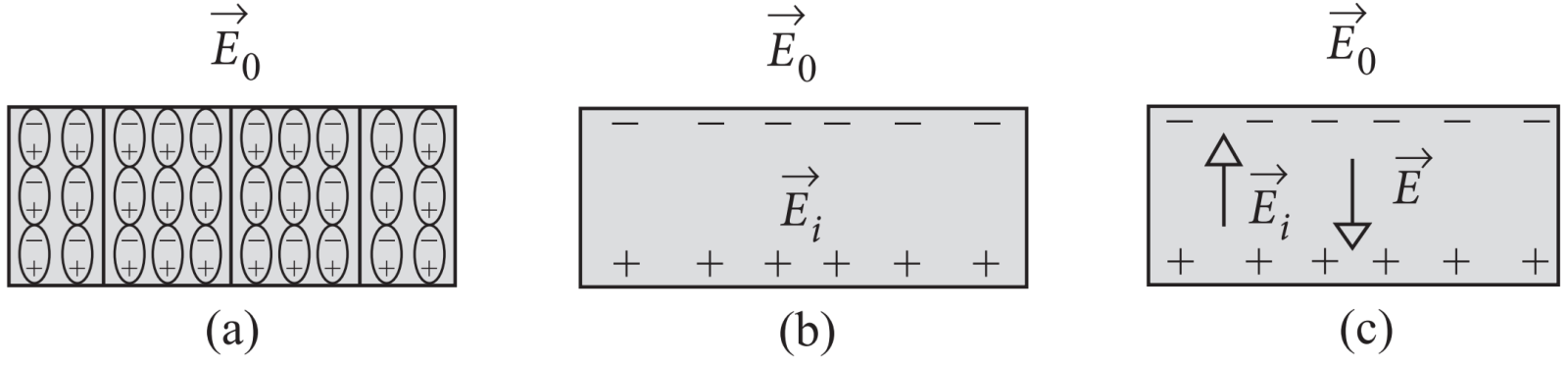
ln polar molecule the centres of positive and negative charges are separated even when there is no external field. Such molecule have a permanent dipole moment. Ionic molecule like HCI is an example of polar molecule.
Explanation:
As $\text{F}_\text{m}=\frac{\text{F}_0}{\text{K}}$
$\therefore$ The maximum force decreases by Klimes.
Explanation:
A polar molecule is one in which the centre of gravity for positive and negative charges are separated.

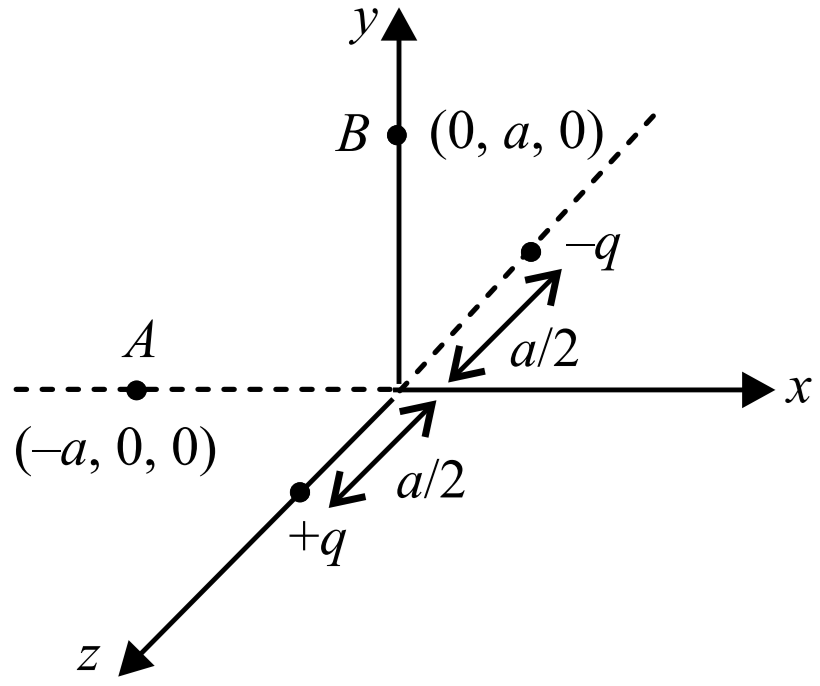
The work done by the electric field when another positive point charge is moved from (-a, 0, 0) to (0, a, 0) is to:
Explanation:
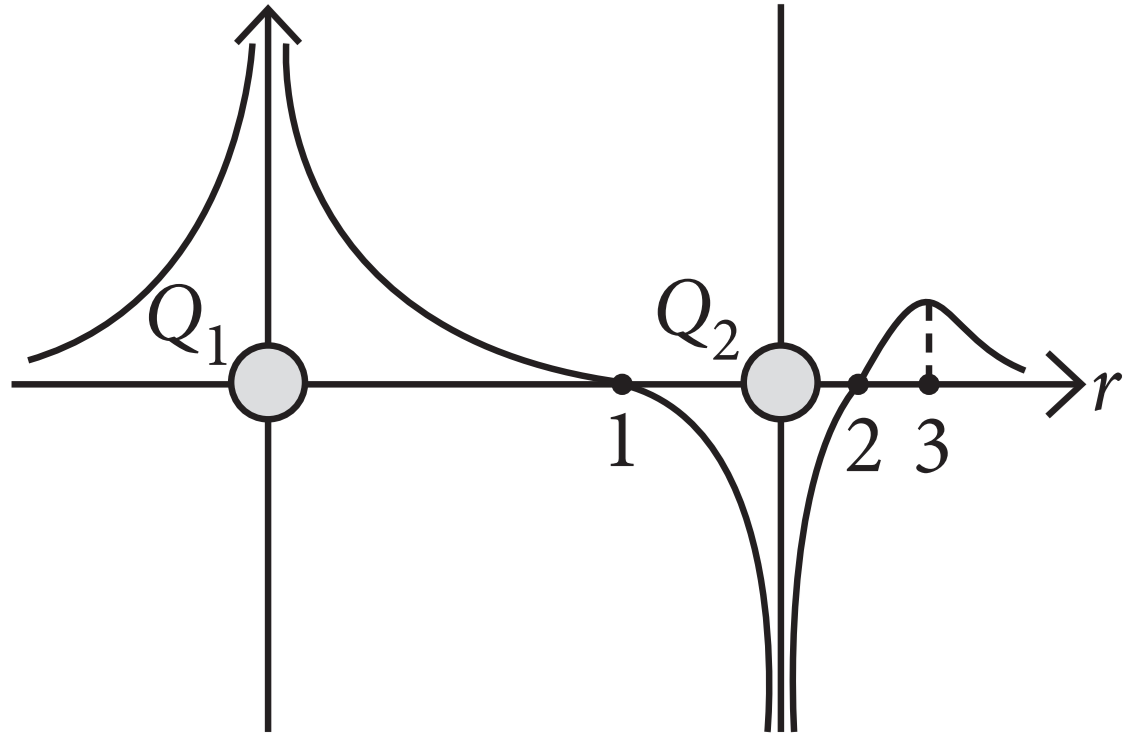
As $\frac{\text{-dV}}{\text{dr}}=\text{E}_\text{r},$ the negative of the slope of V versus r curve represents the component of electric field along r. Slope of curve is zero only at point 3. Therefore, the electric field vector is zero at point 3.
Explanation:
Near positive charge, net potential is positive and near a negative charge, net potential is negative. Thus, charge Q1 is positive and Q2 is negative.
Explanation:
From the figure, it can be seen that net potential due to two charges is positive everywhere in the region left to charge Q1. Therefore the magnitude of potential due to charge Q1 is greater than due to Q2.
Explanation:
It can be seen that potential at the points both A and B are zero. When the charge is moved from A to B, work done by the electric field on the charge will be zero.

Explanation:
Here C = 50pF = 50 × 10-12 F, V = 104V
$\text{R}=\frac{1}{4\pi\in_0}\cdot$
C = 9 × 10⁹ mF-1 × 50 × 10-12F
= 45 × 10-2m = 45cm
Explanation:
As q = CV = 25 × 10-12 × 105
$=2.5\mu\text{C}$
Explanation:
As charge, $\text{q}=\text{CV}=(4\pi\in_0\text{R})\text{V}$
$\therefore$ q depends on both V and R.
Explanation:
64 drops have formed a single drop of radius R. Volume of large sphere= 64 × Volume of small sphere,
$\therefore\frac{4}{3}\pi\text{R}^3=64\frac{4}{3}\pi\text{r}^3$
⇒ R = 4r and Qtotal = 64q
$\text{C'}=4\pi\in_0\text{R}\Rightarrow\text{C'}=(4\pi\in_0)\text{4r}$
$\Rightarrow\text{C'}=\text{4C}.$

Explanation:
As the capacitor is isolated after charging, charge Q on it remains constant. Plate separation d increases, capacitance decreases as $\text{C}=\frac{\in_0\text{A}}{\text{d}}$ and hence, potential increases as $\text{V}=\frac{\text{Q}}{\text{C}}.$
Explanation:
ln a parallel plate capacitor, the capacity of capacitor $\text{C}=\frac{\text{K}\in_0\text{A}}{\text{d}}$ i.e., $\text{C}\propto\text{A}$
The capacity of capacitor increases if area of the plate increases.
Explanation:
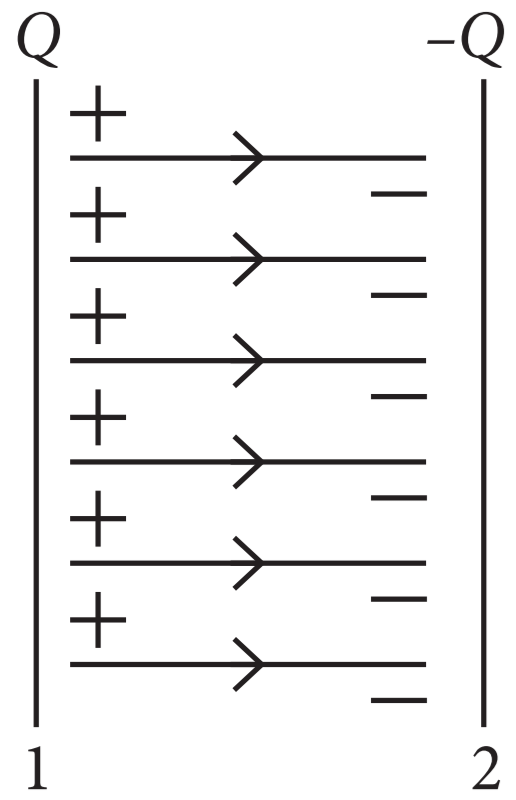
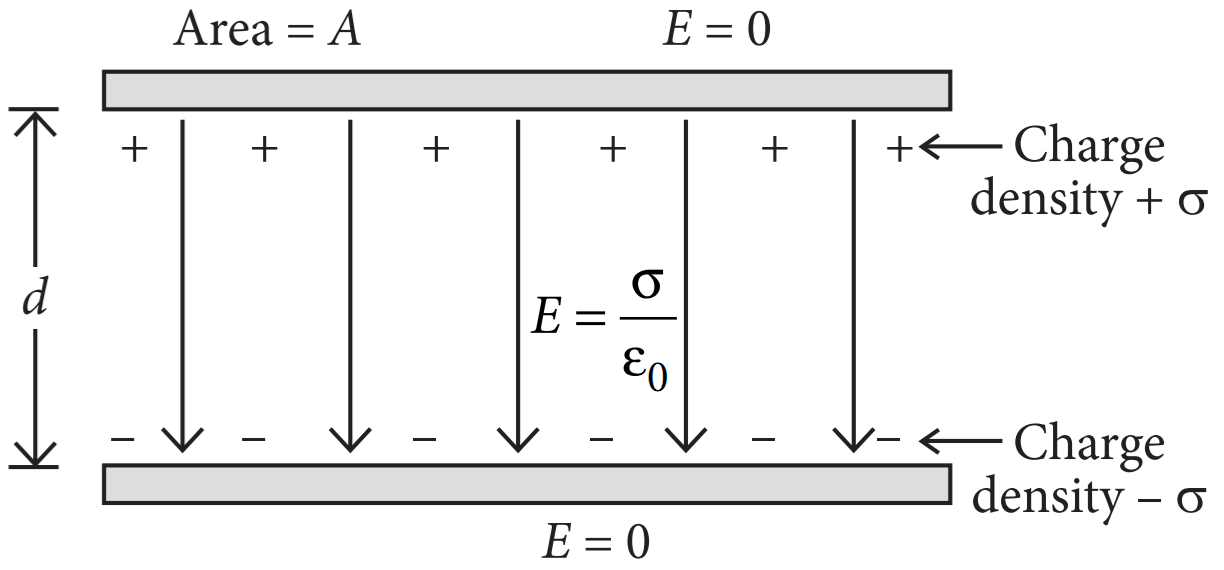
The magnitude of the electric field between the plates is
$\text{E}=\frac{\sigma}{2\in_0}-\Big(-\frac{\sigma}{2\in_0}\Big)=\frac{\sigma}{\in_0}$
Explanation:
As, $\frac{\in_0\text{A}}{\text{d}}=4\pi\in_0\text{R}$ or $\frac{\in_0\text{D}^2}{\text{4d}}=4\pi\in_0\text{R}$
Or $\text{d}=\frac{\text{D}^2}{\text{16R}}=\frac{(0.8)^2}{16\times0.10}$
$=4\times10^{-3}\text{m}=\text{4mm}$
Explanation:
Here, $\text{V}=\frac{\text{q}_1-\text{q}_2}{\text{2C}}$
$=\frac{2.0\times10^{-8}+1.0\times10^{-8}}{2\times1.2\times10^{-9}}=12.5\text{V}$