Question
A tungsten cathode and a thoriated-tungsten cathode have the same geometric dimensions and are operated at the same temperature. The thoriated-tungsten cathode gives 5000 times more current than the other cathode. Find the operating temperature. Take relevant data from the previous problem.
Answer

Pure tungsten:$\phi=4.5\text{eV}$
$\text{A}=60\times10^{4}\text{A/m}^2-\text{k}^2$
$\text{i}=\text{AST}^2\text{e}^{\frac{\phi}{\text{KT}}}$
Thoriated tungsten:$\phi=2.6\text{eV}$
$\text{A}=3\times10^{4}\text{A/m}^2-\text{k}^2$
$\text{i}_{\text{Thoriated Tungsten}}=5000\text{i}_{\text{Tungsten}}$
So, $5000\times\text{S}\times60\times10^{4}\times\text{T}_2\times\text{e}^{\frac{-4.5\times1.6\times10^{-19}}{1.38\times\text{t}\times10^{-23}}}$
$\Rightarrow\text{S}\times3\times10^{4}\times\text{T}^2\times\text{e}^{\frac{-2.56\times1.6\times10^{-19}}{1.38\times\text{T}\times10^{-23}}}$
$\Rightarrow3\times10^{8}\times\text{e}^{\frac{-4.5\times1.6\times10^{-19}}{1.38\times\text{t}\times10^{-23}}}=\text{e}^{\frac{-2.56\times1.6\times10^{-19}}{1.38\times\text{T}\times10^{-23}}}\times3\times10^4$
Taking 'in'$\Rightarrow9.21\text{T}=220.29$
$\Rightarrow\text{T}=\frac{22029}{9.21}=2391.856\text{K}$

Need a full question paper?

Generate a complete, print-ready paper with questions like this in minutes — across 16+ boards, with answer keys.

Start Generating Free

Similar questions

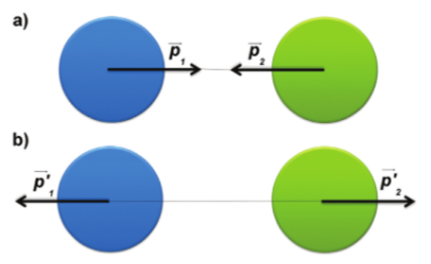
The kinetic energy of an object is the energy associated with the object which is under motion. It is defined as "the energy required by a body to accelerate from rest to stated velocity." It is a vector quantity and the momentum of an object is the virtue of its mass. It is defined as the product of mass and velocity. It is a vector quantity. The relation between them is given by $E =\frac{P^2}{2 m}$. In case of the elastic collision both of these quantities remain constant.
Image
1.Two masses of 1 gm and 4 gm are moving with equal linear momentum. The ratio of their kinetic energy is:
(a) $1: 2$ (b) $4: 1$ (c) $1: 1$ (d) $4: 2$
2. If the linear momentum is increased by $50 \%$, then K .E will be increased by:
(a) $50 \%$ (b) $200 \%$ (c) $125 \%$ (d) $100 \%$
3.A heavy object and a light object have the same momentum. Which has the greater speed?
(a) both heavy and light object
(b) heavy object
(c) Moderate object
(d) light object
OR
Kinetic energy with any reference must be $\qquad$
(a) Change (b) negative (c) zero (d) positive
4.When a body moves with a constant speed along a circle then
(a) no acceleration is produced
(b) no work is done on it
(c) no displacement on it
(d) no force acts on it
Read the passage given below and answer the following questions from 1 to 5. First Law of Thermodynamics The first law of thermodynamics is the general law of conservation of energy applied to any system in which energy transfer from or to the surroundings (through heat and work) is taken into account. It states that the energy supplied to the system goes in partly to increase the internal energy of the system and the rest in work on the environment. Mathematically, $\triangle\text{Q}=\triangle\text{U}+\triangle\text{W}$ where $\triangle\text{Q}$ is the heat supplied to the system, $\triangle\text{W}$ is the work done by the system and $\triangle\text{U}$ is the change in internal energy of the system. $\triangle\text{Q}$ and $\triangle\text{W}$ depend on the path taken to go from initial to final states, but the combination $\triangle\text{Q}​​-​​\triangle\text{W}$ is path independent.
  1. The first law of thermodynamics is concerned with conservation of:
  1. Number of molecules
  2. Number of moles
  3. Energy
  4. Temperature
  1. Which of the following is not a path function?
  1. $\triangle\text{Q}$
  2. $\triangle\text{Q}​​+\triangle\text{W}$
  3. $\triangle\text{W}$
  4. $\triangle\text{Q}​​-​​\triangle\text{W}$
  1. An electric heater supplies heat to a system at a rate of 120W. If system performs work at a rate of $80 J s^{-1}$, the rate of increase in internal energy is:
  1. $30 J s^{-1}$
  2. $40 J s^{-1}$
  3. $50 J s^{-1}$
  4. $60 J s^{-1}$
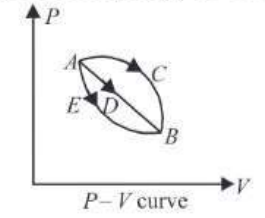
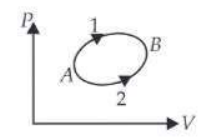
  1. Asystem goes from A to B by two different paths in the P - V diagram as shown in figure. Heat given to the system in path 1 is 1100 J, the work done by the system along path 1 is more than path 2 by 150 J. The heat exchanged by the system in path 2 is:
  1. 800 J
  2. 750 J
  3. 1050 J
  4. 950 J
  1. A certain mass of gas is carried from A to B, along three paths via ACB, ADB and AEB. Which one of the following is correct?
  1. Work done via path ACB is minimum.
  2. Work done via path ADB is maximum.
  3. Work done via path ACB is maximum.
  4. Work done via path AEB is maximum.
The dynamic plate resistance of a triode value is $10\text{k}\Omega$ Find the change in the plate current if the plate voltage is changed from 200V to 220V.
Calculate the force with which you attract the earth.
A deflection magnetometer is placed with its arms in north-south direction. How and where should a short magnet having $\frac{\text{M}}{\text{B}_\text{H}}=40\text{A-m}^2\text{T}$ be placed so that the needle can stay in any position?
Read the passage given below and answer the following questions from $i$ to $v.$ we consider the motion of a projectile. An object that is in flight after being thrown or projected is called a projectile. Such a projectile might be a football, a cricket ball, a baseball or any other object. The motion of a projectile may be thought of as the result of two separate, simultaneously occurring components of motions. One component is along a horizontal direction without any acceleration and the other along the vertical direction with constant acceleration due to the force of gravity. It was Galileo who first stated this independency of the horizontal and the vertical components of projectile motion in his Dialogue on the great world systems. Horizontal range of a projectile: The horizontal distance travelled by a projectile from its initial position $(x = y = 0)$ to the position where it passes $y = 0$ during its fall is called the horizontal range, $R$. It is the distance travelled during the time of flight $T_f .$ Therefore, the range $\text{R is R} =(\text{v}_o\cos\theta_o(\text{T}_\text{f})$
$\text{R}=\frac{(\text{v}_\text{o}\cos\theta_\text{o})(2\text{v}_\text{o}\sin\theta_\text{o})}{\text{g}}$
$\text{R}=\frac{(\text{v}_\text{o}^{2}\sin\theta_\text{o})}{g}$ This shows that for a given projection velocity, $R$ is maximum when $2\theta_\text{o}$ is maximum, i.e., when $\theta_\text{o}=45^\circ.$ The maximum horizontal range is, therefore $\text{R}=\frac{\text{v}_\text{o}^2}{g}$ Maximum height of a projectile: Maximum height that can be achieved during projectile and it is given by: $\text{H}_\text{m}=\frac{\text{(v}_\text{o}\sin\theta)^2}{2g}$
  1. Range in projectile motion is maximum when $\theta^\circ:$
  1. $45^0$
  2. $0^0$
  3. $90^0$
  4. None of these
  1. Who was first stated this independency of the horizontal and the vertical components of projectile motion in his Dialogue on the great world system?
  1. Galileo
  2. Newton
  3. Einstein
  4. None of these
  1. What is projectile motion?
  1. What is horizontal range of projectile? Give its formula:
  1. What is maximum height of projectile? Give its formula:
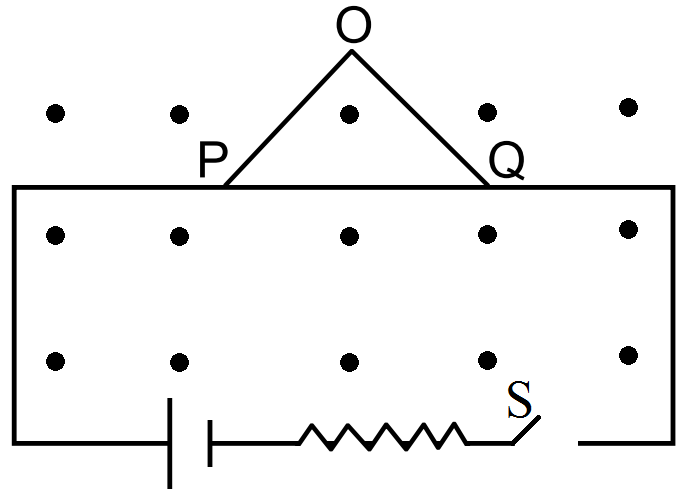
Shows a rod PQ of length 20.0cm and mass 200g suspended through a fixed point O by two threads of lengths 20.0cm each. A magnetic field of strength 0.500T exists in the vicinity of the wire PQ, as shown in the figure. The wires connecting PQ with the battery are loose and exert no force on PQ.
  1. Find the tension in the threads when the switch S is open.
  2. A current of 2.0A is established when the switch S is closed. Find the tension in the threads now.
The magnetic field at a point, 10cm away from a magnetic dipole, is found to be $2.0 \times 10^{-4} \mathrm{~T}$. find the magnetic moment of the dipole if the point is.
  1. In end-on position of the dipole.
  2. In broadside-onposition of the dipole.
When a tyre bursts, the air coming out is cooler than the surrounding air. Explain.