Question
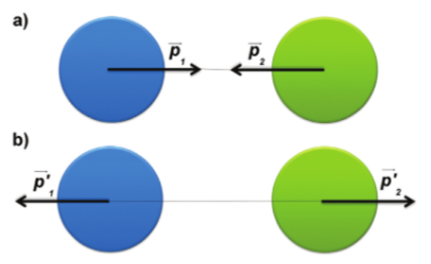
The kinetic energy of an object is the energy associated with the object which is under motion. It is defined as "the energy required by a body to accelerate from rest to stated velocity." It is a vector quantity and the momentum of an object is the virtue of its mass. It is defined as the product of mass and velocity. It is a vector quantity. The relation between them is given by $E =\frac{P^2}{2 m}$. In case of the elastic collision both of these quantities remain constant.
1.Two masses of 1 gm and 4 gm are moving with equal linear momentum. The ratio of their kinetic energy is:
(a) $1: 2$ (b) $4: 1$ (c) $1: 1$ (d) $4: 2$
2. If the linear momentum is increased by $50 \%$, then K .E will be increased by:
(a) $50 \%$ (b) $200 \%$ (c) $125 \%$ (d) $100 \%$
3.A heavy object and a light object have the same momentum. Which has the greater speed?
(a) both heavy and light object
(b) heavy object
(c) Moderate object
(d) light object
OR
Kinetic energy with any reference must be $\qquad$
(a) Change (b) negative (c) zero (d) positive
4.When a body moves with a constant speed along a circle then
(a) no acceleration is produced
(b) no work is done on it
(c) no displacement on it
(d) no force acts on it
1.Two masses of 1 gm and 4 gm are moving with equal linear momentum. The ratio of their kinetic energy is:
(a) $1: 2$ (b) $4: 1$ (c) $1: 1$ (d) $4: 2$
2. If the linear momentum is increased by $50 \%$, then K .E will be increased by:
(a) $50 \%$ (b) $200 \%$ (c) $125 \%$ (d) $100 \%$
3.A heavy object and a light object have the same momentum. Which has the greater speed?
(a) both heavy and light object
(b) heavy object
(c) Moderate object
(d) light object
OR
Kinetic energy with any reference must be $\qquad$
(a) Change (b) negative (c) zero (d) positive
4.When a body moves with a constant speed along a circle then
(a) no acceleration is produced
(b) no work is done on it
(c) no displacement on it
(d) no force acts on it