Question
Calculate the force with which you attract the earth.

Answer

Consider that a man is standing on the surface of the Earth. Force acting on the man $=\mathrm{mg}$ Here, $\mathrm{m}=$ mass of the man and $\mathrm{g}=$ acceleration due to gravity on the surface of earth ( $=10 \mathrm{~m} / \mathrm{s}^2$ ) Assume that the mass of the man is equal to 65 kg . Then $\mathrm{F}=\mathrm{W}=\mathrm{mg}=65 \times 10=650 \mathrm{~N}=$ force acting on the man. $\therefore$ By Newton's third law (actionreaction are always equal), the man is also attracting the earth with a force of 650 N in the opposite direction.

Need a full question paper?

Generate a complete, print-ready paper with questions like this in minutes — across 16+ boards, with answer keys.

Start Generating Free

Similar questions

A steel blade placed gently on the surface of water floats on it. If the same blade is kept well inside the water, it sinks. Explain.
A fat person is standing on a light plank floating on a calm lake. The person walks from one end to the other on the plank. His friend sitting on the shore watches him and finds that the person hardly moves any distance because the plank moves backward about the same distance as the person moves on the plank. Explain.
A deflection magnetometer is placed with its arms in north-south direction. How and where should a short magnet having $\frac{\text{M}}{\text{B}_\text{H}}=40\text{A-m}^2\text{T}$ be placed so that the needle can stay in any position?
On a winter day, the outside temperature is 0°C and relative humidity 40%. The air from outside comes into a room and is heated to 20°C. What is the relative humidity in the room? The saturation vapour pressure at 0°C is 4.6mm of mercury and at 20°C it is 18mm of mercury.
When white radiation is passed through a sample of hydrogen gas at room temperature, absorption lines are observed in Lyman series only. Explain.
Read the passage given below and answer the following questions from (i) to (v). Pressure of an Ideal Gas: according to kinetic theory of gases pressure is given by $\text{P}=\frac{1}{3}\text{ nmv}^2$
Where, n is number of molecules per unit volume, m is mass and $v^2$ is mean squared speed. Though we choose the container to be a cube, the shape of the vessel really is immaterial. The average kinetic energy of a molecule is proportional to the absolute temperature of the gas; it is independent of pressure, volume or the nature of the ideal gas. This is a fundamental result relating temperature, a macroscopic measurable parameter of a gas (a thermodynamic variable as it is called) to a molecular quantity, namely the average kinetic energy of a molecule. The two domains are connected by the Boltzmann constant and given by $E = k_bT$. Where kb is Boltzmann constant having value of $1.38 \times 10^{-23}$ joule per Kelvin. We have seen that in thermal equilibrium at absolute temperature T, for each translational mode of motion, the average energy is $\frac{1}{2}\text{K}_\text{b}\text{t}$. The most elegant principle of classical statistical mechanics (first proved by Maxwell) states that this is so for each mode of energy: translational, rotational and vibrational. That is, in equilibrium, the total energy is equally distributed in all possible energy modes, with each mode having an average energy equal to $\frac{1}{2}\text{K}_\text{b}\text{t}$. This is known as the law of equipartition of energy. Accordingly, each translational and rotational degree of freedom of a molecule contributes $\frac{1}{2}\text{K}_\text{b}\text{t}$ to the energy, while each vibrational frequency contributes $2\times\frac{1}{2}\text{Kb T}=\text{K}_\text{b}\text{T}$ since a vibrational mode has both kinetic and potential energy modes.
  1. Boltzmann constant has value of:
  1. 1.38 × 10 - 23 joule per Kelvin.
  2. 1.38 × 10 - 28 joule per Kelvin.
  3. 1.38 × 10 - 30 joule per Kelvin.
  4. None of these.
  1. SI unit of Boltzmann constant is given by:
  1. Joules per meter
  2. Joules per Kelvin
  3. Joules per Newton
  4. None of these
  1. According to kinetic theory give formula for pressure of idea gas.
  2. According to kinetic theory what is average kinetic energy of molecules of ideal gas?
  3. What is law of equipartition of energy?
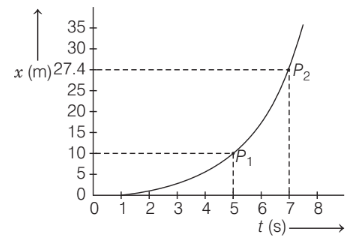
When an object is in motion, its position changes with time. So, the quantity that describes how fast is the position changingm w.r.t. time and in what direction is given by average velocity. It is defined as the change in position or displacement $(\triangle\text{x})$ divided by the time interval $(\triangle\text{t})$ in which that displacement occur. However, the quantity used to describe the rate of motion over the actual path, is average speed. It defined as the total distance travelled by the object divided by the total time taken.
  1. A $250m$ long train is moving with a uniform velocity of $45\ kmh^{-1}.$ The time taken by the train to cross a bridge of length $750m$ is:
  1. $56s$
  2. $68s$
  3. $80s$
  4. $92s$
  1. A truck requires 3hr to complete a journey of $150\ km$. What is average speed?
  1. $50\ km/h$
  2. $25\ km/h$
  3. $15\ km/h$
  4. $10\ km/h$
  1. Average speed of a car between points $A$ and $B$ is $20\ m/s$, between $B$ and $C$ is 15m/s and between $C$ and $D$ is $10\ m/s.$ What is the average speed between $A$ and $D$, if the time taken in the mentioned sections is $20s, 10s$ and $5s,$ respectively?
  1. $17.14\ m/s$
  2. $15\ m/s$
  3. $10\ m/s$
  4. $45\ m/s$
  1. A cyclist is moving on a circular track of radius 40m completes half a revolution in $40s.$ Its average velocity is:
  1. $\text{Zero}$
  2. $2\text{ms}^{-1}$
  3. $4\pi\text{ms}^{-1}$
  4. $8\pi\text{ms}^{-1}$
  1. In the following graph, average velocity is geometrically represented by:
  1. Length of the line $P_1 P_2.$
  2. Slope of the straight line $P_1 P_2.$
  3. Slope of the tangent to the curve at $P_1.$
  4. Slope of the tangent to the curve at $P_2.$
A bar magnet makes 40 oscillations per minute in an oscillation magnetometer. An identical magnet is demagnetized completely and is placed over the magnet in the magnetometer. Find the time taken for 40 oscillations by this combination. Neglect any induced magnetism.
Read the passage given below and answer the following questions from 1 to 5.
When we speak, the sound moves outward from us, without any flow of air from one part of the medium to another. The disturbances produced in air are much less obvious and only our ears or a microphone can detect them. These patterns, which move without the actual physical transfer or flow of matter as a whole, are called waves. The most familiar type of waves such as waves on a string, water waves, sound waves, seismic waves, etc. is the so-called mechanical waves. These waves require a medium for propagation, they cannot propagate through vacuum. They involve oscillations of constituent particles and depend on the elastic properties of the medium. The electromagnetic waves that you will learn in Class XII are a different type of wave. Electromagnetic waves do not necessarily require a medium – they can travel through vacuum. Light, radio waves, X-rays, are all electromagnetic waves. We have seen that motion of mechanical waves involves oscillations of constituents of the medium. If the constituents of the medium oscillate perpendicular to the direction of wave propagation, we call the wave a transverse wave. If they oscillate along the direction of wave propagation, we call the wave a longitudinal wave. In transverse waves, the particle motion is normal to the direction of propagation of the wave. Therefore, as the wave propagates, each element of the medium undergoes a shearing strain. Transverse waves can, therefore, be propagated only in those media, which can sustain shearing stress, such as solids and not in fluids. Fluids, as well as, solids can sustain compressive strain; therefore, longitudinal waves can be propagated in all elastic media.
For example, in medium like steel, both transverse and longitudinal waves can propagate, while air can sustain only longitudinal waves. Answer the following.
  1. Air can sustain:
  1. Transverse waves
  2. Longitudinal waves
  3. Both a and b
  4. None of these
  1. The electromagnetic waves can pass through
  1. Solids only
  2. Fluids only
  3. Any medium even through vacuum
  4. None of these
  1. Define Transverse waves
  1. Define longitudinal waves
  1. Differentiate between Transverse waves and longitudinal waves
The magnetic moment of the assumed dipole at the earth's centre is $8.0 \times 10^{22}A-m^2$. Calculate the magnetic field B at the geomagnetic poles of the earth. Radius of the earth is 6400km.