Question
A tungsten cathode and a thoriated-tungsten cathode have the same geometric dimensions and are operated at the same temperature. The thoriated-tungsten cathode gives 5000 times more current than the other cathode. Find the operating temperature. Take relevant data from the previous problem.

Answer

Pure tungsten:

$\phi=4.5\text{eV}$

$\text{A}=60\times10^{4}\text{A/m}^2-\text{k}^2$

$\text{i}=\text{AST}^2\text{e}^{\frac{\phi}{\text{KT}}}$

Thoriated tungsten:

$\phi=2.6\text{eV}$

$\text{A}=3\times10^{4}\text{A/m}^2-\text{k}^2$

$\text{i}_{\text{Thoriated Tungsten}}=5000\text{i}_{\text{Tungsten}}$

So, $5000\times\text{S}\times60\times10^{4}\times\text{T}_2\times\text{e}^{\frac{-4.5\times1.6\times10^{-19}}{1.38\times\text{t}\times10^{-23}}}$

$\Rightarrow\text{S}\times3\times10^{4}\times\text{T}^2\times\text{e}^{\frac{-2.56\times1.6\times10^{-19}}{1.38\times\text{T}\times10^{-23}}}$

$\Rightarrow3\times10^{8}\times\text{e}^{\frac{-4.5\times1.6\times10^{-19}}{1.38\times\text{t}\times10^{-23}}}=\text{e}^{\frac{-2.56\times1.6\times10^{-19}}{1.38\times\text{T}\times10^{-23}}}\times3\times10^4$

Taking 'in'

$\Rightarrow9.21\text{T}=220.29$

$\Rightarrow\text{T}=\frac{22029}{9.21}=2391.856\text{K}$

Need a full question paper?

Generate a complete, print-ready paper with questions like this in minutes — across 16+ boards, with answer keys.

Start Generating Free

Similar questions

$\int\frac{\text{dx}}{\sqrt{2\text{ax}-\text{x}^2}}=\text{a}^{\text{n}}\sin^{-1}\Big[\frac{\text{x}}{\text{a}}-1\Big].$ The value of n is:
  1. 0
  2. -1
  3. 1
  4. None of these.
Read the passage given below and answer the following questions from i to v.
we consider the motion of a projectile. An object that is in flight after being thrown or projected is called a projectile. Such a projectile might be a football, a cricket ball, a baseball or any other object. The motion of a projectile may be thought of as the result of two separate, simultaneously occurring components of motions. One component is along a horizontal direction without any acceleration and the other along the vertical direction with constant acceleration due to the force of gravity. It was Galileo who first stated this independency of the horizontal and the vertical components of projectile motion in his Dialogue on the great world systems.
Horizontal range of a projectile: The horizontal distance travelled by a projectile from its initial position (x = y = 0) to the position where it passes y = 0 during its fall is called the horizontal range, R. It is the distance travelled during the time of flight Tf . Therefore, the range
$\text{R is R} =(\text{v}_o\cos\theta_o(\text{T}_\text{f})$
$\text{R}=\frac{(\text{v}_\text{o}\cos\theta_\text{o})(2\text{v}_\text{o}\sin\theta_\text{o})}{\text{g}}$
$\text{R}=\frac{(\text{v}_\text{o}^{2}\sin\theta_\text{o})}{g}$
This shows that for a given projection velocity, R is maximum when $2\theta_\text{o}$ is maximum, i.e., when $\theta_\text{o}=45^\circ.$ The maximum horizontal range is, therefore $\text{R}=\frac{\text{v}_\text{o}^2}{g}$
Maximum height of a projectile: Maximum height that can be achieved during projectile and it is given by:
$\text{H}_\text{m}=\frac{\text{(v}_\text{o}\sin\theta)^2}{2g}$
  1. Range in projectile motion is maximum when $\theta^\circ:$
  1. 450
  2. 00
  3. 900
  4. None of these
  1. Who was first stated this independency of the horizontal and the vertical components of projectile motion in his Dialogue on the great world system?
  1. Galileo
  2. Newton
  3. Einstein
  4. None of these
  1. What is projectile motion?
  1. What is horizontal range of projectile? Give its formula:
  1. What is maximum height of projectile? Give its formula:
Refer to the previous problem. Suppose, the goldsmith argues that he has not mixed copper or any other material with gold, rather some cavities might have been left inside the ornament. Calculate the volume of the cavities left that will allow the weights given in that problem.
Read the passage given below and answer the following questions from 1 to 5.
Relative velocity is velocity of any object with respect to other object which may be stationary or moving. Consider two objects A and B moving uniformly with average velocities vA and vB in one dimension, say along x-axis. (Unless otherwise specified, the velocities mentioned in this chapter are measured with reference to the ground). If xA (0) and xB (0) are positions of objects A and B, respectively at time t = 0, their positions xA (t) and xB (t) at time t are given by
xA (t) = xA (0) + vA t
xB (t) = xB (0) + vB t
Then, the displacement from object A to object B is given by
xBA(t) = xB (t) – xA (t)
= [xB (0) – xA (0) ] + (vB – vA) t.
It tells us that as seen from object A, object B has a velocity vB – vA because the displacement from A to B changes steadily by the amount vB – vA in each unit of time. We say that the velocity of object B relative to object A is vB – vA
VBA = vB – vA
Similarly, velocity of object A relative to object B is:
VAB = vA – vB
This shows VBA= – VAB.
  1. Velocity of object A relative to object B is:
  1. VAB = vA – vB
  2. VBA = vB – vA
  3. None of these
  1. Velocity of object B relative to object A is:
  1. vB – vA
  2. vA – vB
  3. None of these
  1. What is relative velocity?
  1. What is relative displacement?
  1. Show that VBA = – VAB :
A triode value operates at Vp = 225V and Vg = -0.5V. The plate current remains unchanged if the plate voltage is increased to 250V and the grid voltage is decreased to -2.5V. Calculate the amplification factor.
The position of a particle is given by $\vec{r}=\left(3 \cdot 0 t \hat{i}-2 \cdot 0 t^2 \hat{j}+4 \cdot 0 \hat{k}\right) m$. where $t$ is in seconds and the coefficient have the proper units for $\vec{r}$ to be in meters.
(a) Find the $\vec{v}$ and $\vec{a}$ of the particle.
(b) What is the magnitude and direction of velocity of the particle at $t=2 s$ ?
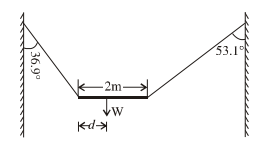
A non-uniform bar of weight W is suspended at rest by two strings of negligible weight as shown in Fig. The angles made by the strings with the vertical are 36.9º and 53.1º respectively. The bar is 2 m long. Calculate the distance d of the centre of gravity of the bar from its left end.
Image
Which of the following is true for a cathode ray?
  1. It travels in a straight line.
  2. It emits an X-ray when it strikes a metal.
  3. It is an electromagnetic wave.
  4. It is not deflected by a magnetic field.
50cc of oxygen is collected in an inverted gas jar over water. The atmospheric pressure is 99.4kPa and the room temperature is 27°C. The water level in the jar is same as the level outside. The saturation vapour pressure at 27°C is 3.4kPa. Calculate the number of moles of oxygen collected in the jar.
Read the passage given below and answer the following questions from  1 to 5.
In general, the errors in measurement can be broadly classified as (a) systematic errors and (b) random errors.
Systematic errors: The systematic errors are those errors that tend to be in one direction, either positive or negative. Some of the sources of systematic errors are:
(a) Instrumental errors that arise from the errors due to imperfect design or calibration of the measuring instrument, zero error in the instrument, etc. For example, the temperature graduations of a thermometer may be inadequately calibrated (it may read 104 °C at the boiling point of water at STP whereas it should read 100 °C); in a vernier calipers the zero mark of vernier scale may not coincide with the zero mark of the main scale, or simply an ordinary metre scale may be worn off at one end.
(b) Imperfection in experimental technique or procedure to determine the temperature of a human body, a thermometer placed under the armpit will always give a temperature lowers than the actual value of the body temperature.
(c) Personal errors that arise due to an individual’s bias, lack of proper setting of the apparatus or individual’s carelessness in taking observations without observing proper precautions, etc. For example, if you, by habit, always hold your head a bit too far to the right while reading the position of a needle on the scale, you will introduce an error due to parallax.Systematic errors can be minimized by improving experimental techniques, selecting better instruments and removing personal bias as far as possible. For a given set-up, these errors may be estimated to a certain extent and the necessary corrections may be applied to the readings.
Random errors:The random errors are those errors, which occur irregularly and hence are random with respect to sign and size. These can arise due to random and unpredictable fluctuations in experimental conditions (e.g. unpredictable fluctuations in temperature, voltage), personal (unbiased) errors by the observer taking readings, etc. For example, when the same person repeats the same observation, it is very likely that he may get different readings every time.
Least count error: The smallest value that can be measured by the measuring instrument is called its least count. All the readings or measured values are good only up to this value. The least count error is the error associated with the resolution of the instrument.
  1. The errors due to imperfect design or calibration of the measuring instrument:
  1. Instrumental error
  2. Random error
  3. Least count error
  4. None of the above
  1. The errors which occur irregularly
  1. Instrumental error
  2. Personal error
  3. Random error
  4. None of these
  1. Write a note on least count error
  1. Write a note on random error
  1. Write a note on systematic error