Question
Read the passage given below and answer the following questions from i to v.
we consider the motion of a projectile. An object that is in flight after being thrown or projected is called a projectile. Such a projectile might be a football, a cricket ball, a baseball or any other object. The motion of a projectile may be thought of as the result of two separate, simultaneously occurring components of motions. One component is along a horizontal direction without any acceleration and the other along the vertical direction with constant acceleration due to the force of gravity. It was Galileo who first stated this independency of the horizontal and the vertical components of projectile motion in his Dialogue on the great world systems.
Horizontal range of a projectile: The horizontal distance travelled by a projectile from its initial position (x = y = 0) to the position where it passes y = 0 during its fall is called the horizontal range, R. It is the distance travelled during the time of flight Tf . Therefore, the range
$\text{R is R} =(\text{v}_o\cos\theta_o(\text{T}_\text{f})$
$\text{R}=\frac{(\text{v}_\text{o}\cos\theta_\text{o})(2\text{v}_\text{o}\sin\theta_\text{o})}{\text{g}}$
$\text{R}=\frac{(\text{v}_\text{o}^{2}\sin\theta_\text{o})}{g}$
This shows that for a given projection velocity, R is maximum when $2\theta_\text{o}$ is maximum, i.e., when $\theta_\text{o}=45^\circ.$ The maximum horizontal range is, therefore $\text{R}=\frac{\text{v}_\text{o}^2}{g}$
Maximum height of a projectile: Maximum height that can be achieved during projectile and it is given by:
$\text{H}_\text{m}=\frac{\text{(v}_\text{o}\sin\theta)^2}{2g}$
  1. Range in projectile motion is maximum when $\theta^\circ:$
  1. 450
  2. 00
  3. 900
  4. None of these
  1. Who was first stated this independency of the horizontal and the vertical components of projectile motion in his Dialogue on the great world system?
  1. Galileo
  2. Newton
  3. Einstein
  4. None of these
  1. What is projectile motion?
  1. What is horizontal range of projectile? Give its formula:
  1. What is maximum height of projectile? Give its formula:
Answer

  1. (a) 450
  2. (a) Galileo
  3. The motion of object under only gravity force in the air is called projectile motion.
  4. The horizontal distance travelled by a projectile from its initial position to the  position where it passes same horizontal position during its fall is called the horizontal range, R. It is the distance travelled during the time of flight Tf . Therefore, the range R is.

$\text{R is R} =(\text{v}_o\cos\theta_o(\text{T}_\text{f})$

$\text{R}=\frac{(\text{v}_\text{o}\cos\theta_\text{o})(2\text{v}_\text{o}\sin\theta_\text{o})}{\text{g}}$

$\text{R}=\frac{(\text{v}_\text{o}^{2}\sin\theta_\text{o})}{g}$

  1. Maximum height of a projectile: Maximum height that can be achieved during projectile and it is given by

$\text{H}_\text{m}=\frac{\text{(v}_\text{o}\sin\theta)^2}{2g}$

Need a full question paper?

Generate a complete, print-ready paper with questions like this in minutes — across 16+ boards, with answer keys.

Start Generating Free

Similar questions

Read the passage given below and answer the following questions from  1 to 5.
Every measurement involves errors. Thus, the result of measurement should be reported in a way that indicates the precision of measurement. Normally, the reported result of measurement is a number that includes all digits in the number that are known reliably plus the first digit that is uncertain. The reliable digits plus the first uncertain digit are known as significant digits or significant figures. If we say the period of oscillation of a simple pendulum is 1.62 s, the digits 1 and 6 are reliable and certain, while the digit 2 is uncertain. Thus, the measured value has three significant figures.A choice of change of different units does not change the number of significant digits or figures in a measurement. This important remark makes most of the following observations clear,
  • All the non-zero digits are significant.
  • All the zeros between two non-zero digits are significant, no matter where the decimal point is, if at all.
  • If the number is less than 1, the zero(s) on the right of decimal point but to the left of the first non-zero digit are not significant.
  • The terminal or trailing zero(s) in a number without a decimal point are not significant.[Thus 123 m = 12300 cm = 123000 mm has three significant figures, the trailing zero(s) being not significant.
  • The trailing zero(s) in a number with a decimal point are significant. [The numbers 3.500 or 0.06900 have four significant figures each]
  • For a number greater than 1, without any decimal, the trailing zero(s) are not significant.
  • For a number with a decimal, the trailing zero(s) are significant
(b) The digit 0 conventionally put on the left of a decimal for a number less than 1 (like 0.1250) is never significant. However, the zeroes at the end of such number are significant in a measurement.
(c) The multiplying or dividing factors which are neither rounded numbers nor numbers representing measured values are exact and have infinite number of significant digits.
(d) In multiplication or division, the final result should retain as many significant figures as are there in the original number with the least significant figures.In addition or subtraction, the final result should retain as many decimal places as are there in the number with the least decimal
places. For example, the sum of the numbers 436.32 g, 227.2 g and 0.301 g by mere arithmetic addition, is 663.821 g. But the least precise measurement (227.2 g) is correct to only one decimal place. The final result should, therefore, be rounded off to 663.8 g.
  1. Significant figures in 12300 cm are:
  1. 5
  2. 4
  3. 3
  4. None of these
  1. All the non-zero digits are:
  1. Significant
  2. Non significant
  3. None of these
  1. Give rules for significant figures
  1. Give rules for addition and subtraction operations with significant figure
  1. Give rules for multiplication and division operations with significant figure
Read the passage given below and answer the following questions from 1 to 5.
When an object is in motion, its position changes with time. But how fast is the position changing with time and in what direction? To describe this, we define the quantity average velocity. Average velocity is defined as the change in position or displacement (x) divided by the time intervals (t), in which the displacement occurs:
$\text{V}=\frac{\text{x2}-\text{x1}}{\text{t2}-\text{t1}}=\frac{\triangle\text{x}}{\triangle\text{t}}$
Where x2 and x1 are the positions of the object at time t2and t1, respectively. The SI unit for velocity is m/s or m s–1, although km h–1 is used in many everyday applications. Like displacement, average velocity is also a vector quantity. Average speed is defined as the total path length travelled divided by the total time interval during which the motion has taken place:
Average speed = Total path length/ Total time interval.
Average speed has obviously the same unit (m s–1) as that of velocity. But it does not tell us in what direction an object is moving. Thus, it is always positive (in contrast to the average velocity which can be positive or negative). If the motion of an object is along a straight line and in the same direction, the magnitude of displacement is equal to the total path length.
The velocity at an instant is defined as the limit of the average velocity as the time interval Dt becomes infinitesimally small. In other words
$\text{V}=\lim_{\text{dt}-0}\frac{\text{dx}}{\text{dt}}$
$\text{V}=\frac{\text{dx}}{\text{dt}}$
Note that for uniform motion, velocity is the same as the average velocity at all instants. Instantaneous acceleration is defined in the same way as the instantaneous velocity
$\text{A}=\lim_{\text{dt}-0}\frac{\text{dv}}{\text{dt}}$
$\text{A}=\frac{\text{dv}}{\text{dt}}$
  1. For uniform motion instantaneous velocity is same as:
  1. Average velocity
  2. Average acceleration
  3. Instantaneous speed
  4. None of these
  1. If velocity is constant then
  1. Acceleration is zero
  2. Acceleration is positive
  3. Acceleration is negative
  4. None of these
  1. Define average speed
  1. Define instantaneous acceleration
  1. Define average velocity
Read the passage given below and answer the following questions from 1 to 5.
Relative velocity is velocity of any object with respect to other object which may be stationary or moving. Consider two objects A and B moving uniformly with average velocities vA and vB in one dimension, say along x-axis. (Unless otherwise specified, the velocities mentioned in this chapter are measured with reference to the ground). If xA (0) and xB (0) are positions of objects A and B, respectively at time t = 0, their positions xA (t) and xB (t) at time t are given by
xA (t) = xA (0) + vA t
xB (t) = xB (0) + vB t
Then, the displacement from object A to object B is given by
xBA(t) = xB (t) – xA (t)
= [xB (0) – xA (0) ] + (vB – vA) t.
It tells us that as seen from object A, object B has a velocity vB – vA because the displacement from A to B changes steadily by the amount vB – vA in each unit of time. We say that the velocity of object B relative to object A is vB – vA
VBA = vB – vA
Similarly, velocity of object A relative to object B is:
VAB = vA – vB
This shows VBA= – VAB.
  1. Velocity of object A relative to object B is:
  1. VAB = vA – vB
  2. VBA = vB – vA
  3. None of these
  1. Velocity of object B relative to object A is:
  1. vB – vA
  2. vA – vB
  3. None of these
  1. What is relative velocity?
  1. What is relative displacement?
  1. Show that VBA = – VAB :
A string of mass 2.50 kg is under a tension of 200 N. The length of the stretched string is 20.0 m. If the transverse jerk is struck at one end of the string, how long does the disturbance take to reach the other end?
The dimensions $\text{ML}^{-1}\text{T}^{-2}$ may correspond to:
  1. Work done by a force.
  2. Linear momentum.
  3. Pressure.
  4. Energy per unit volume.
A stone dropped from the top of a tower of height 300 m splashes into the water of a pond near the base of the tower. When is the splash heard at the top given that the speed of sound in air is $340 ms^{-1}$ ? $\left(g=9.8 ms^{-1}\right)$
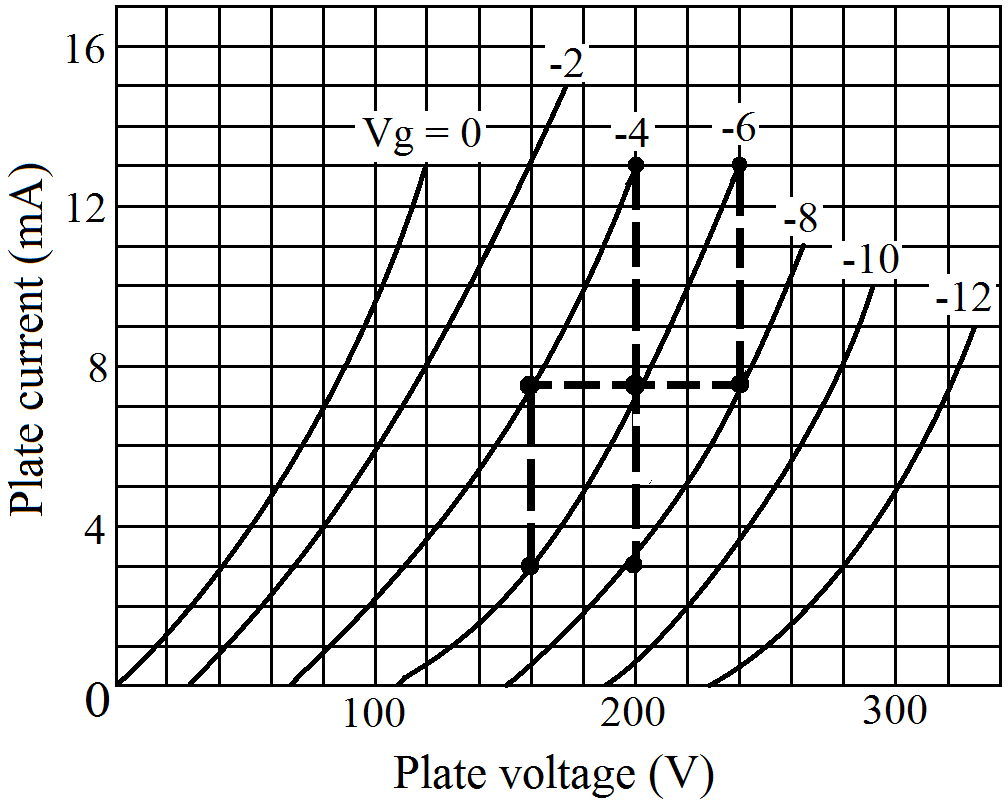
Find the values of $\text{r}_\text{p},\ \mu$ and gm of a triode operating at plate voltage 200V and grid voltage -6. The plate characteristics are shown in the figure.

Read the passage given below and answer the following questions from 1 to 5.

Work
A farmer ploughing the field, a construction worker carrying bricks, a student studying for a competitive examination, an artist painting a beautiful landscape, all are said to be working. In physics, however, the word ‘Work’ covers a definite and precise meaning. Work refers to

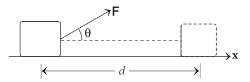
the force and the displacement over which it acts. Consider a constant force F acting on an object of mass m. The object undergoes a displacement d in the positive x-direction as shown in figure.

The work done by the force is defined to be the product of component of the force in the direction of the displacement and the magnitude of this displacement, thus
$\text{W}=(\text{F}\cos\theta) \text{ D}=\text{F}.\text{D}.$

  1. The earth is moving around the sun in a circular orbit, is acted upon by a force and hence work done on the earth by the force is:
  1. zero
  2. positive
  3. negative
  4. None of the above
  1. In which case, work done will be zero?
  1.  A weight-lifter while holding a weight of 100 kg on his shoulders for 1 min
  2. A locomotive against gravity is running on a level plane with a speed of 60 kmh - 1
  3. A person holding a suitcase on his head and standing at a bus terminal
  4. All of the above


  1. Find the angle between force $\text{F}=(3\hat{\text{i}}+4\hat{\text{j}}-5\hat{\text{k}})$ unit and displacement $\text{d}=(5\hat{\text{i}}+4\hat{\text{j}}+3\hat{\text{k}})$ unit.
  1. cos -1 (0.49)
  2. cos -1 (0.32)
  3. cos -1 (0.60)
  4. cos -1 (0.90)
  1. Which of the following statement(s) is/ are correct for work done to be zero?
  1. I. If the displacement is zero.
  2. II. If force applied is zero.
  3. III. If force and displacement are mutually perpendicular to each other.

(a) Only I (b) I and II
(c) Only II (d) I, II and III

  1. A proton is kept at rest. A positively charged particle is released from rest at a distance d in its field. Consider two experiments; one in which the charged particle is also a proton and in another, a positron. In same time t, the work done on the two moving charged particles is:
  1. same as the same force law is involved in the two experiments
  2. less for the case of a positron, as the positron moves away more rapidly and the force on it weakens
  3. more for the case of a positron, as the positron moves away a larger distance
  4. same as the work is done by charged particle on the stationary proton
Cloudy nights are warmer than the nights with clean sky. Explain.
A steel tape 1 m long is correctly calibrated for a temperature of $27.0{ }^{\circ} C$. The length of a steel rod measured by this tape is found to be 63.0 cm on a hot day when the temperature is 45.0 ${ }^{\circ} C$. What is the actual length of the steel rod on that day? What is the length of the same steel rod on a day when the temperature is $27.0{ }^{\circ} C$ ? Coefficient of linear expansion of steel $=1.20 \times 10^5$ $K ^{-1}$.