A tuning fork is used to produce resonance in a glass tube. The length of the air column in this tube can be adjusted by a variable piston. At room temperature of $27\,^o C$ two successive resonances are produced at $20\, cm$ and $73\, cm$ of column length. If the frequency of the tuning fork is $320\, Hz,$ the velocity of sound in air at $27\,^o C$ is .... $m/s$
NEET 2018, Medium


Download our appand get started for free
Experience the future of education. Simply download our apps or reach out to us for more information. Let's shape the future of learning together!No signup needed.*
Similar Questions
- 1This question has Statement $1$ and Statement $2$ .Of the four choices given after the Statements, choose the one that best describes the two Statements.View Solution
Statement $1$ : Bats emitting ultrasonic waves can detect the location of a prey by hearing the waves reflected from it.
Statement $2$ : When the source and the detector are moving, the frequency of reflected waves is changed - 2View SolutionWhich of the following equations represents a travelling wave ?
- 3Two travelling waves produces a standing wave represented by equation,View Solution
${y}=1.0\, {mm} \cos \left(1.57 \,{cm}^{-1}\right) {x} \sin \left(78.5\, {s}^{-1}\right) {t}$
The node closest to the origin in the region ${x}>0$ will be at ${x}=\ldots \ldots \ldots\, {cm}$
- 4The displacement $y$ (in $cm$) produced by a simple harmonic wave is $y = \frac{{10}}{\pi }\sin \left( {2000\pi t - \frac{{\pi x}}{{17}}} \right)$. The periodic time and maximum velocity of the particles in the medium will respectively beView Solution
- 5View SolutionA tuning fork produces waves in a medium. If the temperature of the medium changes, then which of the following will change
- 6A source of sound $S$ of frequency $500 Hz$ situated between a stationary observer $O$ and a wall $W$, moves towards the wall with a speed of $2 m/s$. If the velocity of sound is $332 m/s$, then the number of beats per second heard by the observer is (approximately)View Solution
- 7Standing waves are generated on a sonometer string loaded with a cylindrical body. If the cylinder is completely immersed in water, the length of the loops changes by a factor of $2.2$ . The specific gravity of the material of the cylinder isView Solution
- 8View SolutionThe minimum intensity of sound is zero at a point due to two sources of nearly equal frequencies, when
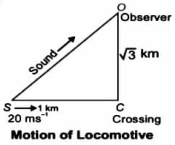
- 9A locomotive approaching a crossing at a speed of $20 \,ms ^{-1}$ sounds a whistle of frequency $640 \,Hz$ when $1 \,km$ from the crossing. There is no wind and the speed of sound in air is $330 \,ms ^{-1}$. What frequency is heard by an observer $\sqrt{3} \,km$ on the straight road from the crossing at right angle ......... $Hz$View Solution
- 10A plane wave is represented by $x = 1.2\sin (314\,t + 12.56y)$Where $x$ and $y$ are distances measured along in $x$ and $y$ direction in meters and $t$ is time in seconds. This wave hasView Solution