A tuning fork with frequency $800 \;\mathrm{Hz}$ produces resonance in a resonance column tube with upper end open and lower end closed by water surface. Surface. Successive resonance are observed at length $9.75 \;\mathrm{cm}, 31.25\; \mathrm{cm}$ and $52.75\; \mathrm{cm} .$ The speed of sound in air is ......$m/s$
NEET 2019, Medium
Download our app for free and get started
Here $\lambda=2\left(l_{2}-l_{1}\right)$
where $l_{1}=9.75 \mathrm{cm}, l_{2}=31.25 \mathrm{cm}$
so $\mathrm{v}=2 \mathrm{n}\left(l_{2}-l_{1}\right)=2 \times 800(31.25-9.75)=344 \mathrm{m} / \mathrm{s}$

Download our appand get started for free
Experience the future of education. Simply download our apps or reach out to us for more information. Let's shape the future of learning together!No signup needed.*
Similar Questions
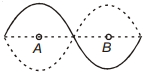
- 1In the standing wave shown, particles at the positions $A$ and $B$ have a phase difference ofView Solution
- 2A steel wire with mass per unit length $7.0 \times 10^{-3}\,kg\,m ^{-1}$ is under tension of $70\,N$. The speed of transverse waves in the wire will be $.........m/s$View Solution
- 3In open organ pipe, if fundamental frequency is $n$ then the other frequencies areView Solution
- 4When a wave travels in a medium, the particle displacements are given by $y = a\, sin\, 2\pi\, (bt -cx)$ where $a, b,$ and $c$ are constants. The maximum particle velocity will be twice the wave velocity ifView Solution
- 5A man stands in front of a hillock and fires a gun. He hears an echo after $1.5\, sec$. The distance of the hillock from the man is ...... $m$ (velocity of sound in air is $330\, m/s$)View Solution
- 6View SolutionAs a wave propagates
- 7A second harmonic has to be generated in a string of length $l$ stretched between two rigid supports. The points where the string has to be plucked and touched are respectivelyView Solution
- 8A wave travels on a light string.The equation of the wave is $Y = A \,\sin \,(kx - \omega t + 30^o)$.It is reflected from a heavy string tied to an end of the light string at $x = 0$. If $64\%$ of the incident energy is reflected the equation of the reflected wave isView Solution
- 9Ten tuning forks are arranged in increasing order of frequency in such a way that any two nearest tuning forks produce $4$ beats/sec. The highest frequency is twice of the lowest. Possible highest and the lowest frequencies areView Solution
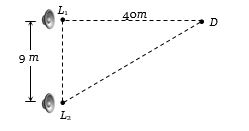
- 10Two loudspeakers $L_1$ and $L_2$ driven by a common oscillator and amplifier, are arranged as shown. The frequency of the oscillator is gradually increased from zero and the detector at $D$ records a series of maxima and minima. If the speed of sound is $330\,ms^{-1}$ then the frequency at which the first maximum is observed is .... $Hz$View Solution