A wave travels on a light string.The equation of the wave is $Y = A \,\sin \,(kx - \omega t + 30^o)$.It is reflected from a heavy string tied to an end of the light string at $x = 0$. If $64\%$ of the incident energy is reflected the equation of the reflected wave is
Medium
Download our app for free and get started
$ y =.8 A \sin \left(-k x-\omega t+30^{\circ}+180^{\circ}\right) $
$=-.8 A \sin \left(-k x-\omega t+30^{\circ}\right) $
$=0.8 A \sin \left(k x+\omega t-30^{\circ}\right)$

Download our appand get started for free
Experience the future of education. Simply download our apps or reach out to us for more information. Let's shape the future of learning together!No signup needed.*
Similar Questions
- 1A man stands in front of a hillock and fires a gun. He hears an echo after $1.5\, sec$. The distance of the hillock from the man is ...... $m$ (velocity of sound in air is $330\, m/s$)View Solution
- 2If $V_m$ is the velocity of sound in moist air, $V_d$ is the velocity of sound in dry air, under identical conditions of pressure and temperatureView Solution
- 3An unknown frequency $x$ produces $8$ beats per seconds with a frequency of $250 Hz$ and $12$ beats with $270 Hz$ source, then $x$ is .... $Hz$View Solution
- 4View SolutionStanding stationary waves can be obtained in an air column even if the interfering waves are
- 5View SolutionIn a transverse wave, the particles of the medium:
- 6A string on a musical instrument is $50 cm$ long and its fundamental frequency is $270 Hz$. If the desired frequency of $1000 Hz$ is to be produced, the required length of the string is .... $cm$View Solution
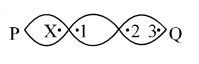
- 7Figure, shows a stationary wave between two fixed points $P$ and $Q$. Which point$(s)$ of $1, 2$ and $3$ are in phase with the point $X?$View Solution
- 8$Assertion :$ Sound travels faster in solids than gases.View Solution
$Reason :$ Solids possess greater density than gases. - 9Two waves represented by,View Solution
${y_1} = 10\,\sin \,200\pi t$,
${y_2} = 20\,\sin \,\left( {2000\pi t + \frac{\pi }{2}} \right)$
are superimposed at any point at a particular instant. The amplitude of the resultant wave is
- 10Unlike a laboratory sonometer, a stringed instrument is seldom plucked in the middle. Supposing a sitar string is plucked at about $\frac{1}{4}$th of its length from the end. The most prominent harmonic would beView Solution