Question
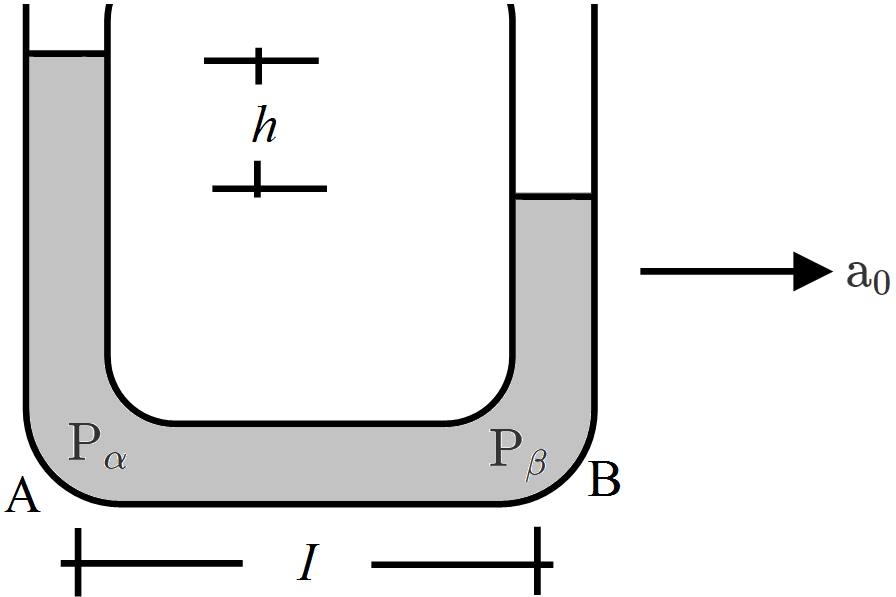
A U- tube containing a liquid is accelerated horizontally with a constant acceleration $a_0$. If the separation between the vertical limbs is 1, find the difference in the heights of the liquid in the two arms.
Answer

Let the pressure at the base of the back limb at A = P, and the pressure at the base of the front limb at B = Ps. The separation between the vertical limbs AB = (given). When the U- tube is accelerated at an acceleration a, the difference of pressure between horizontal points A and B is given as,

$\text{P}_\text{a}-\text{P}_\beta=\text{l}\rho\text{a}_0$


where p is the density of the liquid. Due to this pressure difference, the liquid in limb A will rise to a heighth more than in limb B. The pressure difference due to this height difference balances the difference of pressure between points A and B.

The pressure due to thhis height $\text{h}=\rho\text{gh},$ Equating we get,

$\rho\text{gh}=\text{p}_\text{a}-\text{p}_\beta=\text{l}\rho\text{a}_0$

$\Rightarrow\text{gh}=\text{la}_0$

$\text{h}=\text{a}_0\text{l}/\text{g}$

Need a full question paper?

Generate a complete, print-ready paper with questions like this in minutes — across 16+ boards, with answer keys.
Start Generating Free

Similar questions

The distance between the cathode (filament) and the target in an X-ray tube is 1.5m. If the cutoff wavelength is 30pm, find the electric field between the cathode and the target.
A block of mass 2.00kg moving at a speed of 10.0m/s accelerates at $3.00m/s^2$ for 5.00s. Compute its final kinetic energy.
When a boron nucleus $\big(\text{ }^{10}_5\text{B}\big)$ is bombarded by a neutron, an $\alpha$-particle is emitted. Which nucleus will be formed as a result?
A brass plate having surface area $200cm^2$ on one side is electroplated with 0·10mm thick silver layers on both sides using a 15A current. Find the time taken to do the job. The specific gravity of silver is 10.5 and its atomic weight is 107.9 g/mol.
$1 F ($ farad$)$ is a very large unit for practical purposes. Explain with example.
A sample of $\ce{HCl}$ gas is placed in an electric field of $3 \times 10^4 N / C$. The dipole moment of each molecule of $\ce{HCl}$ is $6 \times 10^{-30} C \times m$. What will be the maximum torque acting on the molecule?
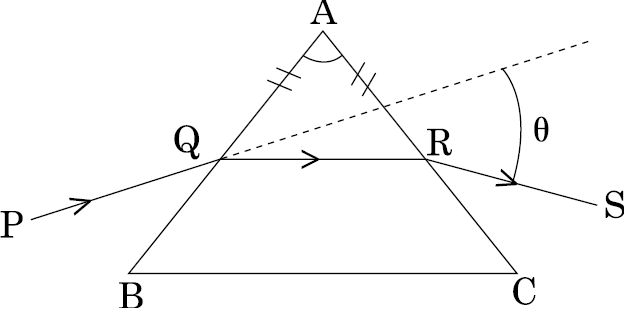
A ray PQ incident on the refracting face BA is refracted in the prism BAC as shown in the figure and emerges from the other refracting face AC as RS such that AQ = AR. If the angle of prism $A = 60^\circ$ and refractive index of material of prism is$\sqrt{3}$, calculate angle $\theta.$
Using the formula $\overrightarrow{\text{F}}=\text{q}\overrightarrow{\text{v}}\times\overrightarrow{\text{B}}$ and $\text{B}=\frac{\mu_0\text{i}}{2\pi\text{r}},$ show that the SI units of the magnetic field B and the permeability constant $\mu_0$ may be written as N/A-m and $NA^2$ respectively.
An $\alpha-\text{particle}$ and a proton of the same kinetic energy are in turn allowed to pass through a magnetic field $\overrightarrow{\text{B}},$acting normal to the direction of motion of the particles. Calculate the ratio of radii of the circular paths described by them.
Explain J J. Thomson's plum pudding model of atom.