Question
Explain J J. Thomson's plum pudding model of atom.

Answer

Experiments by physicist J.J. Thomson showed that atoms of various elements contain negatively charged constituents (electrons). which are the same for all atoms. Although the atom is electrically neutral.
Hence the atom must also have some positive charge to neutralise the negative charge of the electron.
To explain the arrangement of positive and negative charge in atom, Thomson gave an atomic model called the plum pudding model.
The first model of the atom was given by J.J. Thomson. According to this model, the positive charge of the atom is uniformly distributed throughout the volume of the atom and the negatively charged electrons are embedded in like seeds in a watermelon. This model is called plum pudding model of the atom.

Need a full question paper?

Generate a complete, print-ready paper with questions like this in minutes — across 16+ boards, with answer keys.
Start Generating Free

Similar questions

Write the centripetal force formula for an electron moving in a stationary orbit in a hydrogen atom and derive the formula for the radius of the orbit.
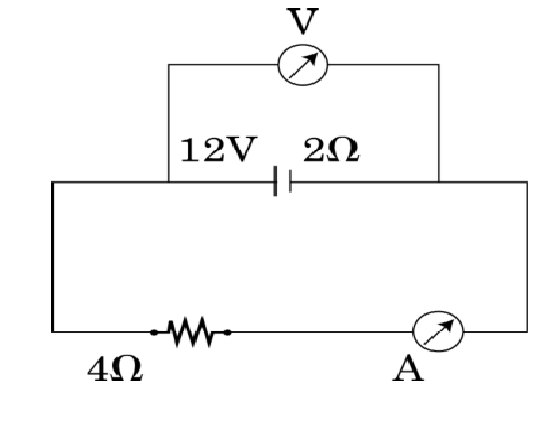
A battery of emf 12V and internal resistance 2 $\Omega$ is connected to a 4 $\Omega$ resistor as shown in the figure.
  1. Show that a voltmeter when placed across the cell and across the resistor, in turn, given the same reading.
  2. To record the voltage and the current in the circuit, why is voltmeter placed in parallel and ammeter in series in the circuit?
A hydrogen atom contains one proton and one electron. It may be assumed that the electron revolves in a circle of radius 0.53 angstrom (1 angstrom $= 10^{-10}m$ and is abbreviated as A) with the proton at the centre. The hydrogen atom is said to be in the ground state in this case. Find the magnitude of the electric force between the proton and the electron of a hydrogen atom in its ground state.
The speed of the yellow light in a certain liquid is $2.4 \times 10^8m/s$. Find the refractive index of the liquid.
By evaluating $\int\text{i}^2\text{Rdt},$ show that when a capacitor is charged by connecting it to a battery through a resistor, the energy dissipated as heat equals the energy stored in the capacitor.
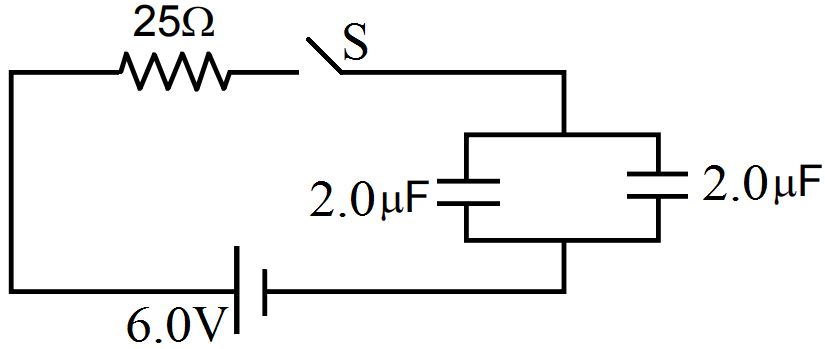
Find the charge on each of the capacitors 0.20ms after the switch S is closed in the figure.
Balmer series was observed and analysed before the other series. Can you suggest a reason for such an order?
Write the name of optical instruments.
Electrons are emitted from an electron gun at almost zero velocity and are accelerated by an electric field E through a distance of 1.0m. The electrons are now scattered by an atomic hydrogen sample in ground state. What should be the minimum value of E so that red light of wavelength 656.3nm may be emitted by the hydrogen?
Three capacitors each of capacitance 9 pF are connected in series.
  1. What is the total capacitance of the combination?
  2. What is the potential difference across each capacitor if the combination is connected to a 120 V supply?