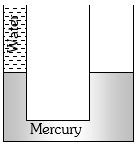
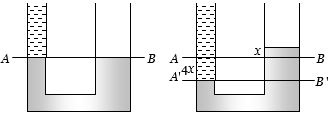
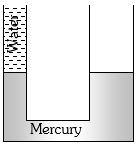
A $U-$ tube in which the cross-sectional area of the limb on the left is one quarter, the limb on the right contains mercury (density $13.6 g/cm^3$). The level of mercury in the narrow limb is at a distance of $36 cm$ from the upper end of the tube. What will be the rise in the level of mercury in the right limb if the left limb is filled to the top with water ........ $cm$
Diffcult


Download our appand get started for free
Experience the future of education. Simply download our apps or reach out to us for more information. Let's shape the future of learning together!No signup needed.*
Similar Questions
- 1View SolutionA wooden cylinder floats vertically in water with half of its length immersed. The density of wood is
- 2$10,000 $ small balls, each weighing $1\, gm$, strike one square cm of area per second with a velocity $100 \,m/s$ in a normal direction and rebound with the same velocity. The value of pressure on the surface will beView Solution
- 3A vessel of area of cross-section A has liquid to a height $H$ . There is a hole at the bottom of vessel having area of cross-section a. The time taken to decrease the level from ${H_1}$ to ${H_2}$ will beView Solution
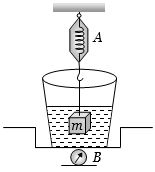
- 4The spring balance $A$ reads $2\, kg$ with a block m suspended from it. $A $ balance $B$ reads $5 \,kg $ when a beaker filled with liquid is put on the pan of the balance. The two balances are now so arranged that the hanging mass is inside the liquid as shown in figure. In this situationView Solution
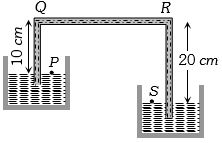
- 5A siphon in use is demonstrated in the following figure. The density of the liquid flowing in siphon is $ 1.5 gm/cc. $ The pressure difference between the point $P$ and $S$ will beView Solution
- 6A drinking straw is dipped in a pan of water to depth d from the surface (see figure below). Now water is sucked into it up to an initial height $h_0$ and then left to oscillate. As a result, its height $y$ from the surface of the water varies periodically. Ignoring damping, the equation for $y$ is ( $g$ is the acceleration due to gravity):View Solution
- 7View SolutionA boat having some iron pieces is floating in a pond. If iron pieces are thrown in the liquid then level of liquid
- 8A $U-$ tube in which the cross-sectional area of the limb on the left is one quarter, the limb on the right contains mercury (density $13.6 g/cm^3$). The level of mercury in the narrow limb is at a distance of $36 cm$ from the upper end of the tube. What will be the rise in the level of mercury in the right limb if the left limb is filled to the top with water ........ $cm$View Solution
- 9If it takes $5\,minutes$ to fill a $15\,litre$ bucket from a water tap of diameter $\frac{2}{{\sqrt \pi }}cm$ then the Reynolds number for the flow is (density of water $= 10^3\,kg/m^3$ ) and viscosity of water $= 10^{-3}\,Pa.s$ ) close toView Solution
- 10A body of density $\rho'$ is dropped from rest at a height $h$ into a lake of density $\rho$ , where $\rho > \rho '$ . Neglecting all dissipative forces, calculate the maximum depth to which the body sinks before returning to float on the surface.View Solution