A uniform chain of length $L$ which hanges partially from a table, is kept in equilibrium by friction. The maximum length that can withstand without slipping is $l$ , then coefficient of friction between the table and the chain is
Medium
Download our app for free and get started
$\mathrm{m}_{1} \mathrm{g}=\mu \mathrm{m}_{2} \mathrm{g} \quad \mathrm{m}_{1} \rightarrow$ mass of hanged part
$\mathrm{m}_{2} \rightarrow$ mass of remaining part
$\mu=\frac{m_{1}}{m_{2}}=\frac{\frac{M}{L} \times \ell}{\frac{M}{L}(L-\ell)}=\frac{\ell}{L-\ell}$

Download our appand get started for free
Experience the future of education. Simply download our apps or reach out to us for more information. Let's shape the future of learning together!No signup needed.*
Similar Questions
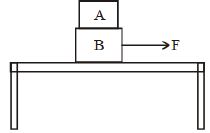
- 1Two blocks $A$ and $B$ of masses $m_A = 1\,kg$ and $m_B = 3\,kg$ are kept on the table as shown in figure. The coefficient of friction between $A$ and $B$ is $0.2$ and between $B$ and the surface of the table is also $0.2.$ The maximum force $F$ that can be applied on $B$ horizontal, so that the block $A$ does not slide over the block $B$ is $...... N. [$Take $g = 10\,m/s^2 ]$View Solution
- 2A uniform chain of length $L$ changes partly from a table which is kept in equilibrium by friction. The maximum length that can withstand without slipping is $l$, then coefficient of friction between the table and the chain isView Solution
- 3A block weighs $W$ is held against a vertical wall by applying a horizontal force $F$. The minimum value of $F$ needed to hold the block isView Solution
- 4A coin placed on a rotating table just slips when it is placed at a distance of $1\,cm$ from the center. If the angular velocity of the table in halved, it will just slip when placed at a distance of from the centre $............\,cm$View Solution
- 5View SolutionWhich is a suitable method to decrease friction
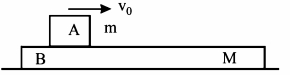
- 6The masses of blocks A and B are $m$ and $M$ respectively. Between $A$ and $B$, there is a constant frictional force $F$ and $B$ can slide on a smooth horizontal surface. A is set in motion with velocity while $B$ is at rest. What is the distance moved by A relative to $B$ before they move with the same velocity?View Solution
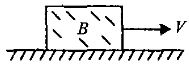
- 7A block $B$ is pushed momentarily along a horizontal surface with an initial velocity $V.$ If $\mu $ is the coefficient of sliding friction between $B$ and the surface, block $B$ will come to rest after a timeView Solution
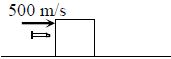
- 8A bullet of mass $20\, g$ travelling horizontally with a speed of $500 \,m/s$ passes through a wooden block of mass $10.0 \,kg$ initially at rest on a surface. The bullet emerges with a speed of $100\, m/s$ and the block slides $20 \,cm$ on the surface before coming to rest, the coefficient of friction between the block and the surface. $(g = 10\, m/s^2)$View Solution
- 9A body of mass $10\, kg$ is lying on a rough plane inclined at an angle of $30^o$ to the horizontal and the coefficient of friction is $0.5$. the minimum force required to pull the body up the plane is ........ $N$View Solution
- 10A body of mass $2\,kg$ slides down with an acceleration of $3\,m/s^2$ on a rough inclined plane having a slope of $30^o$ . The external force required to take the same body up the plane with the same acceleration will be $... N$ $(g\, = 10\, m/s^2)$View Solution