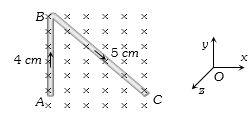
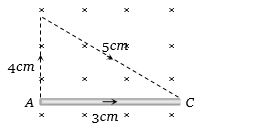
A uniform conducting wire $ABC$ has a mass of $10\,g$. A current of $2\,A$ flows through it. The wire is kept in a uniform magnetic field $B = 2T.$ The acceleration of the wire will be
Medium


Download our appand get started for free
Experience the future of education. Simply download our apps or reach out to us for more information. Let's shape the future of learning together!No signup needed.*
Similar Questions
- 1A $2 \mathrm{~A}$ current carrying straight metal wire of resistance $1 \Omega$, resistivity $2 \times 10^{-6} \Omega \mathrm{m}$, area of cross-section $10 \mathrm{~mm}^2$ and mass $500 \mathrm{~g}$ is suspended horizontally in mid air by applying a uniform magnetic field $\vec{B}$. The magnitude of $B$ is__________.$\times 10^{-1} \mathrm{~T}\left(\right.$ given, $\mathrm{g}=10 \mathrm{~m} / \mathrm{s}^2$ )View Solution
- 2An electric field of $1500\, V/m$ and a magnetic field of $0.40\, weber/metre^2$ act on a moving electron. The minimum uniform speed along a straight line the electron could have isView Solution
- 3A proton (mass $m$ and charge $+e$) and an $\alpha - $particle (mass $4m$ and charge $+2e$) are projected with the same kinetic energy at right angles to the uniform magnetic field. Which one of the following statements will be trueView Solution
- 4View SolutionA particle moving in a magnetic field increases its velocity, then its radius of the circle
- 5Two infinitely long parallel wires carry currents of magnitude $I_1$ and $I_2$ are at a distance $4 cm$ apart. The magnitude of the net magnetic field is found to reach a non-zero minimum value between the two wires and $1 \,cm$ away from the first wire. The ratio of the two currents and their mutual direction isView Solution
- 6View SolutionA charged particle is projected in a plane perpendicular to a uniform magnetic field. The area bounded by the path described by the particle is proportional to
- 7A particle of mass $m$ and charge $q$ moving with velocity $v$ enters a region of uniform magnetic field $B.$ ThenView Solution
- 8View SolutionA charged particle is released from rest in a region of uniform electric and magnetic fields which are parallel to each other. The particle will move on a
- 9Charge $q$ is uniformly spread on a thin ring of radius $R.$ The ring rotates about its axis with a uniform frequency $f\, Hz.$ The magnitude of magnetic induction at the center of the ring isView Solution
- 10View SolutionA uniform electric field and a uniform magnetic field are acting along the same direction in a certain region. If an electron is projected in the region such that its velocity is pointed along the direction of fields, then the electron