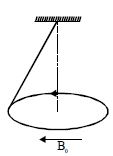
A uniform current carrying ring of mass $m$ and radius $R$ is connected by a massless string as shown. A uniform magnetic field $B_0$ exist in the region to keep the ring in horizontal position, then the current in the ring is ($l =$ length of string)
A$\frac{{mg}}{{\pi R{B_0}}}$
B$\frac{{mg}}{{R{B_0}}}$
C$\frac{{mg}}{{3\pi R{B_0}}}$
D$\frac{{mgl}}{{\pi {R^2}{B_0}}}$
Medium
Download our app for free and get started
A$\frac{{mg}}{{\pi R{B_0}}}$
a $\tau_{\text {net }}=0 ; \mathrm{mgR}=\mathrm{MB}_{0}(\mathrm{M}=$ magnetic dipole moment);
Experience the future of education. Simply download our apps or reach out to us for more information. Let's shape the future of learning together!No signup needed.*
Two parallel long wires carry currents $i_1$ and $i_2$ with ${i_1} > {i_2}$. When the currents are in the same direction, the magnetic field midway between the wires is $10\, \mu T$. When the direction of $i_2$ is reversed, it becomes $40 \,\mu T$. the ratio ${i_1}/{i_2}$ is
A galvanometer of resistance $100\,\Omega $ has $50\, divisions$ on its scale and has sensitivity of $20\,\mu A / division$. It is to be converted to a voltmeter with three ranges, of $0-2\, V$, $0-10\, V$ and $0-20\, V$. The appropriate circuit to do so is
A charged particle of mass $m$ and charge $q$ travels on a circular path of radius $r$ that is perpendicular to a magnetic field $B$. The time taken by the particle to complete one revolution is
A galvanometer coil has $500$ turns and each turn has an average area of $3 \times 10^{-4}\, m ^{2}$. If a torque of $1.5\,Nm$ is required to keep this coil parallel to magnetic field when a current of $0.5\, A$ is flowing through it, the strength of the field (in $T )$ is
An electron moves with a speed of $2 \times 10^5\, m/s$ along the $+ x$ direction in a magnetic field $\vec B = \left( {\hat i - 4\hat j - 3\hat k} \right)\,tesla$. The magnitude of the force (in newton) experienced by the electron is (the charge on electron $= 1.6 \times 10^{-19}\, C$)
Two infinite length wires carries currents $8A$ and $6A$ respectively and placed along $X$ and $Y$-axis. Magnetic field at a point $P\,(0,\,0,\,d)\,m$ will be
A non conducting ring (of mass $m,$ radius $r,$ having charge $Q$) is placed on a rough horizontal surface (in a region with transverse magnetic field). The field is increasing with time at the rate $R$ and coefficient of friction between the surface and the ring is $\mu .$ For ring to remain in equilibrium $\mu$ should be greater than
A coil having $100$ turns, area of $5 \times 10^{-3} \mathrm{~m}^2$, carrying current of $1 \mathrm{~mA}$ is placed in uniform magnetic field of $0.20 \mathrm{~T}$ such a way that plane of coil is perpendicular to the magnetic field. The work done in turning the coil through $90^{\circ}$ is . . . . . . $\mu \mathrm{J}$.