MCQ
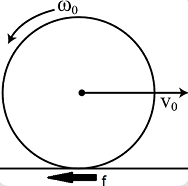
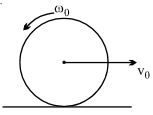
$A$ uniform circular disc placed on $a$ rough horizontal surface has initially a velocity $v_0$ and an angular velocity $\omega_0$ as shown in the figure. The disc comes to rest after moving some distance in the direction of motion. Then $\frac{{{v_0}}}{{r{\omega _0}}}$ is
  • $\frac{1}{2}$
  • B
    $1$
  • C
    $\frac{3}{2}$
  • D
    $2$

Answer

Correct option: A.
$\frac{1}{2}$
a
Slipping will take place and to oppose the relative motion between the disc and the ground, friction will act in the shown direction.

So we can write $f=m a$ So $a=\frac{f}{m}$

$f \cdot r=I \alpha$

For the disc $I=\frac{1}{2} m r^{2}$

$\alpha=\frac{2 f}{m r}$

If the disc stops moving after travelling for a while, both $v_{0}$ and $\omega_{0}$ become zero at the same time.

If time $t$ required to stop, we can write

$v_{0}-a t=0$ and $\omega_{0}-\alpha t=0$

$\therefore \frac{v_{0}}{a}=\frac{\omega_{0}}{\alpha}$

$\therefore \frac{v_{0} m}{f}=\frac{\omega_{0} r m}{2 f}$

$\therefore \frac{v_{0}}{\omega_{0} r}=\frac{1}{2}$

Need a full question paper?

Generate a complete, print-ready paper with questions like this in minutes — across 16+ boards, with answer keys.

Start Generating Free

Similar questions

If the buoyant force $F$ acting on an object depends on its volume $V$ immersed in a liquid, the density $\rho$ of the liquid and the acceleration due to gravity $g$. The correct expression for $F$ can be
Avessel with open mouth contains air at $60^oC$. When the vessel is heated upto temperature $T$, one fourth of the air goes out. The value of $T$ is ..... $^oC$
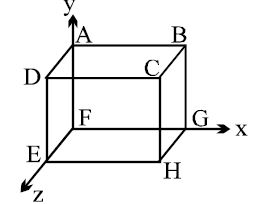
A cuboid $ABCDEFGH$ is anisotropic with $\alpha_x = 1 × 10^{-5} /^o C$, $\alpha_y = 2 × 10^{-5} /^o C$, $\alpha_z = 3 × 10^{-5} /^o C$. Coefficient of superficial expansion of faces can be
A hammer of mass $1kg$ having speed of $50 \,m/s$, hit a iron nail of mass $200\, gm.$ If specific heat of iron is $0.105\, cal/gm°C$ and half the energy is converted into heat, the raise in temperature of nail is........ $^oC$
Radiation from a black body at the thermodynamic temperature $T_1$ is measured by a small detector at distance $d_1$ from it. When the temperature is increased to $T_2$ and the distance to $d_2$ , the power received by the detector is unchanged . What is the ratio $d_2/d_1$ ?
The dimensions of couple are
Under a pressure head the rate of orderly volume flow of a liquid through a capillary tube is $Q$ . If the length of capillary tube is doubled and the diameter of tube is halved, the rate of flow would become
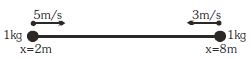
The figure shows the positions and velocities of two particles. If the particles move under the mutual attraction of each other, then the position of centre of mass at $t =1\,s$ is
The moment of inertia of a uniform cylinder of length $l$ and radius $R$ about its perpendicular bisector is $I$. What is the ratio $l/R$ such that the moment of inertia is minimum?
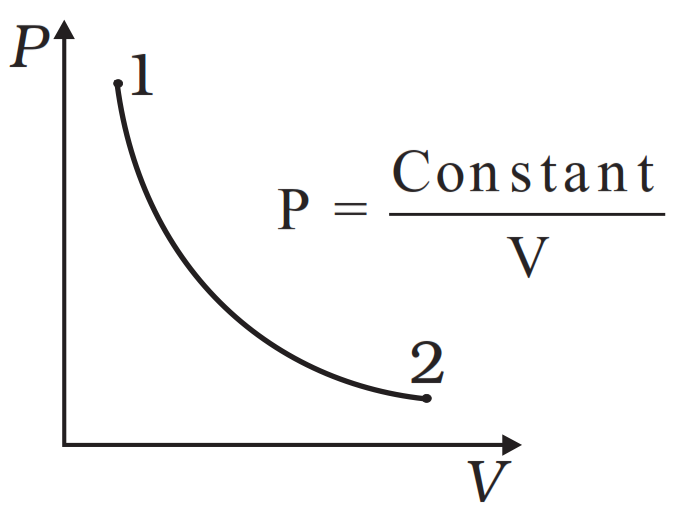
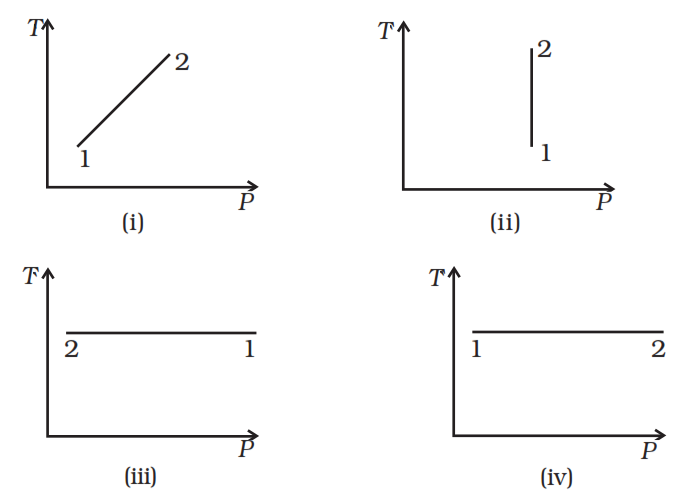
Consider $P-V$ diagram for an ideal gas shown in:

Out of the following diagrams which represents the $T-P$ diagram?