MCQ
A uniform plank of Young's modulus $Y$ is moved over a smooth horizontal surface by a constant horizontal force $F$. The area of cross section of the plank is $A$. The compressive strain on the plank in the direction of the force is
  • $F / A Y$
  • B
    $2 F / A Y$
  • C
    $\frac{1}{2}(F / A Y)$
  • D
    $3 F / A Y$

Answer

Correct option: A.
$F / A Y$
(a) $\quad Y=\frac{F / A}{\text { Strain }} \Rightarrow$ strain $=\frac{F}{A Y}$

Need a full question paper?

Generate a complete, print-ready paper with questions like this in minutes — across 16+ boards, with answer keys.

Start Generating Free

Similar questions

Heat produced in a wire of resistance $R$ due to current flowing at constant potential difference is proportional to
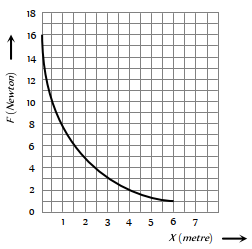
The relation between the displacement $X$ of an object produced by the application of the variable force $F$ is represented by a graph shown in the figure. If the object undergoes a displacement from $X=0.5 \mathrm{~m}$ to $X=2.5 \mathrm{~m}$ the work done will be approximately equal to
Image
If wavelength of a wave is $\lambda=6000 \mathring A$. Then wave number will be
Nature of meniscus for liquid of $0^{\circ}$ angle of contact
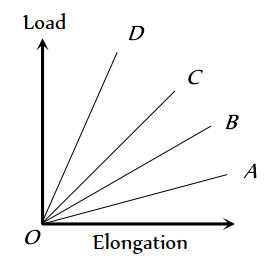
The load versus elongation graph for four wires of the same material is shown in the figure. The thickest wire is represented by the line
Image
A body of mass $2 \mathrm{~kg}$ is being dragged with uniform velocity of $2 \mathrm{~m} / \mathrm{s}$ on a rough horizontal plane. The coefficient of friction between the body and the surface is $0.20.$ The amount of heat generated in $5 \mathrm{sec}$ is $\left(J=4.2 \text { joule } / \mathrm{cal} \text { and } g=9.8 \mathrm{~m} / \mathrm{s^2}\right)$
A battery is charged at a potential of $15 V$ for $8$ hours when the current flowing is $10 A$. The battery on discharge supplies a current of $5 A$ for $15$ hours. The mean terminal voltage during discharge is $14.$ The "Watt-hour" efficiency of the battery is
Which one of the following does not have the same dimensions
The temperature at which a black body of unit area loses its energy at the rate of $1$ joule/second is
If the unit of force and length each be increased by four times, then the unit of energy is increased by