A uniform plank of Young’s modulus $Y $ is moved over a smooth horizontal surface by a constant horizontal force $F.$ The area of cross section of the plank is $A.$ The compressive strain on the plank in the direction of the force is
Easy


Download our appand get started for free
Experience the future of education. Simply download our apps or reach out to us for more information. Let's shape the future of learning together!No signup needed.*
Similar Questions
- 1A stress of $1.5\,kg.wt/mm^2$ is applied to a wire of Young's modulus $5 \times 10^{11}\,N/m^2$ . The percentage increase in its length isView Solution
- 2A rubber cord $10\, m$ long is suspended vertically. How much does it stretch under its own weight $($Density of rubber is $1500\, kg/m^3, Y = 5×10^8 N/m^2, g = 10 m/s^2$$)$View Solution
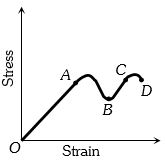
- 3In the below graph, point $D$ indicatesView Solution
- 4A cubical solid aluminium (bulk modulus $=-V \frac{ dP }{ dV }=70 GPa$ ) block has an edge length of $1 m$ on the surface of the earth. It is kept on the floor of a $5 km$ deep ocean. Taking the average density of water and the acceleration due to gravity to be $10^3 kg m ^{-3}$ and $10 ms ^{-2}$, respectively, the change in the edge length of the block in $mm$ is . . . . .View Solution
- 5A wire of length $L$ and radius $r$ is clamped rigidly at one end. When the other end of the wire is pulled by a force $f$, its length increases by $l$. Another wire of same material of length $2 L$ and radius $2 r$ is pulled by a force $2 f$. Then the increase in its length will beView Solution
- 6$A$ and $B$ are two wires. The radius of $A$ is twice that of $B.$ They are stretched by the some load. Then the stress on $B$ isView Solution
- 7A steel wire of length ' $L$ ' at $40^{\circ}\,C$ is suspended from the ceiling and then a mass ' $m$ ' is hung from its free end. The wire is cooled down from $40^{\circ}\,C$ to $30^{\circ}\,C$ to regain its original length ' $L$ '. The coefficient of linear thermal expansion of the steel is $10^{-5} { }^{\circ}\,C$, Young's modulus of steel is $10^{11}\, N /$ $m ^2$ and radius of the wire is $1\, mm$. Assume that $L \gg $ diameter of the wire. Then the value of ' $m$ ' in $kg$ is nearlyView Solution
- 8Two wires $A$ and $B $ of same length and of the same material have the respective radii ${r_1}$ and ${r_2}$. Their one end is fixed with a rigid support, and at the other end equal twisting couple is applied. Then the ratio of the angle of twist at the end of $A$ and the angle of twist at the end of $B $ will beView Solution
- 9What must be the lengths of steel and copper rods at $0^o C$ for the difference in their lengths to be $10\,cm$ at any common temperature? $(\alpha_{steel}=1.2 \times {10^{-5}} \;^o C^{-1})$ and $(\alpha_{copper} = 1.8 \times 10^{-5} \;^o C^{-1})$View Solution
- 10View SolutionThe elastic limit for a gas