Question
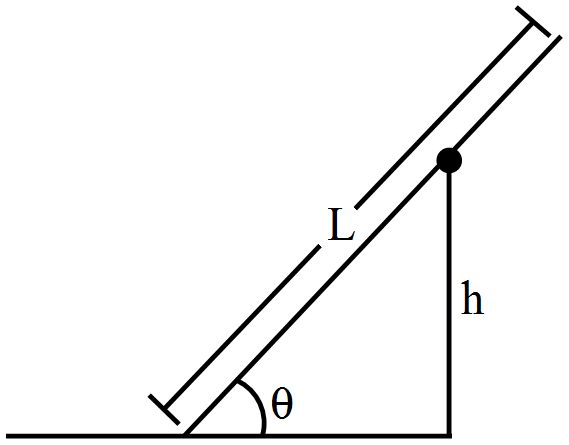
A uniform rod of length L rests against a smooth roller as shown in figure. Find the friction coefficient between the ground and the lower end if the minimum angle that the rod can make with the horizontal is $\theta.$
Answer


Rod has a length = L
It makes an angle $\theta$ with the floor
The vertical wall has a height = h
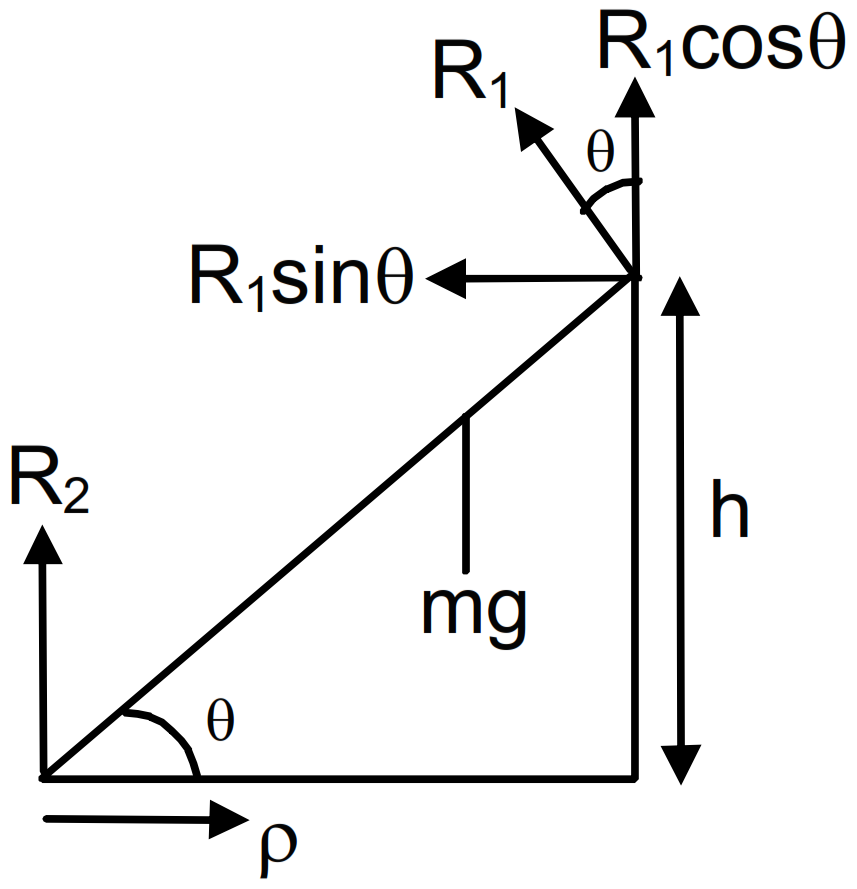
$\text{R}_2=\text{mg}-\text{R}_1\cos\theta\ \dots(1)$
$\text{R}_1\sin\theta=\mu\text{R}_2\ \dots(2)$
$\text{R}_1\cos\theta\times\Big(\frac{\text{h}}{\tan\theta}\Big)+\text{R}_1\sin\theta\times\text{h}=\text{mg}\times\frac{1}{2}\cos\theta$
$\Rightarrow\text{R}_1\times\Big(\frac{\cos^2\theta}{\tan\theta}\Big)+\text{R}_1\sin\theta\times\text{h}=\text{mg}\times\frac{1}{2}\cos\theta$
$\Rightarrow\text{R}_1=\frac{\text{mg}\times\frac{\text{L}}{2\cos\theta}}{\Big\{\Big(\frac{\cos^2\theta}{\sin\theta}\Big)\text{h}+\sin\theta\text{h}\Big\}}$
$\Rightarrow\text{R}_1\cos\theta=\frac{\frac{\text{mg}\text{L}}{2\cos^2\theta\sin\theta}}{\Big\{\Big(\frac{\cos^2\theta}{\sin\theta}\Big)\text{h}+\sin\theta\text{h}\Big\}}$
$\Rightarrow\mu=\frac{\text{R}_1\sin\theta}{\text{R}_2}=\frac{\frac{\text{mgL}}{2\cos\theta\sin\theta}}{\Big\{\Big(\frac{\cos^2\theta}{\sin\theta}\Big)\text{h}+\sin\theta\text{h}\Big\}\text{mg}-\text{mg}\frac{1}{2}\cos^2\theta}$
$\Rightarrow\mu=\frac{\frac{\text{L}}{2\cos\theta.\sin\theta}\times2\sin\theta}{2\big(\cos^2\theta\text{h}+\sin^2\theta\text{h}\big)-\text{L}\cos^2\theta\sin\theta}$
$\Rightarrow\mu=\frac{\text{L}\cos\theta\sin^2\theta}{\text{2h}-\text{L}\cos^2\theta\sin\theta}$

Need a full question paper?

Generate a complete, print-ready paper with questions like this in minutes — across 16+ boards, with answer keys.
Start Generating Free

Similar questions

A wire of mass m and length l can slide freely on a pair of smooth, vertical rails (figure). A magnetic field B exists in the region in the direction perpendicular to the plane of the rails. The rails are connected at the top end by a capacitor of capacitance C. Find the acceleration of the wire neglecting any electric resistance.
What is the frequency of a second pendulum in an elevator moving up with an acceleration of $\frac{\text{g}}{2}$?
Two identical balls, each having a charge of $2.00 \times 10^{-7}C$ and a mass of $100g$, are suspended from a common point by two insulating strings each 50cm long. The balls are held at a separation 5.0cm apart and then released. Find,
  1. The electric force on one of the charged balls.
  2. The components of the resultant force on it along and perpendicular to the string.
  3. The tension in the string.
  4. The acceleration of one of the balls. Answers are to be obtained only for the instant just after the release.
Two discs of moments of inertia $I_1$ and $I_2$ about their respective axes (normal to the disc and passing through the centre), and rotating with angular speed $\omega_1$ and $\omega_2$ are brought into contact face to face with their axes of rotation coincident.
  1. Does the law of conservation of angular momentum apply to the situation? why?
  2. Find the angular speed of the two-disc system.
  3. Calculate the loss in kinetic energy of the system in the process.
  4. Account for this loss.
A room has a window fitted with a single $1.0m \times 2.0m$ glass of thickness $2mm$.
  1. Calculate the rate of heat flow through the closed window when the temperature inside the room is $32^\circ C$ and that outside is $40^\circ C$.
  2. The glass is now replaced by two glasspanes, each having a thickness of $1mm$ and separated by a distance of $1mm$. Calculate the rate of heat flow under the same conditions of temperature. Thermal conductivity of window glass = $1.0Js^{-1}m^{-1^\circ}C^{-1}$ and that of air = $0.025Js^{-1}m^{-1^\circ}C^{-1}$.
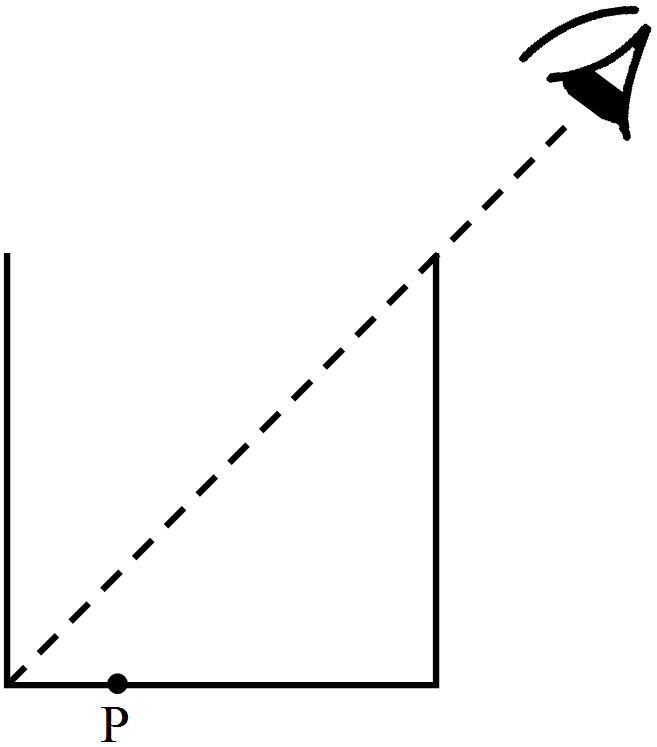
A cylindrical vessel, whose diameter and height both are equal to 30cm, is placed on a horizontal surface and a small particle P is placed in it at a distance of 5.0cm from the centre. An eye is placed at a position such that the edge of the bottom is just visible. The particle P is in the plane of drawing. Up to what minimum height should water be poured in the vessel to make the particle P visible?
Estimate the average thermal energy of a helium atom at:
  1. Room temperature $(27°C)$
  2. The temperature on the surface of the Sun$(6000K)$
  3. The temperature of $10$ million kelvin (the typical core temperature in the case of a star).
Establish the following vector inequalities geometrically or otherwise: $|\text{a}+\text{b}|\ge||\text{a}|-|\text{b}||$ When does the equality sign above apply?
A disc rotating about its axis with angular speed $\omega_0$ is placed lightly (without any translational push) on a perfectly frictionless table. The radius of the disc is R. What are the linear velocities of the points A, B and C on the disc shown in will the disc roll in the direction indicated?
A body of mass $12kg$ is suspended by coil spring of natural length $50cm$ and force constant $2.0 \times 10^3Nm^{-1}$. What is the stretched length of the spring? If the body is pulled down further strething the spring to a length of $5.9cm$ and then released, then what is the frequency of oscillation of the suspended mass? (Neglect the mass of the spring)