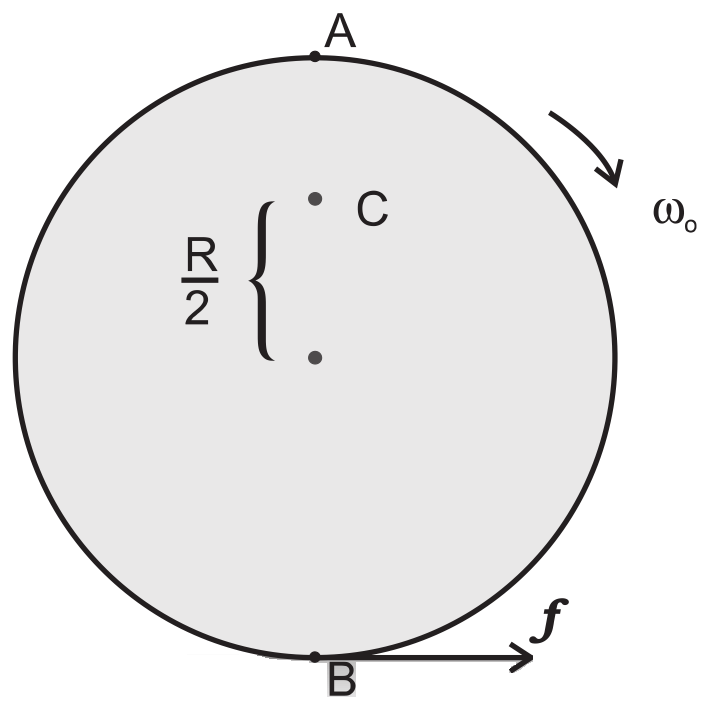
A disc rotating about its axis with angular speed $\omega_0$ is placed lightly (without any translational push) on a perfectly frictionless table. The radius of the disc is R. What are the linear velocities of the points A, B and C on the disc shown in will the disc roll in the direction indicated?
Download our app for free and get started
$\text{v}_{\text{A}}=\text{R}\omega_0,\text{ v}_\text{B}=\text{R}\omega_0,\text{ v}_\text{C}=\Big(\frac{\text{R}}{2}\Big)\omega_0$ The disc will not roll, Angular speed of the disc $=\omega_0$ Radius of the disc = R Using the relation for linear velocity, $\text{v}=\omega_0\text{R}$ For point A: $\text{v}_{\text{A}}=\text{R}\omega_0,$ in the direction tangential to the right. For point B: $\text{v}_{\text{B}}=\text{R}\omega_0,$ in the direction tangential to the left. For point C: $\Big(\frac{\text{R}}{2}\Big)\omega_0$ in the direction same as that of $v_A$. The directions of motion of points A, B, and C on the disc are shown in the following figure:
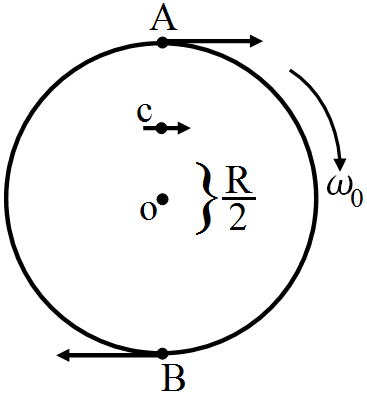
Since the disc is placed on a frictionless table, it will not roll. This is because the presence of friction is essential for the rolling of a body.
Since the disc is placed on a frictionless table, it will not roll. This is because the presence of friction is essential for the rolling of a body.

Download our appand get started for free
Experience the future of education. Simply download our apps or reach out to us for more information. Let's shape the future of learning together!No signup needed.*
Similar Questions
- 1View SolutionA solid sphere rolls down two different inclined planes of the same heights but different angles of inclination.
- Will it reach the bottom with the same speed in each case?
- Will it take longer to roll down one plane than the other?
- If so, which one and why?
- 2Prove that the velocity v of translation of a rolling body (like a ring, disc, cylinder or sphere) at the bottom of an inclined plane of height h is given by:$\text{v}^2=\frac{2\text{gh}}{\big(1+\frac{\text{K}^2}{\text{R}^2}\big)}$View Solution
Note K is the radius of gyration of the body about its symmetry axis, and R is the radius of the body. The body starts from rest at the top of the plane. - 3A beam of uniform cross-section and uniform mass-density of mass $20kg$ is supported at ends. A mass of $5kg$ is placed at a distance of $\frac{\text{L}}{5\text{m}} $ from one of its end. If beam is L m long, what are reactions of supports? In dealing with problems of equilibrium of a rigid body (like beam in this question). first of all draw a free body diagram of the system, indicating all of the forces acting on the system.View Solution
- 4View SolutionA particle of mass m is projected from origin O with speed u at an angle with positive x-axis. Find the angular momentum of particle at any time t about O before the particle strikes the ground again.
- 5View SolutionFig. shows two blocks of masses 5kg and 2kg placed on a frictionless surface and connected by a spring. An external kick gives a velocity 14 m/ s to the heavier block in the direction of lighter one. Deduce (i) the velocity gained by the centre of mass and (ii) the separate velocities of the two blocks in the centre of mass coordinates just after the kick.
- 6View SolutionA uniform disc of radius R is put over another uniform disc of radius 2R of the same thickness and density. The peripheries of the two discs touch each other. Locate the centre of mass of the system.
- 7Prove the result that the velocity v of translation of a rolling body (like a ring, disc, cylinder or sphere) at the bottom of an inclined plane of a height h is given by $\text{v}^2=\frac{2\text{gh}}{\Big(\frac{1+\text{k}^2}{\text{R}^2}\Big)}$ using dynamical consideration (i.e. by consideration of forces and torques).View Solution
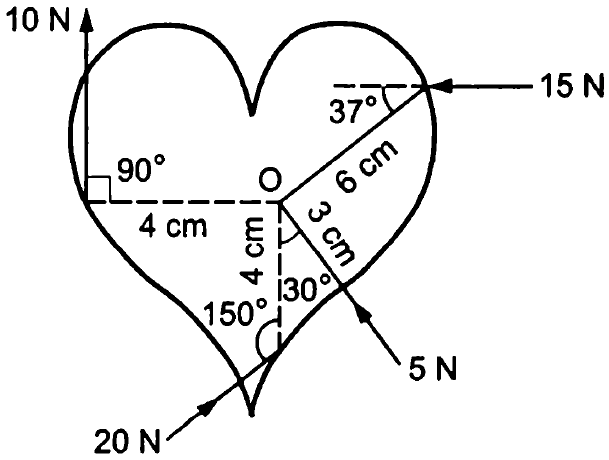
Note: k is the radius of gyration of the body about its symmetry axis, and R is the radius of the body. The body starts from rest at the top of the plane. - 8View SolutionCalculate the total torque acting on the body shown in figure about the point O.
- 9From a uniform circular disc of diameter d, a circular hole of diameter $\frac{\text{d}}{6}$ and having its centre at a distance of $\frac{\text{d}}{4}$ from the centre of the disc is scooped out. Find the centre of mass of the remaining portion.View Solution
- 10From a uniform disk of radius R, a circular hole of radius $\frac{\text{R}}{2}$ is cut out. The centre of the hole is at $\frac{\text{R}}{2}$ from the centre of the original disc. Locate the centre of gravity of the resulting flat body.View Solution